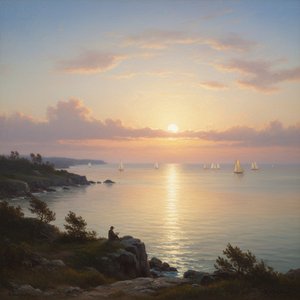
The Evolution of a Visionary: The Artistic Journey of Richard J. Croft
Born in the vibrant cultural landscape of London in 1935, Richard J. Croft embodies the spirit of an artist whose life work serves as a bridge between tradition and the avant-garde. His early years were shaped by a profound connection to classical aesthetics, rooted in a lineage that traces back to the legendary Sir Joshua Reynolds. This heritage instilled in him a deep respect for masterful technique and the pursuit of idealized beauty. During his formative training at the Bromley and Brighton Colleges of Art, Croft honed a meticulous approach to realism, capturing the world with an exacting eye for detail. Yet, even within these disciplined beginnings, there existed a restless intellectual curiosity—a desire to look beyond the surface of things and explore the underlying structures of reality.
The trajectory of Croft’s career is marked by a breathtaking metamorphosis. As the mid-20th century brought waves of modernism to Europe, so too did they wash over his canvas. He began to move away from the illusionistic precision of his early training, finding himself drawn to the fragmented planes and multiple perspectives offered by Cubism. This period of experimentation saw him embracing Geometric Abstraction, where he stripped away the unnecessary to focus on bold color palettes and simplified forms. By rejecting the traditional reliance on light and shadow to create depth, Croft instead utilized shape and pigment to evoke emotion, mirroring a broader global movement toward materiality and the essence of perception.
From London Streets to Irish Landscapes
A defining chapter in Croft’s biography began in 1959, when he moved to Belfast to pursue a career in art education. This relocation proved to be more than a mere change of scenery; it was a profound spiritual and artistic realignment. The rugged, atmospheric beauty of the Irish landscape provided the perfect canvas for his evolving style. In the sweeping vistas of Dundrum and the dramatic coastal reaches of Ulster, Croft found a way to synthesize his abstract sensibilities with the raw power of nature. His work began to breathe with the rhythm of the tides and the mist-covered mountains, blending Impressionistic light with the structural strength of his geometric foundations.
His later works often reflect this deep connection to the land, characterized by:
- Atmospheric Depth: Using cool tones and hazy horizons to capture the ephemeral quality of Irish weather.
- Textural Richness: Employing impasto techniques in oil paintings to evoke the physical weight of clouds and sea.
- Structural Harmony: Integrating the sharp lines of abstraction with the organic curves of tidal flats and hills.
Legacy and Artistic Significance
Throughout his decades-long career, Richard J. Croft has remained a steadfast explorer of form and feeling. Whether he is rendering the quiet intimacy of a Still Life with Blue Oil Lamp or the melancholic grandeur of an industrial seascape like Ulster Summer Miners Town, his work remains anchored in a profound sincerity. His ability to navigate the transition from the meticulous realism of the past to the bold abstractions of the modern era has earned him a respected place within the British and Irish art communities. As a member of the Royal Ulster Academy (RUA), his contributions continue to resonate, reminding us that true artistic progress is not about abandoning tradition, but about finding new ways to honor the beauty of the world through an ever-evolving lens.
问答环节
Ar yra chronologinis Richard J Croft aprašas?
Richard J Croft Chronika – tai vartojimo metu judanti laiko linija, kurioje kūrybos darbai pateikiami chronologine tvarka, suskirstyti į karjeros periodų skyrius.
Kur galima rasti Richard J Croft kūrybą, sugrupuotą pagal spalvas?
Richard J Croft kūrybą pagal spalvas galite tyrinėti puslapio Spektro indeksas svetainėje.
Kaip galiu stebėti Richard J Croft kūrybą metmet metams?
Daugelis Richard J Croft kūrinių pateikiamų puslapio Kūrybos laiko linija sąraše rodomi chronologine tvarka, metus po metų.