Max Beckmann portretas

Ensičiausios Max Beckmann tapybos darbai: visi 100, pagal rangą

Atnaujinta spalis 2026 · pagal mūsų populiarumumo koeficientą (paieškos, lankytojai ir užsakymai kiekvienam kūriniui) · 401 Max Beckmann darbai mūsų kataloge

Trumpai tariant

Labiausiai žinomas Max Beckmann paveikslas yra Naktis (Platė 7) iš Šalo (1919), jį galite pamatyti muzejuje Kunstsammlung Nordrhein-Westfalen, miestame Diuseldorfas. Immediately po tai seka Didelis Agonijos Vaizdas (1906) ir Geležies tiltas (Frankfurto vaizdas) (1922). Iš 401 Max Beckmann darbų mūsų kataloge šie 100 yra žymiausi. Kaskas iš jų aprašytas nurodant metus, muziejų bei trumpą pastabą apie tai, kas daro šį kūrinį išskirtiniu.

1884 – 1950, Leipcigas German expressionism Daugiausia darbų: Bavarijos valstybinės paveikslų kolekcijos

Max Beckmann geriausiųjų 10: darbai, kuriuos žino visi

1
Naktis (Platė 7) iš Šalo (1919) aut. Max Beckmann

Naktis (Platė 7) iš Šalo

1919 · Aliejus ant drobės · Kunstsammlung Nordrhein-Westfalen, Diuseldorfas

„Naktis“ (Plokštė 7) iš „Pokelio“ yra vienas iš Max Beckmanno žymiausių darbų, sukurtas 1919 metais ir įvykęs Niujėnos Štatų Galerijoje. Štai kaip šiuos veiksmus galima įvardinti kaip ekspresijistinę misiją.

Hand-painted oil reproduction from $300 33 × 30 cm Same size as the original $864 153 × 133 cm Order at original size →
Gaukite rankų darbo Perskaitykite istoriją
2
Didelis Agonijos Vaizdas (1906) aut. Max Beckmann

Didelis Agonijos Vaizdas

1906 · Aliejus ant drobės · Bavarijos valstybinės paveikslų kolekcijos, Miunchas

"Didžioji Agonijos scena": Žmogiškosios būsenos atspindys Max Beckmanno 1906 m. sukurtas „Didžiosios agonijos scenos“ paveikslas – tai neeilinė ankstyvos ekspresionizmo pavyzdžio iliustracija, numatanti XX amžiaus meno psichologinius tyrimus ir nerimo jausmą. Tai ne tik figūrų vaizdas; tai visceralus pažeidžiamumo, vienišumo ir galbūt net mirties tyrinimas. Paveikslas kviečia į giluminę apmąstymų kelionę, atskleidžiantis žmogaus patirties sudėtingumus. Kompozicija ir Simbolizmas: Nesaugumo Atmosfera Ant drobės pavaizduoti trys nuogi vyriškos figūros neapibrėtoje interjero erdvėje.…

Hand-painted oil reproduction from $200 33 × 30 cm Same size as the original $710 141 × 131 cm Order at original size →
Užsisakyti šį kūrinį Daugiau apie šį kūrinį
3
Geležies tiltas (Frankfurto vaizdas) (1922) aut. Max Beckmann

Geležies tiltas (Frankfurto vaizdas)

1922 · Aliejus ant drobės · Kunstsammlung Nordrhein-Westfalen, Diuseldorfas

Max Beckmanno „Geležinis tiltas (Frankfurto vaizdas)“: Urbanistinio Peizažo Dinamika Šis paveikslas, pavadintas „Geležinis tiltas (Frankfurto vaizdas)“, sukurtas 1922 metais vokietų ekspresionisto Max Beckmanno, yra neeilinė urbanistinio peizažo interpretacija. Tai tarsi akimirka iš pulsuojančio miesto gyvenimo, užfiksuota audringais dažymo gestais ir ryškiomis spalvomis. Paveikslas kviečia pasitelkti vaizduotę ir įsijausti į ankstyvojo XX amžiaus Frankfurto atmosferą, kuriame industrinė siela susipina su žmogaus egzistencijos dramos akimirkomis. Beckmanno meistriškumas atskleidžiamas ne tik detalizuotoje erdvės…

Hand-painted oil reproduction from $175 26 × 38 cm Same size as the original $177 25 × 42 cm Order at original size →
Užsisakyti šį kūrinį Daugiau apie šį kūrinį
4
Kolumbina (1950) aut. Max Beckmann

Kolumbina

1950 · Aliejus ant drobės · Saint Louis Art Museum, Saint Louis

Maksas Bekmanas savo kūryboje paliko nepaisantą pėdsaką, o „Kolumbina“ yra vienas ryškiausių vokiečių ekspresionizmo pavyzdžių, sukurtas 1950 metais, paskutiniaisjo paveikslą kūrinio autoriaus gyvenimo metais. Šis didelio formatinio erelio audinio paveikslas suCaptivant yra įspūdingas: jame matome sėdinti moterišką figūrą, papuoštą kaukė, apsuptą drąsių architektūrinės formos elementų ir pulsuojančių spalvų. Šis kūrinys yra tikras Bekmano stiliaus manifestas, pasižymintis iškrašytomis figūrinėmis formomis, giliu simbolizmu ir neįtikėtinu emociniu intensyvumu.

Hand-painted oil reproduction from $175 28 × 36 cm
Gaukite rankų darbo Perskaitykite istoriją
5
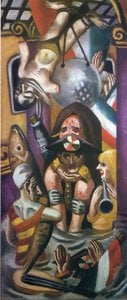
Aktoriai (1942) aut. Max Beckmann

Aktoriai

1942 · Aliejus ant drobės

Exploring Human Condition and Society This powerful triptych by Max Beckmann captures the complex tapestry of human existence and societal roles through a vivid, emotionally charged composition. Each panel presents a dynamic scene filled with distorted figures, symbolic objects, and expressive gestures that invite viewers to reflect on themes of confinement, identity, and social interaction. Beckmann’s portrayal of human figures—some seated, others standing or behind bars—evokes a sense of tension,…

Hand-painted oil reproduction from $225 41 × 24 cm
Užsisakykite šį kūrinį Sužinokite daugiau
6
Selfportrait in tuxedo, Busch-Reisinger M (1927) aut. Max Beckmann

Selfportrait in tuxedo, Busch-Reisinger M

1927 · Oil On Canvas

The gaze of Max Beckmann meets the viewer directly in Selfportrait in tuxedo, Busch-Reisinger M. This oil-on-canvas work, executed in 1927, captures the artist in a moment of poised, formal presence. He stands before us, a figure of quiet strength, wearing the elegant attire of a tuxedo that marks a specific era of social transition. The painting exists as a significant presence within the German Expressionism movement, embodying the tension…

Hand-painted oil reproduction from $175 26 × 38 cm
Gaukite rankų darbo Perskaitykite istoriją
7
Temptation (1937) aut. Max Beckmann

Temptation

1937 · Oil On Canvas

Max Beckmann, a renowned German Expressionist painter, created his masterpiece Temptation in 1937. This oil on canvas painting is housed at the Bayerische Staatsgemäldesammlungen (Munich, Germany), and it exemplifies Beckmann's unique style and thematic exploration of human nature. The Artistic Context Beckmann was a key figure in the Expressionist movement, which emphasized subjective emotional experience. His work often drew upon historical and mythological themes to convey contemporary moral and spiritual…

Hand-painted oil reproduction from $175 41 × 24 cm Same size as the original $1128 199 × 170 cm Order at original size →
Užsisakyti šį kūrinį Daugiau apie šį kūrinį
9
The argonauts (1950) aut. Max Beckmann

The argonauts

1950 · Oil On Canvas

The artwork is a triptych titled The Argonauts, created between 1949 and 1950. The composition features a middle panel containing several figures: the poet Orpheus is positioned at the center, with Jason located at his right and the sea god Glaucus at his left. The painting depicts a variety of people in different positions, including individuals who are standing, sitting, or lying down. The scene includes at least 12 people,…

Hand-painted oil reproduction from $175 38 × 26 cm
Gaukite rankų darbo Perskaitykite istoriją
10
Temptation (1936) aut. Max Beckmann

Temptation

1936 · Oil On Canvas · Bavarijos valstybinės paveikslų kolekcijos, Miunchas

We are looking at Temptation, a significant work by Max Beckmann. Created in 1937, this oil on canvas painting is a triptych, a format that allows the artist to structure a complex narrative across three distinct panels. The work is a definitive example of German Expressionism within the Modern era.

Hand-painted oil reproduction from $225 26 × 38 cm Same size as the original $824 100 × 216 cm Order at original size →
Užsisakykite šį kūrinį Sužinokite daugiau

Toliausiai ieškokite: Max Beckmann: 11 iki 100

11Quappi in blue in a boat (1950) aut. Max BeckmannQuappi in blue in a boat1950 Gaukite rankų darbo from $175 →
12Apachentanz (1938) aut. Max BeckmannApachentanz1938 · Kunsthalle Bremen Užsisakykite šį kūrinį from $275 →
13Still Life with Large Green Fruits aut. Max BeckmannStill Life with Large Green Fruits Užsisakyti šį kūrinį from $175 →
14Galleria Umberto (1925) aut. Max BeckmannGalleria Umberto1925 Užsisakykite šį kūrinį from $175 →
15Siesta aut. Max BeckmannSiesta Užsisakykite šį kūrinį from $200 →
16Bathing Scene (The Green Cloak) (1934) aut. Max BeckmannBathing Scene (The Green Cloak)1934 · National Gallery of Art Užsisakykite šį kūrinį from $175 →
17Christ in Limbo (1947) aut. Max BeckmannChrist in Limbo1947 · National Gallery of Art Užsisakyti šį kūrinį from $225 →
18Still Life with Cigar Box (1926) aut. Max BeckmannStill Life with Cigar Box1926 · Bavarijos valstybinės paveikslų kolekcijos Užsisakyti šį kūrinį from $200 →
19Self Portrait in Olive and Brown (1945) aut. Max BeckmannSelf Portrait in Olive and Brown1945 · Detroito meno institutas Užsisakykite šį kūrinį from $175 →
20The Argonauts: Music (1949) aut. Max BeckmannThe Argonauts: Music1949 · National Gallery of Art Užsisakyti šį kūrinį from $250 →
21Self-Portrait in Gray Robe (1941) aut. Max BeckmannSelf-Portrait in Gray Robe1941 · Bavarijos valstybinės paveikslų kolekcijos Gaukite rankų darbo from $175 →
22Portrait of Carl Couple (1918) aut. Max BeckmannPortrait of Carl Couple1918 · Städel Museum Gaukite rankų darbo from $200 →
23Leave-Taking (1942) aut. Max BeckmannLeave-Taking1942 · Thyssen-Bornemisza muziejus Užsisakyti šį kūrinį from $200 →
24Cabins (1948) aut. Max BeckmannCabins1948 · Kunstsammlung Nordrhein-Westfalen Užsisakyti šį kūrinį from $250 →
25Reclining Woman by the Sea (1950) aut. Max BeckmannReclining Woman by the Sea1950 · Hamburger Kunsthalle Užsisakykite šį kūrinį from $175 →
26Farmers Carrying Wood (1941) aut. Max BeckmannFarmers Carrying Wood1941 · Bavarijos valstybinės paveikslų kolekcijos Gaukite rankų darbo from $300 →
27The Duchess of Malvedi (1926) aut. Max BeckmannThe Duchess of Malvedi1926 · Bavarijos valstybinės paveikslų kolekcijos Užsisakykite šį kūrinį from $175 →
28The Circus Carriage (1940) aut. Max BeckmannThe Circus Carriage1940 · Städel Museum Užsisakykite šį kūrinį from $225 →
29Lady in gray cap (1944) aut. Max BeckmannLady in gray cap1944 · Kunsthalle Bremen Užsisakyti šį kūrinį from $175 →
30Declaration of War aut. Max BeckmannDeclaration of War Užsisakyti šį kūrinį from $450 →
31Family Scene (Beckmann Family) aut. Max BeckmannFamily Scene (Beckmann Family) Užsisakyti šį kūrinį from $225 →
32Maternidad aut. Max BeckmannMaternidad Gaukite rankų darbo from $200 →
33Departure (1935) aut. Max BeckmannDeparture1935 Užsisakyti šį kūrinį from $175 →
34Portrait of Edie Rickey (1949) aut. Max BeckmannPortrait of Edie Rickey1949 · Saint Louis Art Museum Gaukite rankų darbo from $175 →
35Double image. People on the street (1914) aut. Max BeckmannDouble image. People on the street1914 · Berlinische Galerie Gaukite rankų darbo from $225 →
36Hotel de l’Ambre (1949) aut. Max BeckmannHotel de l’Ambre1949 · Bavarijos valstybinės paveikslų kolekcijos Užsisakyti šį kūrinį from $200 →
37Small cafe, revolving door (1944) aut. Max BeckmannSmall cafe, revolving door1944 · Kunstmuseum Den Haag Gaukite rankų darbo from $175 →
38The argonauts, Detalj, Private collect (1950) aut. Max BeckmannThe argonauts, Detalj, Private collect1950 Gaukite rankų darbo from $175 →
39Conversation (Society I) (1908) aut. Max BeckmannConversation (Society I)1908 · Alte Nationalgalerie Gaukite rankų darbo from $250 →
40Vampire (1948) aut. Max BeckmannVampire1948 · Museum Folkwang Užsisakykite šį kūrinį from $175 →
41The removal of the sphinxes (1945) aut. Max BeckmannThe removal of the sphinxes1945 · Staatliche Kunsthalle Karlsruhe Gaukite rankų darbo from $250 →
42Studio with Table and Glasses (1931) aut. Max BeckmannStudio with Table and Glasses1931 · Bavarijos valstybinės paveikslų kolekcijos Užsisakyti šį kūrinį from $175 →
43Woman Reading at the Beach aut. Max BeckmannWoman Reading at the Beach Užsisakyti šį kūrinį from $175 →
44Fisherwomen aut. Max BeckmannFisherwomenSaint Louis Art Museum Užsisakyti šį kūrinį from $250 →
45Resting Woman with Carnations aut. Max BeckmannResting Woman with Carnations Gaukite rankų darbo from $175 →
46Small italian Landscape aut. Max BeckmannSmall italian Landscape Užsisakyti šį kūrinį from $175 →
47Sinagoga aut. Max BeckmannSinagogaStädel Museum Užsisakykite šį kūrinį from $200 →
48Girl in Black on Gray / Young Girl (1940) aut. Max BeckmannGirl in Black on Gray / Young Girl1940 · Bavarijos valstybinės paveikslų kolekcijos Užsisakyti šį kūrinį from $175 →
49Floral still life with mirror (1927) aut. Max BeckmannFloral still life with mirror1927 Gaukite rankų darbo from $175 →
50Rugby players, Wilhelm-Lehmbruck-Museum, (1929) aut. Max BeckmannRugby players, Wilhelm-Lehmbruck-Museum,1929 Užsisakykite šį kūrinį from $175 →
51Sculpture Studio / Studio Corner (1950) aut. Max BeckmannSculpture Studio / Studio Corner1950 · Bavarijos valstybinės paveikslų kolekcijos Užsisakykite šį kūrinį from $200 →
52Red Clown / Man with Crown (1941) aut. Max BeckmannRed Clown / Man with Crown1941 · Bavarijos valstybinės paveikslų kolekcijos Užsisakyti šį kūrinį from $175 →
53The Argonauts: Painting (1949) aut. Max BeckmannThe Argonauts: Painting1949 · National Gallery of Art Užsisakykite šį kūrinį from $175 →
54Still life with yellow roses aut. Max BeckmannStill life with yellow rosesThyssen-Bornemisza muziejus Užsisakykite šį kūrinį from $175 →
55Carnival Paris (1930) aut. Max BeckmannCarnival Paris1930 · Bavarijos valstybinės paveikslų kolekcijos Užsisakyti šį kūrinį from $200 →
56The Trapeze (1923) aut. Max BeckmannThe Trapeze1923 · Toledo meno muziejus Užsisakyti šį kūrinį from $250 →
57Baccarat (1947) aut. Max BeckmannBaccarat1947 · The Nelson-Atkins Museum of Art Užsisakyti šį kūrinį from $375 →
58Portrait of Augusta Countess vom Hagen (1908) aut. Max BeckmannPortrait of Augusta Countess vom Hagen1908 · Staatliche Kunstsammlungen Dresden Užsisakykite šį kūrinį from $175 →
59Self-Portrait in Black (1944) aut. Max BeckmannSelf-Portrait in Black1944 · Bavarijos valstybinės paveikslų kolekcijos Užsisakyti šį kūrinį from $175 →
60Woman with Mirror and Orchids (1947) aut. Max BeckmannWoman with Mirror and Orchids1947 · Houston meno muziejus Užsisakykite šį kūrinį from $175 →
61The Harbor of Genoa aut. Max BeckmannThe Harbor of GenoaSaint Louis Art Museum Gaukite rankų darbo from $175 →
62The Rape of Europa aut. Max BeckmannThe Rape of Europa Užsisakyti šį kūrinį from $175 →
63The acrobats (1939) aut. Max BeckmannThe acrobats1939 · Saint Louis Art Museum Užsisakykite šį kūrinį from $175 →
64Flower Shop / In Front of the Hotel (1936) aut. Max BeckmannFlower Shop / In Front of the Hotel1936 · Bavarijos valstybinės paveikslų kolekcijos Užsisakykite šį kūrinį from $225 →
65Self-Portrait (1905) aut. Max BeckmannSelf-Portrait1905 · Städel Museum Užsisakyti šį kūrinį from $175 →
66Self-portrait (1899) aut. Max BeckmannSelf-portrait1899 Užsisakykite šį kūrinį from $175 →
67Self-portrait (1901) aut. Max BeckmannSelf-portrait1901 Užsisakykite šį kūrinį from $175 →
68Self-portrait with champagne glass (1919) aut. Max BeckmannSelf-portrait with champagne glass1919 · Städel Museum Užsisakykite šį kūrinį from $175 →
69The street (1914) aut. Max BeckmannThe street1914 · Berlinische Galerie Gaukite rankų darbo from $250 →
70Self-Portrait with Raised Hand (1908) aut. Max BeckmannSelf-Portrait with Raised Hand1908 · Thyssen-Bornemisza muziejus Gaukite rankų darbo from $175 →
71Dance halls (1909) aut. Max BeckmannDance halls1909 Užsisakykite šį kūrinį from $250 →
72Company III. Family Battenberg (1915) aut. Max BeckmannCompany III. Family Battenberg1915 Gaukite rankų darbo from $250 →
73Before the Masked Ball (1922) aut. Max BeckmannBefore the Masked Ball1922 · Bavarijos valstybinės paveikslų kolekcijos Užsisakykite šį kūrinį from $300 →
74Carnival (1920) aut. Max BeckmannCarnival1920 Užsisakyti šį kūrinį from $225 →
75Women's Bath (1919) aut. Max BeckmannWomen's Bath1919 Užsisakykite šį kūrinį from $350 →
76Double Portrait (1923) aut. Max BeckmannDouble Portrait1923 · Städel Museum Užsisakykite šį kūrinį from $200 →
77Portrait of Käthe von Porada (1924) aut. Max BeckmannPortrait of Käthe von Porada1924 · Städel Museum Užsisakyti šį kūrinį from $175 →
78Portrait of an Argentinean (1929) aut. Max BeckmannPortrait of an Argentinean1929 · Bavarijos valstybinės paveikslų kolekcijos Užsisakyti šį kūrinį from $175 →
79The Beach (1927) aut. Max BeckmannThe Beach1927 · Städel Museum Gaukite rankų darbo from $275 →
80Two Ladies at the Window (1928) aut. Max BeckmannTwo Ladies at the Window1928 Gaukite rankų darbo from $200 →
81Carnival (Pierrette and Clown) (1925) aut. Max BeckmannCarnival (Pierrette and Clown)1925 · Kunsthalle Mannheim Užsisakykite šį kūrinį from $175 →
82Portrait of S.H. (1928) aut. Max BeckmannPortrait of S.H.1928 Užsisakyti šį kūrinį from $175 →
83Still Life with Gramophone and Irises (1924) aut. Max BeckmannStill Life with Gramophone and Irises1924 Gaukite rankų darbo from $175 →
84Reclining woman with book and irises (1931) aut. Max BeckmannReclining woman with book and irises1931 Gaukite rankų darbo from $175 →
85The Skaters (1932) aut. Max BeckmannThe Skaters1932 · Minneapolis Institute of Art Gaukite rankų darbo from $225 →
86Departure: The Castle (1933) aut. Max BeckmannDeparture: The Castle1933 · MOMA - Moderniosios menų muziejus Gaukite rankų darbo from $175 →
87Lute Player / Banjo-Playing Woman (1930) aut. Max BeckmannLute Player / Banjo-Playing Woman1930 Užsisakykite šį kūrinį from $175 →
88Margarethe Wichert (daughter of Professor Wichert) (1930) aut. Max BeckmannMargarethe Wichert (daughter of Professor Wichert)1930 Gaukite rankų darbo from $175 →
89Girls Playing with Dogs (1933) aut. Max BeckmannGirls Playing with Dogs1933 Gaukite rankų darbo from $200 →
90Woman in Bed (1932) aut. Max BeckmannWoman in Bed1932 Užsisakyti šį kūrinį from $175 →
91Claridge II (1930) aut. Max BeckmannClaridge II1930 Gaukite rankų darbo from $175 →
92Portrait of the Family Lütjens (1944) aut. Max BeckmannPortrait of the Family Lütjens1944 · Museum Boijmans Van Beuningen Gaukite rankų darbo from $225 →
93Self-Portrait (1938) aut. Max BeckmannSelf-Portrait1938 · Solomon R. Guggenheim muziejus Gaukite rankų darbo from $175 →
94Artist (1936) aut. Max BeckmannArtist1936 Užsisakyti šį kūrinį from $175 →
95Portrait of a Frenchmen (1933) aut. Max BeckmannPortrait of a Frenchmen1933 · Centre Pompidou Užsisakykite šį kūrinį from $175 →
96Heinrich George Family Portrait (1935) aut. Max BeckmannHeinrich George Family Portrait1935 Gaukite rankų darbo from $250 →
97Death (1938) aut. Max BeckmannDeath1938 Užsisakykite šį kūrinį from $250 →
98Birth (1937) aut. Max BeckmannBirth1937 Užsisakykite šį kūrinį from $300 →
99Woman thinking by the sea (1937) aut. Max BeckmannWoman thinking by the sea1937 · Kunsthalle Bremen Užsisakyti šį kūrinį from $175 →
100Self Portrait with Crystal Ball (1936) aut. Max BeckmannSelf Portrait with Crystal Ball1936 · Kunstmuseum Liechtenstein Gaukite rankų darbo from $175 →

Max Beckmann tapų periodai

Daugiausiai paveikęs Max Beckmann

Keturios dažniausiai pasitaikančios šių kūrinių temos, kiekviena su savo žymiausiu pavyzdžiu.

Kur galite pamatyti Max Beckmann paveikslus

8 muziejai, kuriuose saugoma daugiausia šioje pusėje esamų paveikslų.

Muzejaus Miestas Max Beckmann darbai Šiojo sąrašo paveikslai
Bavarijos valstybinės paveikslų kolekcijos, MiunchasBavarijos valstybinės paveikslų kolekcijos Miunchas 38 Didelis Agonijos Vaizdas, Woman with Mandolin in Yellow and Red, Temptation
Städel Museum, FrankfurtasStädel Museum Frankfurtas 18 Portrait of Carl Couple, The Circus Carriage, Sinagoga
Saint Louis Art Museum, Saint LouisSaint Louis Art Museum Saint Louis 39 Kolumbina, Portrait of Edie Rickey, Fisherwomen
National Gallery of Art, VašingtonasNational Gallery of Art Vašingtonas 7 Bathing Scene (The Green Cloak), Christ in Limbo, The Argonauts: Music
Kunsthalle Bremen, BremenaKunsthalle Bremen Bremena 4 Apachentanz, Lady in gray cap, Woman thinking by the sea
Thyssen-Bornemisza muziejus, MadridasThyssen-Bornemisza muziejus Madridas 4 Leave-Taking, Still life with yellow roses, Self-Portrait with Raised Hand
Kunstsammlung Nordrhein-Westfalen, DiuseldorfasKunstsammlung Nordrhein-Westfalen Diuseldorfas 3 Naktis (Platė 7) iš Šalo, Geležies tiltas (Frankfurto vaizdas), Cabins
Berlinische Galerie, BerlinasBerlinische Galerie Berlinas 2 Double image. People on the street, The street

Vienas garsus Max Beckmann kūrinys kiekvienam dešimtmetmečiui

Darbai pagal dešimtmečius

Pasirinkite dešimtmetį, kad pamatytumėte jo išskirtinį kūrinį.

Max Beckmann paveikslai: ką žmonės nori sužinoti

Kuriu paveiksluku Max Beckmann yra labiausiai žinomas?Peržiūrėti atsakymą

Pirmoje vietoje yra Naktis (Platė 7) iš Šalo (1919), Kunstsammlung Nordrhein-Westfalen, Diuseldorfas. Tuoj antras, Didelis Agonijos Vaizdas (1906), o trečias – Geležies tiltas (Frankfurto vaizdas) (1922).

Kiek metų buvo Max Beckmann, kai buvo sukurtas Naktis (Platė 7) iš Šalo?Peržiūrėti atsakymą

35 mmet. Max Beckmann gimė 1884, o Naktis (Platė 7) iš Šalo datuojama 1919 m.

Kurios 10 Max Beckmann paveikių yra garsiausių?Peržiūrėti atsakymą

Naktis (Platė 7) iš Šalo, Didelis Agonijos Vaizdas, Geležies tiltas (Frankfurto vaizdas), Kolumbina, Aktoriai, Selfportrait in tuxedo, Busch-Reisinger M, Temptation, Woman with Mandolin in Yellow and Red, The argonauts ir Temptation. Viršujei esančiame sąraše rasite kiekvieno kūrinio metus ir muziejų.

Kiek yra Max Beckmann darbų?Peržiūrėti atsakymą

Mūsų kataloge yra 401 Max Beckmann darbų, datuojamų nuo 1899 iki 1950.

Kuriuose muziejuose eksponuojami žymiausi Max Beckmann tapybos darbai?Peržiūrėti atsakymą

Daugumą jų rasite Bavarijos valstybinės paveikslų kolekcijos (Miunchas), Städel Museum (Frankfurtas) ir Saint Louis Art Museum (Saint Louis). Viršuje pateiktame muziejų sąraše yra išsami informacija.

Kada buvo sukuriami garsiausi Max Beckmann kūriniai?Peržiūrėti atsakymą

1930s laikotarpyje – daugiau nei bet kada kitais: 25 iš 100 šioje pusėje esamų darbų date iš to laiko, iš jų Temptation.

Kokie yra seniausi ir naujausi garsūs Max Beckmann paveikslai?Peržiūrėti atsakymą

Seniausias čia esantis kūrinys yra Self-portrait (1899), o naujausias – Kolumbina (1950).

Ką dažniausiai tapė Max Beckmann?Peržiūrėti atsakymą

Woman (20), Man (16) ir People (16) iš 100 darbų šiame puslapyje.

Kuo paprastai dirbo Max Beckmann?Peržiūrėti atsakymą

Oil On Canvas, naudojamas 44 iš 100 šioje pusėje esančių darbų.

Su kokiu meno kieru siejama Max Beckmann?Peržiūrėti atsakymą

German expressionism, kaip matote šioje puslapio kolekcijoje.

Ką galite pamatyti Max Beckmann darbuose Bavarijos valstybinės paveikslų kolekcijos?Peržiūrėti atsakymą

Šioje pusėje laikinėje Bavarijos valstybinės paveikslų kolekcijos, Miunchas galima pamatyti 17 kūrinių, įskaitant Didelis Agonijos Vaizdas, Woman with Mandolin in Yellow and Red ir Temptation.

Ar galiu užsisakyti Max Beckmann reprodukciją į savo namus?Peržiūrėti atsakymą

Taip. Kiekvienas šioje pusėje esantis paveikslas galėto būti užsakytas kaip ranku dažytas aliejus reprodukcija arba spausdinys jums patinkaniu dydžiu. Norėdami užsakyti, tiesiog atidarykite paveikslą.

Susipažinkite su Max Beckmann

The Life and Art of Max Beckmann

Max Beckmann was a man of many disciplines, working as a painter, draftsman, printmaker, sculptor, and writer. He entered the world on February 12, 1884, in Leipzig, Saxony. He grew up in an upper-middle-class family as the youngest of three children. His early years were shaped by the quiet stability of his home until 1894, when his father, Carl Beckmann, a grain merchant, passed away. His mother, Antoine Beckmann, remained a central figure in his life as he began to find his way through the complexities of modern existence.

His work often felt like a confrontation with the reality of the human condition. He did not merely paint scenes; he captured the tension of a changing era through a variety of mediums. His output was vast, ranging from large-scale canvases to intimate prints. He was a man who sought to articulate the weight of history through his hands, often using the tools of his trade to process the shifting landscapes of the twentieth century.

Early Life and Artistic Training

Born into a middle-class family in Leipzig, Germany, Max Beckmann showed an early inclination toward drawing. His initial sketches revealed a precocious talent that hinted at the depth of his later work. During these formative years, he sought out the rigor of the old traditions, training in a conservative academic style that emphasized technical precision. This grounding in formal technique provided him with a solid foundation, even as his own spirit began to push against the boundaries of conventional methods.

As he matured, Beckmann found himself drawn to the Old Masters. He spent much of his time studying their compositions and mastery of form, a fascination that would eventually help him develop a strikingly original style. He was not content with mere imitation; instead, he used the lessons of the past to build a personal visual language. This period of study was marked by a tension between his academic training and a growing desire to express something more profound and less structured.

By 1912, he was already tackling ambitious subjects that required a command of large-scale composition. One such work was his painting of The Sinking of the Titanic, a piece that demonstrated his ability to handle complex, dramatic narratives. At this stage, his work was characterized by academically correct depictions, focusing on the weight and presence of figures within a defined space. He was a history painter at heart, using the grand scale of the past to explore the human condition through a lens of structured, deliberate form.

Experiences During World War I

The outbreak of World War I brought a sudden, violent end to Beckmann's academic training. He did not remain a bystander to the conflict; instead, he volunteered to serve in the medical corps. Working as a medical orderly, he was thrust into the direct reality of human suffering. The clinical, structured world of his early training was replaced by the chaotic and harrowing conditions of the front lines.

The strain of this service eventually became too much to bear. While stationed on the Belgian front, the weight of the war's devastation led to a nervous breakdown. He was discharged from the military in 1915, returning to a life that had been fundamentally altered by what he had witnessed. The horrors he saw during his time in the medical corps ignited a radical shift in his vision. The academic precision of his youth gave way to a new way of seeing, one that reflected a fractured and troubled humanity.

Artistic Style and Technique

Beckmann’s visual language was built from a tension between tradition and a restless, modern impulse. He looked back to the Old Masters, finding a foundation in the works of Rembrandt and Rubens, while also drawing from the structured forms of Cézanne and the emotive brushwork of Van Gogh. His compositions often felt crowded and compressed, utilizing shallow space and dark, heavy outlines to push his subjects toward the viewer. This technique created a sense of claustrophobia, as if the figures were trapped within the frame. He frequently paired this distorted figuration with a brutal realism, using his canvases to offer sharp social criticism of the world around him.

The physical application of paint was central to his expressive power. He favored a masterful impasto technique, applying the medium in thick, gestural brushstrokes that gave his surfaces a palpable, heavy weight. This texture added a sense of urgency to his depictions of human struggle. His interests were not limited to the Western tradition; he also found inspiration in the unsettling, symbolic narratives of Northern European artists like Bosch, Bruegel, and Matthias Grünewald. By blending these influences, he developed a way of painting that felt both ancient and deeply rooted in the anxieties of the twentieth century.

The Weimar Republic and New Objectivity

During the 1920s, Beckmann found himself moving through a Germany that was struggling to find its footing. He became associated with the New Objectivity movement, a style that moved away from the inward-looking emotions of earlier years toward a more direct, often biting, look at reality. His work from this period captured the doomed nature of the Weimar Republic with a sense of acidic cynicism. He did not shy away from the chaos of the era, instead using his brush to document the tension of a society in transition.

Even when his subjects appeared light or festive, such as circus performers or social gatherings, an undercurrent of moodiness or unease often remained beneath the surface. There was a persistent sense of discomfort in his compositions. This tension was particularly evident in his graphic work. He produced several black-and-white print portfolios during these years, including the work titled Hell, which utilized the raw power of printmaking to explore the darker aspects of the human condition.

Exile in Amsterdam and the Nazi Regime

The political climate in Germany grew increasingly hostile toward Beckmann’s vision. In 1933, the rise of the Nazi regime brought direct consequences to his professional life when he was dismissed from his teaching position at the Stadel Art School in Frankfurt. His work was targeted by the authorities and included in the Degenerate Art exhibition, a move that signaled the impossibility of remaining in his homeland. Facing this mounting pressure and the threat of the regime, he chose to leave Germany behind.

Beckmann spent ten years in self-imposed exile in Amsterdam. This period was marked by the profound uncertainty of living through the Second World War. While in Amsterdam, his paintings often turned toward mythic and parabolic images, moving away from the specific realities of the world he had left behind. His art during these years reflected a sense of being unmoored from a particular time or place, focusing instead on the internal struggles of the human condition.

Life and Work in America

After years of living in exile in Amsterdam, Max Beckmann finally immigrated to America in 1947. His arrival marked a new chapter of stability, though his focus remained deeply tied to the act of creation and the sharing of his craft. He spent his first two years in the United States living in St. Louis, Missouri, where he became an active part of the local artistic community. During this time, he shared his knowledge through teaching positions at Washington University in St. Louis and the Brooklyn Museum.

The final years of his life were spent in New York, where he moved in 1949. This period was brief, lasting only until his death in 1950. Even in these concluding months, his work continued to reflect the personal and psychological depth that had characterized his entire career. His presence in the American art scene was marked by a refusal to simplify his complex visual language, even as he settled into a new home far from his German roots.

Notable and Key Artworks

Beckmann’s canvases often felt like crowded, claustrophobic rooms where the tension of the era was physically palpable. In 1919, he produced The Night, a work that captures the fragmentation of modern life through distorted figures and a sense of profound alienation. This piece reflects the societal trauma left in the wake of the Great War, using a heavy, psychological approach to depict the chaos of the post-war period. His ability to translate internal anxiety into a visual language became a defining feature of his output.

As the industrial landscape of Germany shifted, so did his focus. His 1922 painting, The Iron Bridge (View of Frankfurt), uses thick, gestural brushstrokes to depict a city in transition. The composition is anchored by the heavy, geometric silhouette of the suspension bridge, cutting through a palette of saturated earth tones and industrial grays. It captures the pulsating energy of an urban environment caught between the old world and a rapidly modernizing future.

Throughout his life, Beckmann returned to his own image, using his own face to explore the human condition. His 1938 work, Self-Portrait with Horn, shows him navigating a world of increasing uncertainty. Even in his final years, his work remained deeply personal. His Self-Portrait in Blue Jacket, painted in 1950, remains a significant part of his late period, reflecting the man he had become after his time in exile and his move to America.

Legacy and Historical Impact

Max Beckmann remains a central figure in the history of 20th-century painting. While he often resisted the labels placed upon him, his work is widely considered a cornerstone of the German Expressionism movement. He possessed a singular ability to translate the fractured psyche of a continent into a visual language that felt both deeply personal and universally understood. His paintings do not merely depict scenes; they carry an extraordinary psychological depth that forces a confrontation with the human condition.

His influence extended far beyond the borders of Germany. Even as he navigated the difficult years of exile in Amsterdam and his eventual move to the United States, his voice remained distinct. He managed to bridge the gap between traditional academic training and the radical shifts of modernism. By refusing to settle into a single movement, he carved out a space that was entirely his own, characterized by a tension between the physical world and the internal, often troubled, landscape of the mind.

Where to See His Works Today

Finding the physical traces of Beckmann's life requires traveling through the cities that shaped his exile and his later years. In Germany, the Kunstsammlung Nordrhein-Westfalen in Duesseldorf maintains a significant presence of his work, holding pieces like The Night from 1919. His presence in Europe is also felt in Zurich, where the Kunsthaus Zürich preserves his imagery. These collections offer a way to see how his vision shifted as he moved through the complexities of the early twentieth century.

For those following his path to the United States, his later life is documented in American institutions. The Metropolitan Museum of Art in New York holds works from his final years, including his 1950 Self-Portrait in Blue Jacket. The Museum of Modern Art (MoMA) also maintains his works within its permanent collection. These pieces reflect the final chapter of a man who spent his last years navigating the streets of New York.