The Radiant Bridge: The Life and Vision of Louis Valtat
In the grand tapestry of early twentieth-century French art, few threads are as vibrantly colored or as structurally vital as those woven by Louis Valtat. Born in 1869 amidst the maritime salt air of Dieppe, Normandy, Valtat’s early life was shaped by a lineage of seafaring tradition and an inherited passion for the natural world. As the son of a shipowner and an amateur landscape painter, his childhood was steeped in the observation of light dancing upon the waves—a formative experience that would later manifest in his legendary ability to capture the atmospheric soul of the French coast. Moving from the rugged shores of Normandy to the academic rigor of Paris, Valt and his contemporaries began a journey that would eventually dismantle the boundaries of traditional representation.
Valtat’s formal education at the École des Beaux-Arts placed him at the heart of a stylistic revolution. Under the guidance of masters such as Gustave Boulanger and Jules Lefebvre, he mastered the disciplined foundations of academic painting, yet his spirit yearned for something more liberated. His time studying under the Barbizon School painter Jules Dupré introduced him to a deeper, more tonal understanding of landscape, while his burgeoning friendships with artists like Pierre Bonnard and Édouard Vuillard—the celebrated "Nabis"—infused his work with a new sense of decorative pattern and symbolic depth. This period was not merely an era of learning, but one of profound connection, as Valtat moved within a circle of innovators who were collectively reimagining the purpose of the canvas.
From Impressionist Light to Fauvist Fire
The true genius of Louis Valtat lies in his role as a stylistic conduit, a painter who successfully bridged the delicate, ephemeral light of Claude Monet’s Impressionism with the raw, emotive power of Henri Matisse’s Fauvism. In his early years, Valtat’s work echoed the soft, atmospheric sensitivity of the Impressionists, focusing on the fleeting nuances of sunlight and shadow. However, as he spent more time under the Mediterranean sun, his palette underwent a dramatic metamorphosis. The muted tones of his youth gave way to a fierce, non-naturalistic use of color that would soon shock and delight the Parisian art world.
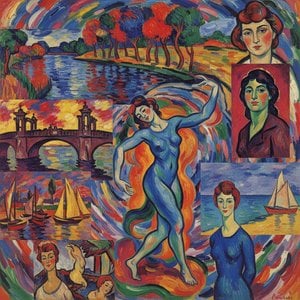
This evolution reached its zenith during the seminal Salon d'Automne of 1905. Alongside Matisse and André Derain, Valtat was identified with the "Fauves"—the "wild beasts"—a group notorious for their aggressive and exuberant use of pigment. While he did not fully abandon the structural integrity of his earlier training, his brushwork became increasingly fluid and gestural. His landscapes and street scenes began to pulse with an internal energy, where color was no longer a mere description of reality but an emotional force in its own right. This transition marked a pivotal moment in modern art, as Valtat helped move the focus from the external observation of nature to the internal expression of the artist's psyche.
A Lasting Legacy of Color and Light
Throughout a long and prolific career that spanned over half a century, Valtat remained a steadfast explorer of the interplay between form and vibrancy. His repertoire was remarkably diverse, ranging from intimate, sun-drenched interiors to expansive, luminous seascapes that seemed to breathe with the rhythm of the tides. Even as he experimented with the optical precision of Pointillism and the decorative flatness of the Nabis, a sense of joyful immediacy remained the hallmark of his oeuvre. His ability to synthesize the structural lessons of Paul Cézanne with the chromatic freedom of the Fauves ensured that his work always possessed a unique, lyrical harmony.
Today, the historical significance of Louis Valtat is recognized by his presence in the world's most prestigious museums. He stands as a testament to the courage required to navigate the turbulent waters of artistic change. His life’s work serves as a vital link in the evolution of modernism, reminding us that art is a continuous dialogue between tradition and rebellion. To look upon a Valtat painting is to witness the moment when the soft glow of the nineteenth century ignited into the brilliant, unbridled flame of the twentieth.