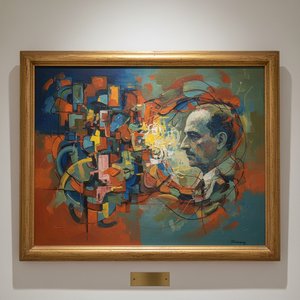
The Essence of Form: The Life and Legacy of José Francisco Arregui Arambarri
In the quiet, storied landscapes of Oñati, Spain, a profound artistic journey began in 1935, marking the birth of a visionary who would eventually redefine the boundaries of Spanish abstraction. José Francisco Arregui Arambarri did not merely paint or sculpt; he interrogated the very fabric of perception. His early years were steeped in the rich cultural heritage of his homeland, yet his gaze was always fixed upon the horizon of modernity. Through his formative studies at the Escrabia Superior de Diseño Cristóbal Goya in Bilbao, Arregui developed a rigorous technical foundation. This period was crucial, as it instilled in him a deep respect for the tactile nature of materials—a reverence for stone, metal, and clay that would later breathe life into his three-dimensional works and inform the structural integrity of his canvases.
As his career matured, Arregui’s artistic language underwent a transformative evolution, moving away from traditional representation toward a sophisticated synthesis of Cubism and Minimalism. He possessed a rare ability to strip an object down to its skeletal essence, finding beauty in the geometric purity of a line or the weight of a shadow. His work became a dialogue between presence and absence, where the space between forms was just as vital as the forms themselves. This mastery of spatial relationships allowed him to create compositions that felt both monumental and intimate. When viewing his paintings, one does not simply see color; one experiences a rhythmic pulse of light and energy, orchestrated through a deliberate and masterful use of palette.
A Symphony of Color and Geometry
The true magic of Arregui’s oeuvre lies in his fearless deployment of color. He treated hues not merely as decorative elements but as emotional protagonists capable of altering the viewer's psychological state. In works such as "Woman in a Blue Hat," the artist demonstrates his signature ability to distill complex human narratives into striking, simplified motifs. The vibrant blues and bold contrasts serve to anchor the eye, guiding it through a labyrinth of geometric shapes that evoke a sense of structured harmony. This approach—blending the fragmented perspective of Cubism with the restrained elegance of Minimalism—created a tension that is both intellectually stimulating and visually arresting.
Beyond the borders of Spain, Arregui’s influence expanded through his dedication to pedagogy and international exchange. His tenure teaching at the Universidad Nacional de Educación Superior Autónoma Metropolitana (UNESAM) in Mexico City allowed him to share his profound understanding of form with a new generation of creators. This cross-pollination of Spanish tradition and Mexican modernism enriched his own perspective, infusing his later works with an even greater sense of global connectivity and structural complexity. His ability to translate the language of sculpture into the two-dimensional realm of painting ensured that his art remained a cohesive exploration of volume and light.
Historical Significance and Lasting Impact
The passing of José Francisco Arregui Arambarri in 2021 marked the end of an era, yet his contribution to contemporary art remains an enduring legacy. He stands as a bridge between the classical traditions of Spanish craftsmanship and the avant-garde movements of the late 20th century. His work continues to challenge collectors and historians to reconsider the relationship between simplicity and depth. To engage with an Arregui piece is to participate in a timeless meditation on the fundamental elements of our visual world:
- The Power of Abstraction: His ability to communicate profound truths through non-representational forms.
- Materiality and Space: The seamless integration of sculptural thought into the medium of painting.
- Chromatic Emotion: The use of bold, strategic color to evoke visceral human responses.
- Geometric Precision: A lifelong commitment to finding order and beauty within simplified structures.
Today, Arregui’s name is synonymous with a particular brand of Spanish modernism—one that is both intellectually rigorous and deeply soulful. His canvases remain vibrant testaments to a life spent chasing the thresholds of light and the hidden geometries of the human experience.
问答环节
Ar galiu ieškoti José Francisco Arregui Arambarri kūrybos temų pagal temos?
José Francisco Arregui Arambarri Tematų atlasas yra puslapis, kuriame kūriniai suskirstyti pagal jų tematiką.
Kur galiu rasti statistiką apie José Francisco Arregui Arambarri kūrybinį veiklą?
Statistika apie José Francisco Arregui Arambarri kūrybinį veiklą galima rasti puslapyje Statistika.
Kokie kiti pseudonimai arba alternatyvūs vardai priklauso José Francisco Arregui Arambarri?
José Francisco Arregui Arambarri taip pat žinomas (a) pavadinimais José Arregi, Jose Arregi, Jose Francisco Arregui Arambarri.