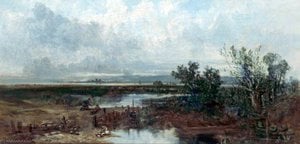
John Wright Oakes portretas

Jūsų gidas po 25 garsiausiomis John Wright Oakes paveikslais

Atnaujinta lapkritis 2026 · pagal mūsų populiarumumo koeficientą (paieškos, lankytojai ir užsakymai kiekvienam kūriniui) · 25 John Wright Oakes darbai mūsų kataloge

Trumpai tariant

Žymiausias John Wright Oakes kūrinys yra Moonlight, Near Cemmaes, Anglesea (1871). Kitos sąraše yra A North Devon Glen, Autumn (1870) ir Slate Quarries, Llanberis (1847). Mūsų kataloge yra 25 darbų autoriaus John Wright Oakes; šiame vadove pateikiamos 25 žymiausi darbai su informacija apie jų metus, muziejus bei kiekvieno kūrinio istoriją.

1820 – 1887, Cheshire West and Chester Daugiausia darbų: Walker Art Gallery

10 John Wright Oakes paveikslų, kuriuos reikėtų žinoti pirmiausia

1
Moonlight, Near Cemmaes, Anglesea (1871) aut. John Wright Oakes

Moonlight, Near Cemmaes, Anglesea

1871 · Oil

In Moonlight, Near Cemmaes, Anglesea, John Wright Oakes captures a moment of profound stillness as the sun begins its descent or perhaps prepares to rise, casting warm, glowing hues across the sky. A tranquil landscape unfolds, centered around a quiet body of water that mirrors the shifting colors of the heavens. Upon this liquid surface, a small boat carries a single figure, a solitary presence that provides a sense of…

Ranku tapytos aliejaus reprodukcija nuo $175 35 × 29 cm
Gaukite rankų darbo Perskaitykite istoriją
3
Slate Quarries, Llanberis (1847) aut. John Wright Oakes

Slate Quarries, Llanberis

1847 · Oil On Canvas · Harris Museum - Art Gallery, Preston

is an oil painting by John Wright Oakes, executed in 1847. The artist, born in 1820 in Cheshire West and Chester, United Kingdom, transitioned from the precise study of still-life fruit pieces to the direct observation of the natural landscape. This work emerged during a period of significant industrial expansion and a simultaneous romantic interest in the untouched natural world.

Ranku tapytos aliejaus reprodukcija nuo $175 35 × 28 cm Pusė kaip originalo $247 66 × 52 cm Užsakyti originalaus dydžio →
Užsisakyti šį kūrinį Daugiau apie šį kūrinį
4
The Mouth of the River Derwent (1848) aut. John Wright Oakes

The Mouth of the River Derwent

1848 · Oil On Canvas · Nottingham Castle Museum And Art Gallery, Notinghamas

The landscape captures the confluence of the River Derwent, where the water meets the horizon under a vast, shifting sky. Mountains rise in the background, their forms softened by the heavy, moisture-laden air characteristic of the British Isles. A single boat floats upon the surface, a small, solitary presence amidst the expanse of the river. Scattered figures populate the banks, their scale emphasizing the quiet magnitude of the natural environment.…

Ranku tapytos aliejaus reprodukcija nuo $175 39 × 25 cm Pusė kaip originalo $490 125 × 94 cm Užsakyti originalaus dydžio →
Užsisakyti šį kūrinį Daugiau apie šį kūrinį

Skaičiai nuo 11 iki 25: daugiau darbių autoriaus John Wright Oakes

Daugiausiai paveikęs John Wright Oakes

Keturios dažniausiai pasitaikančios šių kūrinių temos, kiekviena su savo žymiausiu pavyzdžiu.

Kur galite pamatyti John Wright Oakes paveikslus

7 muziejai, kuriuose saugoma daugiausia šioje pusėje esamų paveikslų.

Muzejaus Miestas John Wright Oakes darbai Šiojo sąrašo paveikslai
Walker Art Gallery, LiverpulisWalker Art Gallery Liverpulis 3 A North Devon Glen, Autumn, Morning at Angera, Lago Maggiore, The Tivey at Newcastle Emlyn, Cardiganshire
Nottingham Castle Museum And Art Gallery, NotinghamasNottingham Castle Museum And Art Gallery Notinghamas 2 The Mouth of the River Derwent, A Sandy Bit of Road
Harris Museum - Art Gallery, PrestonHarris Museum - Art Gallery Preston 1 Slate Quarries, Llanberis
Ludlow Library - Museum Resource Centre, LudlowLudlow Library - Museum Resource Centre Ludlow 1 Malltreath Bay
Laing Art Gallery, Newcastle upon TyneLaing Art Gallery Newcastle upon Tyne 1 Loch Muick, Aberdeenshire
New Walk Museum - Art Gallery, LesterisNew Walk Museum - Art Gallery Lesteris 1 Picking up Wreckage on a Rocky Shore
Touchstones Rochdale, RochdaleTouchstones Rochdale Rochdale 1 Mountain Stream, Glen Derry, Aberdeenshire, 'Like time the restless waters rush along'

Kas dešimtmetė – žymiausias kiekvieno John Wright Oakes kūrinys

Darbai pagal dešimtmečius

Pasirinkite dešimtmetį, kad pamatytumėte jo išskirtinį kūrinį.

John Wright Oakes: trumpi atsakymai apie paveikslus

Koks yra žymiausias John Wright Oakes tapas?Peržiūrėti atsakymą

Pirmosios sąraše yra Moonlight, Near Cemmaes, Anglesea (1871). Tuoj antrasioji: A North Devon Glen, Autumn (1870) ir Slate Quarries, Llanberis (1847).

Kokia buvo John Wright Oakes amžius kūpdamos Moonlight, Near Cemmaes, Anglesea?Peržiūrėti atsakymą

51 mmet. John Wright Oakes gimė 1820, o Moonlight, Near Cemmaes, Anglesea datuojama 1871 m.

Kokie yra 10 geriausių John Wright Oakes paveikslų?Peržiūrėti atsakymą

Moonlight, Near Cemmaes, Anglesea, A North Devon Glen, Autumn, Slate Quarries, Llanberis, The Mouth of the River Derwent, Landscape, Woman by River, Barmouth, Malltreath Bay, Loch Muick, Aberdeenshire, Morning at Angera, Lago Maggiore ir Picking up Wreckage on a Rocky Shore. Viršujei esančiame sąraše rasite kiekvieno kūrinio metus ir muziejų.

Kiek John Wright Oakes darbų yra jūsų kataloge?Peržiūrėti atsakymą

Mūsų kataloge yra 25 John Wright Oakes darbų, datuojamų nuo 1847 iki 1887.

Kuriuose muziejuose galite pamatyti garsiausius John Wright Oakes kūrinius?Peržiūrėti atsakymą

Daugumą jų rasite Walker Art Gallery (Liverpulis), Nottingham Castle Museum And Art Gallery (Notinghamas) ir Harris Museum - Art Gallery (Preston). Viršuje pateiktame muziejų sąraše yra išsami informacija.

Kada John Wright Oakes sukūrė savo garsiausius kūrinius?Peržiūrėti atsakymą

1870s laikotarpyje – daugiau nei bet kada kitais: 10 iš 25 šioje pusėje esamų darbų date iš to laiko, iš jų Moonlight, Near Cemmaes, Anglesea.

Kokie yra pirmasis ir paskutinis garsieji John Wright Oakes kūriniai?Peržiūrėti atsakymą

Seniausias čia esantis kūrinys yra Slate Quarries, Llanberis (1847), o naujausias – A coastal scene with figures by beached fishing boats in the foreground (1887).

Kurią temą John Wright Oakes tapė dažniausiai?Peržiūrėti atsakymą

Boat (2), Water (2) ir Rural landscape (2) iš 25 darbų šiame puslapyje.

Kuri technika dažniausiai pasitaiko John Wright Oakes paveiksluose?Peržiūrėti atsakymą

Oil On Canvas, naudojamas 3 iš 25 šioje pusėje esančių darbų.

Kurių garsių John Wright Oakes paveikslų eksponuojama Walker Art Gallery?Peržiūrėti atsakymą

Šioje pusėje laikinėje Walker Art Gallery, Liverpulis galima pamatyti 3 kūrinių, įskaitant A North Devon Glen, Autumn, Morning at Angera, Lago Maggiore ir The Tivey at Newcastle Emlyn, Cardiganshire.

Kur galiu užsakyti John Wright Oakes reprodukciją?Peržiūrėti atsakymą

Taip. Kiekvienas šioje pusėje esantis paveikslas galėto būti užsakytas kaip ranku dažytas aliejus reprodukcija arba spausdinys jums patinkaniu dydžiu. Norėdami užsakyti, tiesiog atidarykite paveikslą.

John Wright Oakes istorija

The Soul of the Welsh Landscape: The Life and Art of John Wright Oakes

In the heart of the Victorian era, a period defined by both industrial expansion and a profound romantic longing for the untouched natural world, the works of John Wright Oakes emerged as a poignant bridge between reality and imagination. Born in 1820 at Sproston House near Middlewich, Cheshire, Oakes was a man whose lineage and upbringing provided a stable foundation for a life dedicated to the pursuit of aesthetic truth. While his early years were rooted in the English countryside, his artistic spirit found its true home amidst the rugged, mist-shrouded peaks and dramatic coastlines of Wales. His journey from a student of fine details to a master of atmospheric grandeur represents one of the most compelling narratives of nineteenth-century British landscape painting.

Oakes’s formal training began in Liverpool, where he studied under the guidance of John Bishop at the school attached to the Liverpool Mechanics’ Institution. This early education instilled in him a meticulous discipline that would later serve as the bedrock for his more expansive works. Interestingly, his initial foray into the art world was not through the sweeping vistas for which he is now celebrated, but through the delicate and precise genre of fruit paintings. These early still lifes, exhibited at the Liverpool Academy—where he eventually served as an honorary secretary—demonstrated a profound understanding of texture, light, and form. However, around 1843, a transformative shift occurred; drawn by the raw power of nature, Oakes began painting directly from the landscape, trading the controlled environment of the studio for the unpredictable beauty of the outdoors.

A Mastery of Light and Romantic Grandeur

The transition from still life to landscape allowed Oakes to explore the tenets of Romanticism, an art movement that prioritized emotion, the sublime, and the awe-inspiring power of the natural world. Influenced by the legendary techniques of masters like Turner and Constable, Oakes developed a signature style characterized by masterful tonal modulation and atmospheric perspective. He possessed a rare ability to capture the fleeting, ephemeral qualities of light—the way a sudden sunbeam pier sculpting through heavy clouds, or the soft, melancholic glow of twilight over a mountain glen. His canvases were not merely topographical records but emotional landscapes that invited the viewer to feel the dampness of the mist and the chill of the wind.

His technical prowess was particularly evident in his treatment of diverse terrains:

  • Mountainous Vistas: In works inspired by Snowdonia, he utilized rugged textures and dramatic shadows to convey the intimidating majesty of the Welsh peaks.
  • Coastal Scenes: His depictions of places like Aberffraw Bay and Malldraeth Sands showcased a fluid command of water, capturing the turbulent energy of the sea meeting the shore.
  • Rural Serenity: In pieces such as A North Devon Glen, Autumn, he employed warm palettes and soft brushstrokes to evoke a sense of pastoral peace and seasonal transition.

Legacy and Artistic Triumph

The trajectory of Oakes’s career was marked by consistent recognition from the most prestigious institutions of his time. His debut in London at the Royal Academy in 1847, featuring On the River Greta, Keswick, signaled his arrival as a significant force in British art. Throughout his prolific life, he became a regular contributor to the Society of British Artists, the Dudley Gallery, and the Portland Gallery. His accolades were numerous, including being elected an Associate of the Royal Academy in 1876 and receiving honorary membership in the Royal Scottish Academy in 1883. Even as ill health began to impede his physical practice in his final years, his dedication to the craft remained unshaken, continuing to exhibit at the Royal Academy until the very end.

Today, the historical significance of John Wright Oakes lies in his ability to have captured the vanishing essence of the nineteenth-century landscape. His works, now held in esteemed collections such as the Walker Art Gallery and the Nottingham Castle Museum, serve as windows into a world of sublime beauty and quiet contemplation. He remains a vital figure for anyone seeking to understand the Victorian fascination with the wild, untamed corners of the British Isles, leaving behind a legacy of over 300 canvases that continue to resonate with visual splendor and psychological depth.