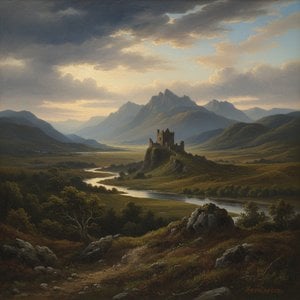
The Romantic Vision of James Loder
Born in 1784 to a Scottish clergyman in the historic city of Edinburgh, James Loder emerged from a background of intellectual rigor to become one of the most evocative voices of the Romantic era. His early years were defined by a profound, self-driven passion for the visual arts, as he navigated the rich artistic traditions of Scotland and England. While his initial training leaned toward the structured discipline of classical portraiture, Loder’s spirit was fundamentally drawn to the untamed grandeur of the natural world. This transition from the precise depiction of human character to the sweeping narratives of the landscape marked the beginning of a career dedicated to capturing the sublime.
As his travels took him across Europe, Loder found a spiritual and artistic home in the rugged landscapes of Cornwall. The dramatic coastline, with its jagged cliffs and the rhythmic, powerful motion of the Atlantic, provided the perfect canvas for his developing Romantic sensibility. He did not merely seek to document these scenes; he sought to translate the emotional weight of the environment onto the canvas. Through his eyes, the Cornish coast became a stage for exploring the relationship between human emotion and the overwhelming majesty of nature, a hallmark of the 19th-century aesthetic that celebrated both beauty and terror.
Mastery of Light and Atmosphere
Loder’s technical prowess was rooted in an extraordinary ability to manipulate light and atmosphere. Drawing deep inspiration from the innovative approaches of masters such as J.M.W. Turner and John Constable, he mastered the use of atmospheric perspective to instill his works with a sense of breathing life and immense depth. His technique involved a meticulous observation of how light interacts with mist, sea spray, and shifting clouds, creating luminous compositions that seem to glow from within. His brushwork, while deliberate and controlled, possessed an expressive quality that allowed him to capture the intangible moods of a setting—the quiet serenity of a sheltered bay or the turbulent energy of a storm-tossed sea.
This skill was perhaps most strikingly displayed in his animalier works, where he applied his landscape sensibilities to the study of equine subjects. In masterpieces such as "A Bay Charger in His Stable," Loder demonstrated an unparalleled command over tonal harmony and texture. The way soft sunlight filters through a stable to illuminate the muscular detail of a horse reveals a painter deeply attuned to the subtle nuances of light. Similarly, his "Equestrian Portrait of William Stephens" showcases his ability to blend the dignity of portraiture with the dynamic energy of the animal subject, creating a sense of noble character that transcends simple representation.
Legacy and Artistic Significance
The historical significance of James Loder lies in his role as a bridge between the formal traditions of the late 18th century and the emotive, atmospheric freedom of the Romantic movement. His work serves as a vital record of the British landscape during a period of profound cultural shift. By focusing on the rugged beauty of the Cornish coast and the intimate details of pastoral life, he contributed to a lasting visual language that continues to resonate with viewers today.
Loder’s enduring impact can be summarized through several key artistic contributions:
- The Romantic Ideal: His ability to infuse landscapes with profound human emotion and the concept of the sublime.
- Atmospheric Innovation: The sophisticated use of light, color, and perspective to create depth and luminosity in watercolor and oil.
- Versatility of Subject: A seamless transition between the precision of classical portraiture and the expansive freedom of seascape and landscape painting.
- Regional Documentation: His profound contribution to the artistic heritage of Cornwall and the broader British maritime tradition.