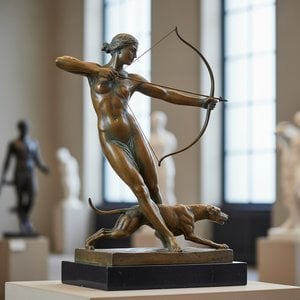
A Sculptor of Grace: The Life and Art of Hermann Hugo Otto Poertzel
Born in the small Thuringian town of Scheibe, Germany, in 1876, Hermann Hugo Otto Poertzel emerged as a significant voice within the burgeoning Art Deco movement. His story is one of early artistic immersion, dedicated craftsmanship, and a distinctive style that captured the spirit of an era—a time defined by both technological advancement and a yearning for elegance and refinement. Poertzel’s initial training wasn't in a grand academy but within the walls of the local porcelain factory, A.W. Fr. Kister. This formative experience proved crucial; it instilled in him not only technical skill – an understanding of form, material, and the delicate balance between precision and artistry – but also a deep appreciation for the beauty inherent in craftsmanship. He began as an apprentice, mastering mold-making before transitioning to studio work where he honed his skills as a porcelain designer, following in the footsteps of his father who was already established at the factory. This early exposure laid the foundation for his later explorations with bronze and ivory, materials that would become synonymous with his signature style.From Porcelain to Bronze: Developing an Artistic Identity
Poertzel’s artistic journey wasn't confined to porcelain. By 1900, he had established himself as an independent sculptor in Coburg, actively seeking commissions from both public and private entities. This period marked a crucial shift towards larger-scale works and the development of his unique aesthetic. He later relocated to Munich, enrolling at the academy and establishing his own studio—a space where he could fully realize his creative vision. It was during this time that Poertzel began to cultivate the style for which he is now celebrated: elongated figures imbued with a sense of dynamic movement and graceful poise. His sculptures weren’t merely representations of form; they were expressions of energy, capturing fleeting moments in dance or the subtle allure of the human figure. The 1920s and 30s saw Poertzel receive prestigious commissions from the noble family of Sachsen-Coburg und Gotha for portrait busts, further solidifying his reputation and providing him with opportunities to refine his technique and explore new avenues within portraiture.Themes of Movement and Modernity
Poertzel’s oeuvre is characterized by a captivating focus on dancers, bathers, and film stars—subjects that embodied the spirit of the Jazz Age and the evolving role of women in society. His sculptures weren't static representations but rather captured the fluidity and dynamism of movement. The elongated forms of his dancers, often crafted from bronze, ivory, or porcelain, seem to defy gravity, conveying a sense of lightness and ethereal beauty. His work reflects a fascination with the human body as a vessel for expression, celebrating its inherent grace and power. The inclusion of film stars in his repertoire speaks to the growing influence of popular culture during this period—a recognition of the new icons that were captivating audiences worldwide. Poertzel’s sculptures weren't simply beautiful objects; they were reflections of a changing world, capturing the energy and excitement of modernity.Recognition and Lasting Legacy
Otto Poertzel exhibited his work at numerous international exhibitions and fairs throughout his career, gaining recognition for his distinctive style and technical mastery. His sculptures found their way into private collections and public spaces, establishing him as a prominent figure within the Art Deco landscape. Today, his work is represented in prestigious institutions such as the Art Deco Museum in Moscow, Russia, with ‘The Top’ serving as a prime example of his artistic achievement.- His sculptures continue to be highly sought after by collectors worldwide.
- Poertzel's influence can be seen in the work of subsequent sculptors who embraced Art Deco aesthetics.
- He remains an important figure in understanding the evolution of sculpture during the early 20th century.
问答环节
Kuriame mieste ir šalyje gimė Hermann Hugo Otto Poertzel?
Hermann Hugo Otto Poertzel gimė Saabye, Germany šalyje.
Kuriame istoriniame laikotarpyje kūrė Hermann Hugo Otto Poertzel?
Hermann Hugo Otto Poertzel kūrė Modern laikotarpiu. Šis laikotarpis nustato kūrybinę veiklą istoriniame kontekste.
Kokia Hermann Hugo Otto Poertzel kūryba yra populiari?
Statistika apie Hermann Hugo Otto Poertzel kūrybinį veiklą galima rasti puslapyje Statistika.