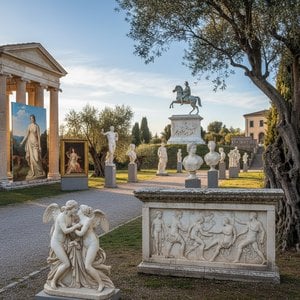
Pierre-Jean David d’Angers: The Sculptor of Heroic Idealism
Pierre-Jean David d’Angers (1788 – 1856) stands as a pivotal figure in the neoclassical artistic landscape of France, embodying the spirit of republican idealism and monumental sculptural achievement. Born in Angers, Loiret, his early life was marked by familial ties to the Republican army—his father, a wood carver and sculptor himself, participated valiantly against the Chouan rebellion—a formative experience that instilled within him a profound appreciation for civic duty and artistic expression as instruments of national pride. This heritage profoundly shaped his artistic trajectory, propelling him toward a distinguished career centered on sculpting and modeling, particularly during the influential period of Jacques-Louis David’s studio.
- Early Training & Influences: David's formative years were spent honing his craft under Jean-Jacques Delusse and Philippe-Laurent Roland in Paris, absorbing the stylistic precepts of Romanticism alongside the enduring legacy of classical sculpture. Notably, he encountered Antonio Canova—a sculptor whose meticulous attention to anatomical detail and emotive portrayal captivated David’s imagination—establishing a crucial connection with the artistic traditions of Rome that would define his oeuvre.
- The École des Beaux-Arts & The Prix de Rome: Recognizing his talent, David secured admission to the École des Beaux-Arts in 1808 where he excelled, culminating in victory at the École’s competition for *tête d'expression* and subsequently claiming the prestigious Prix de Rome in 1811. This scholarship afforded him unparalleled access to Roman artistic ideals and allowed him to develop his sculptural technique—characterized by a masterful command of marble and bronze—further refining his ability to capture human emotion and heroic grandeur.
- Roman Period & Artistic Evolution: David’s five-year sojourn in Rome proved transformative, fostering collaborations with fellow artists and immersing himself in the artistic fervor of the era. He meticulously studied the works of Michelangelo Buonarroti and Bernini, absorbing their techniques and stylistic sensibilities—influences that would permeate his subsequent sculptures and etchings. During this time he undertook expeditions to Venice, Naples and Florence, broadening his artistic horizons and enriching his understanding of classical art history.
- Monumental Sculpture & Notable Commissions: David’s reputation soared as a sculptor during the Restoration period, securing commissions for monumental works that cemented his place in French cultural history. Among his most celebrated achievements are the Pantheon frieze—a breathtaking depiction of Roman mythology commissioned to commemorate Napoleon Bonaparte's triumph—the equestrian statue of Marshal Jacques-Nicolas Gobert erected in Père Lachaise Cemetery—and the monumental sculpture commemorating the Greek liberator Markos Botsaris, a testament to David’s commitment to portraying heroic figures with unwavering conviction.
- Legacy & Recognition: David’s prolific output encompassed over 500 medallions and busts, capturing portraits of luminaries from across Europe—including Voltaire, Rousseau, Goethe, Napoleon Bonaparte, and Friedrich Schiller—demonstrating his versatility as an artist and cementing his enduring influence on subsequent generations of sculptors. His unwavering dedication to classical ideals and his ability to convey profound emotion through sculptural form ensured that David d’Angers would remain a revered figure in the annals of French art history, securing his place among the foremost sculptors of his time.
Key Works & Artistic Style
David’s artistic style is characterized by an unwavering commitment to neoclassical principles—specifically anatomical accuracy, idealized beauty, and dramatic composition—reflecting the influence of Michelangelo Buonarroti and Bernini. He skillfully employed marble and bronze to convey emotion and grandeur, prioritizing clarity of form and expressive gesture above mere decorative embellishment. His sculptures are imbued with a palpable sense of pathos and nobility, capturing moments of profound human experience with meticulous detail and unwavering conviction. The Pantheon frieze exemplifies his mastery of monumental sculpture, presenting an ambitious undertaking that celebrates Roman mythology and commemorates Napoleon Bonaparte’s victory—a testament to David's ambition and artistic vision. Similarly, the equestrian statue of Marshal Gobert stands as a symbol of French military prowess and civic virtue, demonstrating David’s ability to elevate sculptural form into a vehicle for conveying complex narratives and emotional resonance.