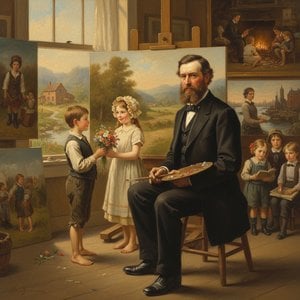
Benjamin Franklin Reinhart: A Painter of Midwestern Landscapes and Genre Scenes
Benjamin Franklin Reinhart (1829 – May 3, 1885) stands as a prominent figure in American art history, particularly recognized for his evocative depictions of the American Midwest and engaging genre paintings that captured everyday life. Born in Waynesburg, Pennsylvania, Reinhart’s artistic journey began with formal training at the National Academy of Design in New York City, where he honed his skills during the summers spent in Hayesville, Ohio—a region that would profoundly influence his artistic vision. This formative period instilled a deep appreciation for the rural landscapes and working-class communities of Ohio, themes which consistently recurred throughout his prolific career.
- Early Life and Education: Reinhart’s upbringing fostered an interest in art from a young age. He pursued studies abroad in Rome, Paris, and Düsseldorf between 1850 and 1853, immersing himself in the artistic traditions of Europe while simultaneously absorbing influences from German Romanticism. These experiences broadened his artistic horizons and equipped him with technical mastery—a cornerstone of his distinctive style.
- Academic Recognition and Artistic Style: Reinhart’s membership in the National Academy of Design since 1871 solidified his position within the American art establishment. His paintings are characterized by a meticulous attention to detail, combined with a masterful use of color and light—techniques that effectively convey emotion and atmosphere. Notably, Reinhart excelled at capturing the nuances of human interaction and portraying scenes from ordinary life with remarkable sensitivity.
- Notable Works: Reinhart’s artistic output encompassed both historical paintings and genre depictions. Among his most celebrated achievements is “Washed Ashort,” a monumental canvas commemorating the shipwreck of the SS Atlantic off Cape Cod in 1873—a dramatic portrayal imbued with psychological depth and rendered with breathtaking realism. His landscapes, particularly those depicting Ohio's rolling hills and fertile valleys, exemplify the Romantic spirit of his time, capturing the grandeur and beauty of the American wilderness.
- Influence and Legacy: Reinhart’s artistic legacy extends beyond individual paintings; he served as an uncle to Charles Stanley Reinhart—another accomplished artist who continued the family tradition of landscape painting. His work continues to inspire admiration for its technical precision, emotional resonance, and unwavering commitment to portraying authentic human experience.
European Influences and Artistic Development
Reinhart’s artistic development was significantly shaped by his formative years spent studying in Europe—a period that proved instrumental in establishing his distinctive style. The National Academy of Design provided a foundational grounding in classical art principles, while the Düsseldorf Akademie der Bildenden Künste exposed him to German Romanticism—an aesthetic movement characterized by an emphasis on emotion, imagination, and the sublime. These influences permeated Reinhart’s oeuvre, informing his compositional choices, color palettes, and expressive gestures.
- Rome and Paris: During his time in Rome and Paris, Reinhart engaged with the artistic currents of the Belle Époque—a period marked by innovation and experimentation within painting. He absorbed inspiration from Impressionist artists like Claude Monet and Pierre-Auguste Renoir, incorporating elements of plein air painting into his landscapes and portraits.
- German Romanticism: The Düsseldorf Akademie fostered Reinhart’s appreciation for German Romantic landscape painters such as Caspar David Friedrich—whose works explored themes of solitude, spirituality, and the relationship between humanity and nature. These influences contributed to Reinhart's ability to convey profound emotional states within his canvases.
Genre Painting and Narrative Vision
Reinhart’s artistic reputation rests largely on his genre paintings—works that depict scenes from everyday life with remarkable realism and psychological insight. Unlike historical narratives, genre paintings focus on human behavior and emotion—capturing fleeting moments of interaction and conveying nuanced characterizations. Reinhart's ability to portray ordinary individuals with empathy and sensitivity distinguishes him as a master storyteller—a skill honed through meticulous observation and skillful artistic execution.
- Ohio Landscapes: Reinhart’s landscapes are not merely representations of scenery; they serve as vehicles for conveying emotional resonance—reflecting the moods of seasons, the tranquility of rural life, and the grandeur of the American wilderness.
- Psychological Depth: His genre paintings delve into the complexities of human psychology—illuminating motivations, emotions, and interpersonal relationships with remarkable accuracy.
A Lasting Impression on Midwestern Art
Benjamin Franklin Reinhart’s contribution to American art extends beyond his individual masterpieces; he established a tradition of landscape painting that continues to resonate within the Midwest—a region that served as an enduring source of inspiration for his artistic endeavors. His legacy resides not only in his technical prowess but also in his unwavering commitment to portraying authentic human experience—a quality that distinguishes him as one of America’s most perceptive and emotionally resonant artists.