
- Pradžia

- Straipsniai
- William Stanley Haseltine: Evoking Atmosphere & Light in American Tonalism
William Stanley Haseltine: Evoking Atmosphere & Light in American Tonalism
Turinio sąrašas
Early Life & Artistic Foundations: A Philadelphia Beginnings
 Wikipedia: William Stanley Haseltine
William Stanley Haseltine (June 11, 1835 – February 3, 1900) was an American painter and draftsman who was associated with the Düsseldorf school of painting, the Hudson River School and Luminism. == Early life and education == Born on June 11, 1835...
William Stanley Haseltine’s artistic journey began not amidst the grand vistas he would later become renowned for, but within the refined circles of 19th-century Philadelphia. Born in 1835 to John and Elizabeth Shinn Haseltine – a businessman and an amateur landscape painter respectively – young William was immersed in a world that valued both commerce and creative expression. This duality perhaps foreshadowed his own career path, one marked by meticulous observation and a keen understanding of light and form, yet also driven by a desire for artistic recognition. His initial studies at the University of Pennsylvania provided a foundation in classical learning, but it was Harvard University, where he earned his degree in 1854, that truly ignited his passion for art. However, formal academic training alone proved insufficient to satisfy his burgeoning talent; Haseltine sought further instruction, embarking on a path that would lead him across continents and into the heart of artistic innovation.
The Düsseldorf Influence & European Travels: Shaping a Luminist Vision
 Study from Nature
Explore William Stanley Haseltine’s "Study from Nature," a detailed oil painting of a secluded forest scene. Impasto technique & naturalistic style – a captivating landscape study.
Following Harvard, Haseltine’s pursuit of artistic mastery led him to Europe, specifically to Düsseldorf, Germany. This city served as a magnet for American painters seeking rigorous academic training, and Haseltine joined a vibrant colony of artists studying at the Düsseldorf Academy. The school's emphasis on detailed realism and precise draftsmanship profoundly influenced his technique. He wasn’t alone in this artistic pilgrimage; Emanuel Leutze, Albert Bierstadt, and Worthington Whittredge were among his companions, forging lifelong friendships that would shape their respective careers. From Düsseldorf, Haseltine ventured further afield – into Switzerland and Italy – sketching the dramatic landscapes of the Rhine and the sun-drenched vistas of the Italian Alps. It was in Italy, particularly Rome, that he discovered a subject matter that would captivate him for decades to come. These early European experiences were not merely about acquiring technical skill; they instilled within Haseltine a deep appreciation for atmosphere, light, and the subtle nuances of nature – qualities that would become hallmarks of his signature style.
Mastering the Coastal Landscape: Narragansett, Nahant & the American Shoreline
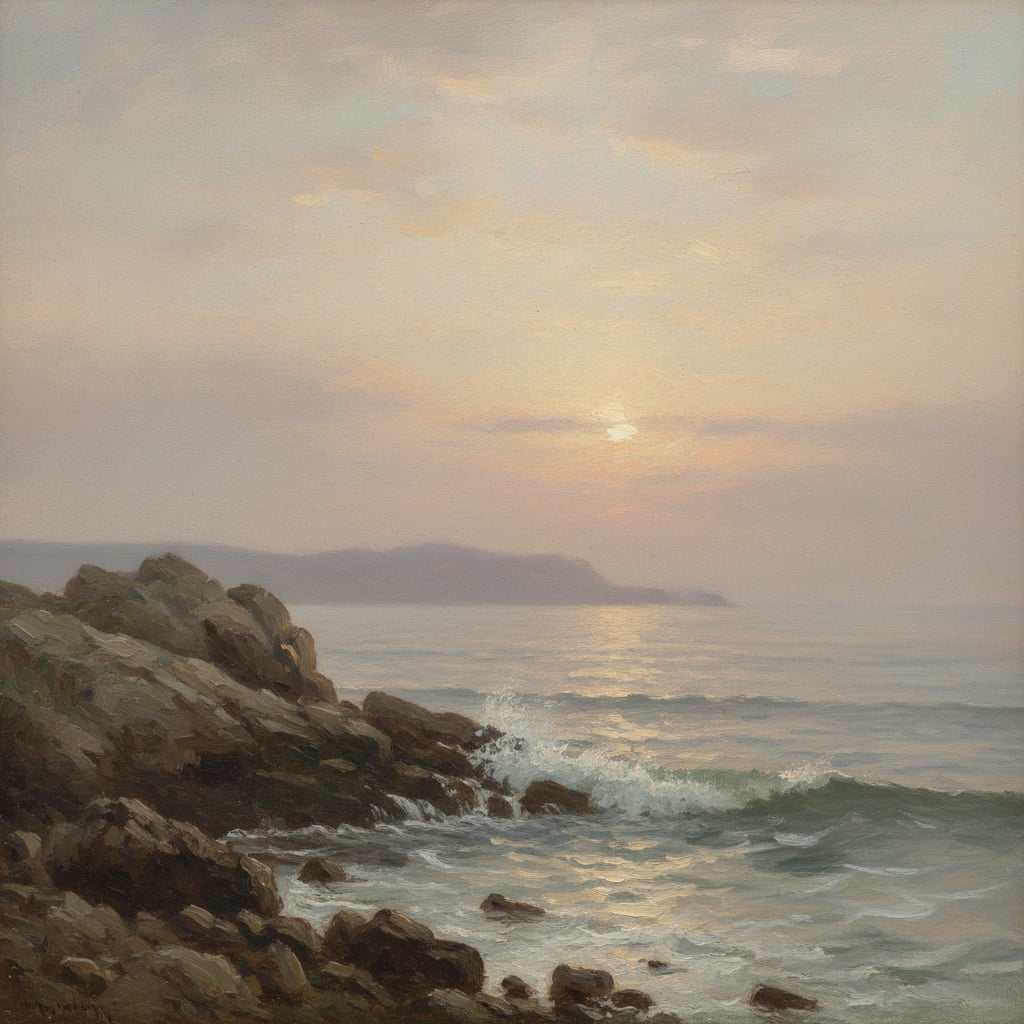
 Rocks at Narragansett 1
Explore William Stanley Haseltine’s ‘Rocks at Narragansett 1,’ a stunning 19th-century oil landscape painting of coastal beauty. Discover its realism, linear style & serene atmosphere.
Upon returning to America in 1859, Haseltine found himself at a pivotal moment in the development of Luminism. While influenced by his European training, he began to forge his own path, focusing on the rugged beauty of the New England coastline. Locations like Narragansett, Rhode Island, and Nahant, Massachusetts, became frequent subjects for his meticulous paintings. Nahant Rocks, for example, exemplifies his ability to capture the raw power and serenity of the ocean. His technique was characterized by a remarkable precision – each rock formation rendered with painstaking detail, reflecting an almost geological accuracy. Unlike the dramatic, sweeping landscapes favored by some of his contemporaries, Haseltine’s compositions were often intimate and focused, emphasizing the interplay of light and shadow on the water and stone. This dedication to realism wasn't merely technical; it was a means of conveying a profound sense of place and evoking the emotional resonance of the natural world.
Tonalism Defined: Haseltine’s Contribution to Atmospheric Painting
Tonalism was an artistic style that emerged in the 1880s when American artists began to paint landscape forms with an overall tone of colored atmosphere or mist. Between 1880 and 1915, dark, neutral hues such as gray, brown or blue, often dominated c...
Haseltine is often associated with Tonalism, an artistic style that emerged in the 1880s as American painters shifted their focus towards capturing mood and atmosphere. While not strictly adhering to all tenets of the movement, his work embodies its core principles: a preference for subdued palettes, soft edges, and a poetic sensibility. Rocks at Narragansett 1, with its muted tones and serene composition, is a prime example. The emphasis wasn’t on bright colors or dramatic contrasts but rather on the subtle gradations of light and shadow that create a sense of depth and tranquility. Haseltine's paintings weren’t simply representations of landscapes; they were evocations of feeling – capturing the quiet beauty of nature and inviting viewers to contemplate its mysteries. He skillfully employed linear style, creating compositions that felt both grounded in reality and imbued with a dreamlike quality. This mastery of atmosphere earned him recognition as a leading figure within this influential artistic circle.
Italian Interlude: A Lifelong Passion and Artistic Refinement
Despite his success in America, Haseltine harbored a lifelong passion for Italy. After several extended visits, he ultimately settled near Rome in 1867, establishing a studio that would serve as his base of operations for much of the remainder of his life. The Italian landscape – its rolling hills, ancient ruins, and sun-drenched vistas – provided endless inspiration. Tivoli, painted during this period, showcases his ability to capture the unique light and atmosphere of the region. He wasn’t merely replicating scenes; he was interpreting them through a distinctly American lens, blending meticulous observation with a poetic sensibility. His studio became a gathering place for American expatriates and tourists alike, further solidifying his reputation as a leading landscape painter. Even during periods spent back in America, his artistic focus often returned to the Italian countryside, demonstrating the enduring power of this formative influence.
Legacy & Lasting Influence: Rediscovering a Master of Evocative Landscapes
William Stanley Haseltine’s career spanned a period of significant change in American art. While he achieved considerable recognition during his lifetime – becoming an Associate and then full Academician of the National Academy of Design – his work experienced a relative decline in prominence after his death in 1900. However, recent scholarship has led to a renewed appreciation for his contributions to Luminism and Tonalism. His meticulous technique, subtle use of color, and evocative depictions of landscape continue to resonate with contemporary audiences. Study from Nature, for instance, reveals the depth of his observational skills and his ability to capture the essence of the natural world. Today, Haseltine’s paintings are held in prominent museum collections across the United States, offering a glimpse into the serene beauty he so skillfully captured. At ArtsDot.com, we celebrate his legacy by providing high-quality reproductions that allow art enthusiasts to experience the captivating landscapes of this remarkable American master in their own homes.
Susiję straipsniai

Evocations of Place: A Historical Journey Through Landscape Art
Explore the rich history of landscape art with ArtsDot. Discover renowned artists, movements like Impressionism & Romanticism, and expert guidance for collecting timeless pieces. Find your perfect serene escape today!

Atmospheric Visions: Exploring Tonalism in American Painting
Explore the captivating world of American Tonalism! Discover its history, key artists like Whistler & Inness, techniques, and lasting influence on art. Expert insights for collectors & enthusiasts.

