
- Pradžia

- Straipsniai
- Neoplasticism: A Radical Geometry of Utopian Vision – Origins, Principles, and Enduring Influence
Neoplasticism: A Radical Geometry of Utopian Vision – Origins, Principles, and Enduring Influence
Turinio sąrašas
The Genesis of Neoplasticism: From Cubism to a New Aesthetic
 Wikipedia: Abstract art
Abstract art uses visual language of shape, form, color and line to create a composition which may exist with a degree of independence from visual references in the world. Abstract art, non-figurative art, non-objective art, and non-representational ...
The early decades of the 20th century witnessed a seismic shift in artistic perception, a dismantling of representational traditions that paved the way for entirely new modes of visual expression. While movements like Fauvism and Expressionism fractured form through emotional intensity and subjective color, it was Cubism—with its analytical dissection of objects and subsequent reassembly into fragmented planes—that provided the crucial initial impetus for what would become Neoplasticism. Artists grappling with the limitations of depicting a three-dimensional world on a two-dimensional canvas began to question the very nature of reality itself. The desire wasn’t merely to represent *what* was seen, but to explore the underlying structures governing perception and existence. This intellectual ferment, coupled with a growing spiritual yearning in the aftermath of World War I, set the stage for a radical simplification—a stripping away of all non-essential elements to reveal what its proponents believed was a universal visual language.
Early experiments by artists like Wassily Kandinsky and Kazimir Malevich hinted at abstraction’s potential, but it was in the Netherlands that this pursuit coalesced into a coherent movement. The seeds were sown not only in artistic circles but also within philosophical discussions concerning theosophy and the search for underlying spiritual principles. This quest for an essential truth, divorced from the chaos of the material world, would become central to the Neoplasticist ethos. The initial explorations weren’t immediate leaps into pure geometry; rather, they involved a gradual reduction of form, a careful distillation of visual elements until only the most fundamental components remained.
Piet Mondrian and Theo van Doesburg: Architects of a Visual Language
This development would eventually lead to his revolutionary artistic philosophy, neoplasticism, an abstract trend characterized by rigorous geometry and a ...
The figures most inextricably linked with Neoplasticism are undoubtedly Piet Mondrian and Theo van Doesburg. Mondrian, initially influenced by Impressionism and later Cubism, embarked on a relentless pursuit of abstraction, progressively eliminating naturalistic forms from his canvases. His early works demonstrate this evolution—a gradual move away from recognizable landscapes towards increasingly geometric compositions. Van Doesburg, a painter, designer, writer, poet, and critic, served as the movement’s primary theorist and propagandist through the publication of *De Stijl*, the journal that gave the movement its name. He wasn't simply an artist; he was the intellectual engine driving its development and dissemination.
The relationship between Mondrian and Van Doesburg, though initially collaborative, became increasingly fraught with tension as their artistic visions diverged. While both championed abstraction, they differed on the degree of rigidity it should embody. Mondrian advocated for a strict adherence to horizontal and vertical lines, primary colors (red, yellow, blue), and non-colors (black, white, grey), believing this represented the purest expression of universal harmony. Van Doesburg, however, later introduced diagonal elements into his work, arguing that they injected dynamism and energy into the compositions. This fundamental disagreement ultimately led to Mondrian’s departure from *De Stijl* in 1923.
Core Principles of De Stijl: Abstraction, Geometry, and the Pursuit of Harmony
At its heart, Neoplasticism—or “New Plasticism,” as Mondrian preferred—was a philosophy predicated on the belief that art should reflect an underlying cosmic order. This wasn’t merely about aesthetic preference; it was a deeply held conviction that visual form could be a conduit to spiritual understanding. The movement's principles were meticulously articulated by Mondrian in his 1937 essay, “Neo-Plasticism in Pictorial Art.” He posited that true art should transcend the particulars of appearance—natural forms and colors—and instead focus on the abstraction of form and color itself.
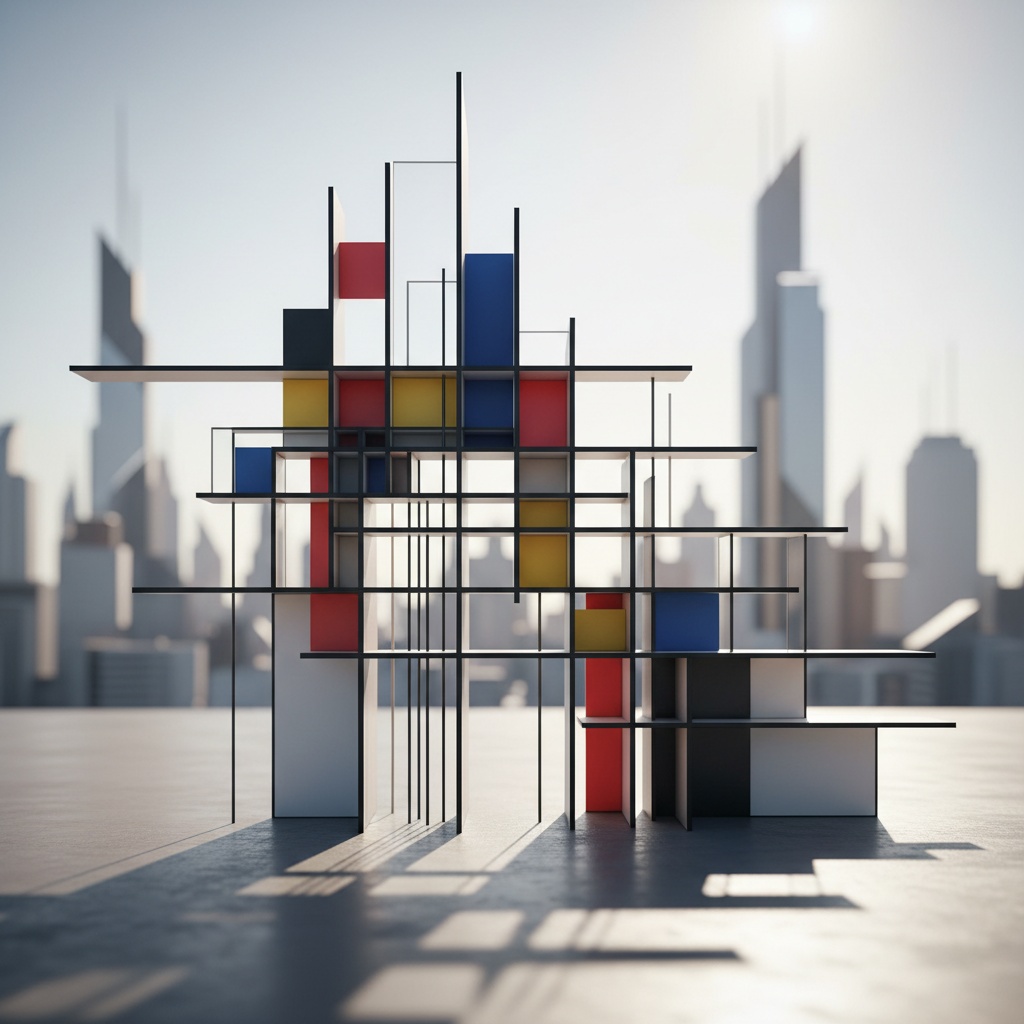
The resulting aesthetic was characterized by a stark simplicity: straight lines, squares, and rectangles arranged in carefully balanced compositions. The use of primary colors was not arbitrary; they were seen as representing fundamental forces within the universe. Black, white, and grey served as neutral elements, providing contrast and structure. Symmetry was deliberately avoided, replaced instead with an emphasis on dynamic equilibrium—a tension between opposing forces that created a sense of vitality. This wasn’t about replicating nature but about revealing its underlying principles through pure abstraction.
Beyond Painting: The Expansion of Neoplasticism into Architecture and Design
The influence of De Stijl extended far beyond the confines of painting. Van Doesburg, in particular, was keen to apply its principles to all aspects of visual culture—architecture, furniture design, typography, even fashion. He envisioned a total environment where every element reflected the movement’s aesthetic ideals. Gerrit Rietveld, an architect and designer, became instrumental in translating Neoplasticist concepts into three-dimensional form.
His most iconic creation, the Schröder House (1924), is a masterpiece of De Stijl architecture—a dynamic composition of intersecting planes, bold colors, and open spaces. The house wasn’t simply a functional dwelling; it was a living embodiment of Neoplasticist principles, designed to promote a new way of life. Furniture designs followed suit, characterized by clean lines, geometric forms, and primary color accents. This expansion into design demonstrated the movement's ambition—to create a harmonious environment that reflected its utopian vision.
The Legacy of Neoplasticism: Influence on Modern Art and Contemporary Aesthetics
Although De Stijl was relatively short-lived as a cohesive group, its impact on modern art and design is undeniable. Its emphasis on abstraction, geometry, and the pursuit of universal harmony resonated deeply with artists and architects across Europe and beyond. The movement’s influence can be seen in the Bauhaus, the influential German art school that championed functionalism and minimalist aesthetics. It also laid the groundwork for Minimalism, a later artistic movement that further explored the possibilities of geometric abstraction.
Today, Neoplasticist principles continue to inspire contemporary artists and designers. The clean lines, bold colors, and dynamic compositions remain strikingly modern—a testament to the enduring power of its aesthetic vision. Collecting works by key figures like Mondrian, Van Doesburg, and Rietveld offers a unique opportunity to engage with a pivotal moment in art history—a period when artists dared to imagine a new world order expressed through the language of pure form. ArtsDot.com provides access to high-quality reproductions of these iconic works, allowing you to experience the transformative power of Neoplasticism firsthand and explore the enduring legacy of this revolutionary movement.
Susiję straipsniai

Constructivism: A Revolutionary Aesthetic – Ideology, Form & Impact on 20th-Century Art
Explore the revolutionary world of Constructivism! Discover key artists like Malevich & Lissitzky, its impact on modern art & design, and guidance for building a valuable collection. Expert insights at ArtsDot.

The Aesthetic Evolution of Design in Art: From Functional Form to Conceptual Expression
Explore the evolution of design in art from functionalism to conceptual expression. Discover Bauhaus ideals, De Stijl's impact & post-war abstraction. Expert insights for collectors.

