
- Pradžia

- Straipsniai
- Ivan Aivazovsky: Mastering Light & Emotion in 19th-Century Marine Painting
Ivan Aivazovsky: Mastering Light & Emotion in 19th-Century Marine Painting
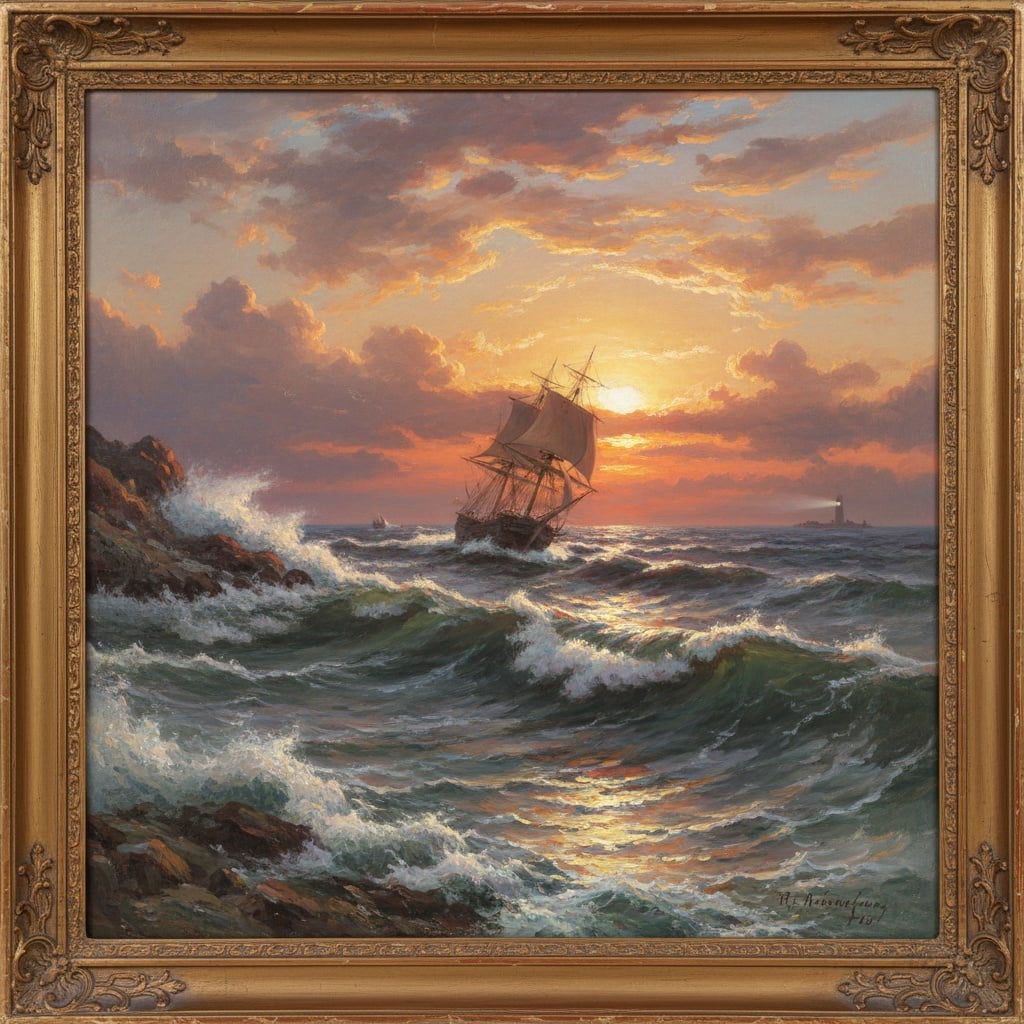
Turinio sąrašas
A Life Immersed: The Early Years & Artistic Formation of Ivan Aivazovsky
 Wikipedia: Ivan Aivazovsky
Ivan Konstantinovich Aivazovsky (Russian: Иван Константинович Айвазовский; 29 July [O.S. 17 July] 1817 – 2 May [O.S. 19 April] 1900) was a Russian Romantic painter who is considered one of the greatest masters of marine art. Baptized as Hovhannes Aiv...
Ivan Konstantinovich Aivazovsky, a name synonymous with the tempestuous beauty and sublime power of the sea, wasn’t born into privilege or artistic lineage. His story begins in Feodosia, Crimea, in 1817 – a bustling Black Sea port steeped in maritime tradition. Born Hovhannes Aivazian to an Armenian family, his early life was inextricably linked to the rhythms of the ocean, a constant presence that would ultimately define his artistic vision. Though accounts vary regarding formal training from local artists, it’s clear young Ivan possessed an innate talent for sketching the ships and coastal scenes that populated his world. This precocious ability caught the attention of patrons who recognized a spark worth nurturing, facilitating his journey to St. Petersburg in 1830 to study at the Imperial Academy of Arts.
The Academy provided Aivazovsky with a rigorous foundation in classical techniques, under the tutelage of landscape painter Maxim Vorobyov. However, it was his subsequent travels to Europe – Italy in particular – that truly ignited his artistic sensibility. Immersing himself in the Romantic movement, he encountered works that resonated deeply with his own burgeoning emotional response to nature. The dramatic landscapes and evocative color palettes of masters like J.M.W. Turner left an indelible mark, influencing his approach to light, atmosphere, and the depiction of raw natural power. He wasn’t merely learning technique; he was absorbing a philosophy – one that prioritized feeling, imagination, and the awe-inspiring grandeur of the sublime.
His return to Russia in 1844 marked a turning point. Appointed official painter of the Russian Navy, Aivazovsky gained unprecedented access to naval life, witnessing firsthand the dramas of seafaring – battles, storms, and the quiet beauty of calm waters. This proximity to his subject matter would become a defining characteristic of his work, lending an authenticity and immediacy that set him apart.
The Romantic Sensibility: Aivazovsky’s Embrace of Nature and Emotion
 Ivan Konstantinovich Aivazovsky
Romantic Sensibility: Embodies the Romantic movement’s emphasis on emotion, imagination, and the sublime power of nature.
Aivazovsky wasn't simply *painting* the sea; he was channeling its very essence. His art is deeply rooted in the tenets of Romanticism, a movement that championed emotion, imagination, and individuality as paramount values. Rejecting the strict rationalism of earlier periods, Romantics sought to evoke powerful feelings through their work, often focusing on the untamed beauty and overwhelming power of nature. Aivazovsky embodied this sensibility perfectly. His seascapes aren’t precise topographical records; they are emotional landscapes – expressions of awe, fear, hope, and the inherent drama of human existence in the face of the infinite.
This emphasis on emotion is particularly evident in his treatment of light. He wasn't interested in merely replicating what he *saw*; he sought to capture how light *felt* – its shimmering brilliance, its dramatic contrasts, and its ability to transform a scene from tranquil beauty to terrifying chaos within moments. This mastery of light became his signature, allowing him to imbue his paintings with an almost ethereal quality. Consider works like ‘Sea View’ (1895), where turbulent waters are illuminated by a lone ship under a cloudy sky; the atmosphere is palpable, drawing the viewer into the heart of the storm.
Furthermore, Aivazovsky's Romanticism extended to his patriotic fervor. He frequently depicted scenes of Russian naval victories and heroic seafaring endeavors, celebrating the nation’s power and resilience. However, even in these depictions, it was rarely about glorifying war itself; rather, it was about capturing the courage and determination of those who faced the unforgiving sea – a testament to the human spirit against overwhelming odds.
Mastering the Elements: Techniques in Capturing Light, Water, and Atmosphere
 Stormy Sea.
Experience the raw power of nature in Ivan Aivazovsky's 'Stormy Sea.' This iconic 1868 oil painting captures a dramatic seascape at the Tretyakov Gallery.
Aivazovsky’s technical prowess was legendary. He wasn't merely skilled; he possessed an almost uncanny ability to translate the fluidity of water and the ephemeral quality of light onto canvas. Unlike many marine painters who relied on preliminary sketches or studies from life, Aivazovsky often worked directly *en plein air*, completing entire paintings in a single sitting – a feat that astonished his contemporaries. This rapid execution demanded an exceptional understanding of color mixing, brushwork, and atmospheric perspective.
His technique involved layering thin glazes of oil paint to create depth and luminosity. He’d begin with a dark underpainting, gradually building up layers of lighter tones to capture the subtle nuances of light reflecting off the water's surface. He was particularly adept at using broken brushstrokes to simulate the movement of waves and the play of sunlight on foam. This technique wasn’t simply about visual accuracy; it was about creating a sense of *vibration* – an impression that the sea itself was alive and breathing.
The artist also employed a unique method of using his palette knife to create texture and simulate the crests of waves, adding a tactile quality to his work. His ability to capture the raw power of storms, as seen in ‘Stormy Sea’ (1868), is particularly remarkable. The painting isn't just visually striking; it evokes the sound and feel of the tempest – a testament to his mastery of atmosphere and emotional resonance.
Beyond Seascapes: Exploring the Breadth of Aivazovsky's Oeuvre
While Aivazovsky is rightfully celebrated for his seascapes, limiting him to that single genre would be a disservice to his artistic range. Throughout his prolific career – encompassing approximately 6,000 paintings – he explored a diverse array of subjects, demonstrating a versatility often overlooked in discussions of his work. He painted landscapes depicting scenes from the Crimean countryside, historical events beyond naval battles, and even portraits.
His Armenian heritage played a significant role in shaping some of his lesser-known works. Pieces like ‘Dejection of Noah from mountain Ararat’ (1889) reflect his deep connection to his ancestral roots, exploring themes of faith, resilience, and the enduring power of cultural identity. These paintings offer a glimpse into a more personal side of Aivazovsky, revealing his emotional investment in subjects beyond the purely aesthetic.
Furthermore, he wasn’t afraid to experiment with different styles and techniques. While firmly rooted in Romanticism, he occasionally incorporated elements of realism and even Symbolism into his work, demonstrating a willingness to push boundaries and explore new artistic possibilities. His ‘Chaos (The Creation)’ (early 1840s) is an early example of this experimentation, showcasing his ambition and technical skill while grappling with complex theological themes.
A Legacy Endures: Aivazovsky’s Influence & Lasting Impact on Marine Art
Ivan Aivazovsky's influence on marine art is undeniable. He set a new standard for capturing the beauty, power, and emotional depth of the sea, inspiring generations of artists to follow in his footsteps. His work transcended national boundaries, captivating audiences across Europe and America. He held numerous solo exhibitions throughout his lifetime, earning international acclaim and solidifying his reputation as one of the greatest masters of his time.
His impact can be seen in the works of later artists who embraced his techniques for depicting light and atmosphere. Konstantin Bogaevsky, a Ukrainian-Russian Symbolist painter, was directly influenced by Aivazovsky’s approach to capturing dreamlike landscapes and evocative Crimean scenes. The saying “worthy of Aivazovsky's brush,” popularized by Anton Chekhov, became synonymous with exceptional beauty – a testament to his enduring cultural impact.
Today, Aivazovsky’s paintings continue to captivate viewers worldwide. His works are held in prestigious museums and private collections, serving as a reminder of the sublime power of nature and the enduring legacy of a true artistic visionary. At ArtsDot.com, we offer high-quality reproductions of Aivazovsky’s iconic seascapes, allowing you to experience the drama and beauty of his work firsthand. Explore our collection and discover the timeless allure of this master painter – a testament to the enduring power of art to evoke emotion, inspire awe, and connect us to the natural world.
Susiję straipsniai

Navigating the Depths of Representation: A Historical Exploration of Marine Painting
Explore the rich history of marine painting with ArtsDot. Discover Dutch Masters, Romantic seascapes & renowned artists like Wyllie and Harris. Expert guidance for collectors & custom reproductions.


The Azure Depths: Exploring Representations of the Ocean in Art History
Explore the rich history of ocean art! Discover Romantic seascapes, renowned artists like Aivazovsky & Harris, and expert guidance for collectors at ArtsDot.com.
Evoking the Horizon: A Historical & Artistic Exploration of Coastal Scenes in Painting
Explore the rich history of coastal scenes in painting! Discover Impressionist masterpieces, American realism & contemporary visions. Learn about renowned artists and find your perfect seascape at ArtsDot.

