A Bridge Between Worlds: The Life and Art of Yasuo Kuniyoshi
Yasuo Kuniyoshi’s story is one of remarkable artistic fusion, a life lived at the intersection of two cultures during a period of immense social and political upheaval. Born in Okayama, Japan, in 1889, his journey to becoming a pivotal figure in American Modernism began with an unexpected departure from tradition. At seventeen, Kuniyoshi defied expectations by choosing emigration over military service, setting sail for the United States with the initial intention of mastering English and pursuing a career as a translator. Fate, however, had other plans. The vibrant art scene of early 20th-century America quickly captured his imagination, leading him to abandon linguistic pursuits in favor of artistic expression. He initially studied at the Los Angeles School of Art and Design before relocating to New York City, where he honed his skills under the tutelage of Kenneth Hayes Miller at the Art Students League. This foundational period established Kuniyoshi as a rising talent, poised to contribute uniquely to the evolving landscape of American art.From Cubist Angles to Personal Visions
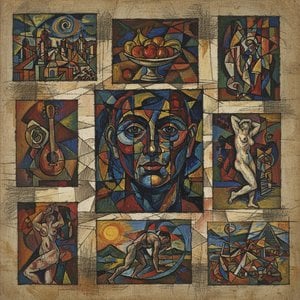
Kuniyoshi’s early artistic explorations were deeply influenced by the burgeoning Cubist movement sweeping across Europe. Paintings like “Little Joe with Cow” (1923) demonstrate a clear fascination with fragmented forms and tilted planes, yet even in these initial works, a distinctly Japanese sensibility began to emerge. He wasn't simply replicating Western styles; rather, he was synthesizing them with an inherent understanding of Japanese aesthetics – a preference for depicting idealized images over strict representational accuracy. A pivotal moment arrived after several trips to Paris in the late 1920s. Immersed in the heart of European modernism, Kuniyoshi shifted his approach, moving away from painting from memory towards direct observation and embracing perspective. This transition is evident in works like “Daily News” (1935), which showcases a newfound realism tempered by his signature poetic sensibility. Throughout his career, Kuniyoshi’s subject matter was diverse, ranging from intimate still lifes of everyday objects to evocative portraits of female circus performers and nudes. However, beneath the surface beauty often lay deeper currents – reflections on loneliness, alienation, and the complexities of modern life. His style evolved continuously, demonstrating a willingness to experiment with color, line, and composition, always striving for a visual language that was both innovative and deeply personal.Recognition Amidst Adversity: A Patriot’s Paradox
Despite facing prejudice as an immigrant and being classified as an “enemy alien” during World War II, Kuniyoshi achieved significant recognition throughout his career. In 1935, he was awarded a prestigious Guggenheim Fellowship, providing crucial financial support for his artistic endeavors. This acknowledgment solidified his position within the American art world. However, it was in 1948 that Kuniyoshi reached an unprecedented milestone: becoming the first living artist to have a retrospective exhibition at the Whitney Museum of American Art. This landmark event cemented his legacy as one of the most important artists of his generation. Further international acclaim followed with his inclusion in the Venice Biennale in 1952. Perhaps the most poignant aspect of Kuniyoshi’s story is his unwavering patriotism during wartime. Despite facing suspicion and discrimination, he dedicated himself to creating propaganda art for the United States government, using his artistic talents to denounce Japanese aggression and rally support for the American cause. This act of loyalty, born from a deep love for his adopted country, underscores the complex identity that defined Kuniyoshi’s life and work. He also served as an honorary member of the National Institute of Arts and Letters and president of Artists Equity, demonstrating his commitment to fostering a thriving artistic community.A Lasting Legacy: Bridging East and West
Yasuo Kuniyoshi's historical significance extends far beyond his individual achievements. He stands as a pivotal figure in bridging Eastern and Western art traditions, seamlessly blending Japanese aesthetics with the innovations of European modernism. His work challenged conventional notions of identity and belonging, resonating deeply within the context of American immigration history. He mentored numerous artists, including Nan Lurie and Irene Krugman, nurturing the next generation of creative talent. In his later years, as he battled cancer, Kuniyoshi returned to his Japanese roots, embracing the simplicity and expressiveness of sumi-e ink drawings. This final artistic phase served as a poignant reflection on his life’s journey – a testament to the enduring power of cultural heritage. Though he passed away in 1953, Kuniyoshi's influence continues to be felt today. Recent exhibitions and scholarly research have sparked a renewed appreciation for his contributions, solidifying his place within the canon of 20th-century American art. His story serves as a powerful reminder that artistic innovation often arises from the intersection of cultures, and that true patriotism transcends national boundaries.Key Themes in Kuniyoshi’s Oeuvre
- Still Life: Frequent depictions of everyday objects imbued with symbolic meaning.
- Figurative Work: Evocative portraits, particularly of women – often circus performers or nudes – exploring themes of vulnerability and isolation.
- War & Propaganda: Powerful wartime imagery reflecting his commitment to the United States despite facing discrimination.
- Japanese Influence: Subtle yet pervasive elements of Japanese aesthetics, including composition, color palettes, and a preference for idealized forms.
- Identity & Belonging: Exploration of the complexities of being an immigrant navigating cultural boundaries and societal expectations.