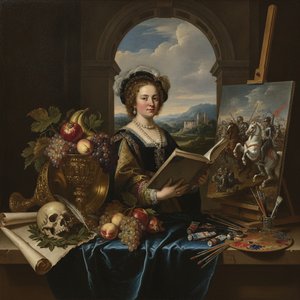
A Legacy Carved in Color and Line
In the vibrant heart of the Flemish Baroque era, Jan The Younger Brueghel emerged as a master of detail, carrying forward a profound artistic lineage that shaped the visual language of the Habsburg Netherlands. As the son of Jan Brueghel the Elder and the grandson of the legendary Pieter Bruegel the Elder, his very existence was intertwined with the evolution of Renaissance and Baroque painting. Taking command of his father's workshop at an early age, he did not merely inherit a studio; he inherited a tradition of meticulous observation and storytelling that allowed him to become an independent force in Antwerp.
His early years were spent immersed in the rich textures of his family's workshop, where the boundaries between generations often blurred. While much of his early repertoire mirrored the subjects established by his father, he possessed a unique ability to breathe new life into classical and religious themes. His work often served as a bridge between the intricate, almost microscopic precision of the previous century and the more dramatic, emotive qualities of the Baroque period. Through his brush, the delicate beauty of nature and the grand narratives of myth were rendered with an unparalleled clarity.
The Mastery of Nature and Myth
The artistry of Jan The Younger Brueghel is perhaps most captivating in his ability to weave together the terrestrial and the divine. He possessed a remarkable gift for still-life composition, where every petal and leaf seemed to pulse with life. In works such as Still-Life of the Holy Kinship, one can witness his extraordinary command over color and light; he arranged roses, lilies, and tulips in intricate borders that framed sacred figures, using a striking contrast between vibrant hues and dark backgrounds to create a sense of profound depth. This technique did more than showcase botanical accuracy; it imbued the natural world with a layer of spiritual symbolism.
Beyond the floral, his talent extended into the realm of mythological storytelling. He had a profound capacity to capture the tension of classical legends, such as in Venus at the Forge of Vulcan. In these compositions, he balanced the rugged, industrial atmosphere of a workshop with the luminous, ethereal grace of the goddess herself. Whether depicting the lush, wild landscapes of Paradise with the Fall of Man or the dark, infernal vistas inspired by the works of his predecessors, Jan The Younger Brueghel utilized a sophisticated palette to guide the viewer's eye through complex, multi-layered narratives.
Artistic Influence and Historical Resonance
The significance of Jan The Younger Brueghel lies in his role as a custodian of Flemish excellence. While he was deeply influenced by the "hell landscapes" of his father and the earlier inspirations of Hieronymus Bosch, he was not a mere imitator. He navigated the transition of styles with grace, maintaining the technical rigor of the Brueghel tradition while embracing the burgeoning complexity of 17th-century art. His ability to sustain the workshop's prestige ensured that the stylistic hallmarks of his family remained at the forefront of European painting.
Today, his contributions are recognized through the presence of his works in some of the world's most esteemed institutions, including the Getty Museum and the Museo del Prado. His legacy is defined by:
- Technical Precision: An unwavering commitment to detail in both botanical still-lifes and complex mythological scenes.
- Lineage and Continuity: The successful stewardship of one of the most important artistic workshops in Antwerp.
- Symbolic Depth: The seamless integration of natural beauty with religious and classical allegory.