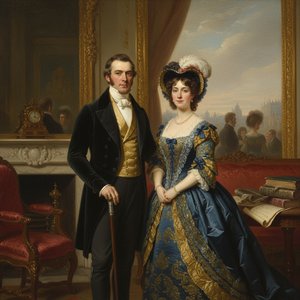
William Shiels: Bridging the Victorian Era Through Portraiture and Artistic Patronage
William Shiels (1785-1857) stands as a significant, yet often understated, figure in 19th-century British art. More than simply a portrait painter, he was a pivotal director of the South Carolina Academy of Fine Arts, a role that shaped the artistic landscape of early American art institutions and provided a platform for emerging talent. His career spanned several decades, marked by a dedication to capturing distinguished figures – from nobility and politicians to prominent members of society – and a quiet but consistent contribution to the evolving aesthetic sensibilities of his time.
Born in Maghera, County Londonderry, Ireland, Shiels’ early life was steeped in Presbyterian traditions. He arrived in Melbourne, Australia, as a young child in 1853, an experience that profoundly influenced his artistic perspective and likely informed the nuanced portrayals of character he would later develop. He received a solid education, graduating from Scotch College and the University of Melbourne with degrees in law and arts, demonstrating a breadth of intellectual curiosity alongside his burgeoning artistic talent. His legal training, surprisingly, provided a grounding in observation and detail – skills that translated directly to his meticulous portraiture.
A Career Defined by Patronage and Artistic Direction
Shiels’ career trajectory reveals a fascinating interplay between independent practice and institutional leadership. Initially, he established himself as a portrait painter, gaining recognition for his ability to capture the essence of his subjects – their personalities, social standing, and even subtle emotional states. His work frequently featured gentlemen engaged in conversation, often within domestic settings or reflecting on shared experiences, indicative of a keen interest in human interaction and psychological depth. He exhibited at both the Royal Academy in London and the American Academy in New York City, showcasing his versatility and establishing a network of contacts crucial to his professional development.
However, Shiels’ most enduring legacy lies in his tenure as director of the South Carolina Academy of Fine Arts from 1821 to 1822. This role was far more than simply administrative; it represented a deliberate effort to cultivate artistic talent within the burgeoning American South. He actively sought out promising young artists, providing them with opportunities for training and exhibition – effectively laying the groundwork for future generations of Southern painters. His commitment to fostering artistic growth demonstrates a rare blend of entrepreneurial spirit and genuine dedication to the advancement of art.
Style and Influences: A Blend of Neo-Classicism and Romanticism
Shiels’ style is often described as a sophisticated synthesis of neo-classical restraint and romantic sensibility. His portraits are characterized by careful attention to detail, precise draughtsmanship, and an understated elegance. He skillfully employed light and shadow to create a sense of depth and atmosphere, capturing not just the physical likeness of his subjects but also their inner character. While influenced by the prevailing academic traditions of portraiture, Shiels’ work possesses a subtle emotional resonance that distinguishes it from purely formal representations.
The influence of British artists like Sir Thomas Lawrence, known for his idealized portraits of royalty and nobility, is evident in Shiels' compositions and techniques. However, he also incorporated elements of Romanticism – particularly the emphasis on capturing fleeting emotions and the beauty of nature – into his work. This fusion resulted in a distinctive style that resonated with the tastes of the Victorian era.
Legacy and Historical Significance
Despite not achieving widespread fame during his lifetime, William Shiels’ contributions to the development of American art are considerable. His role as director of the South Carolina Academy of Fine Arts was particularly significant, providing a vital platform for artistic education and exhibition in a region where opportunities were limited. His portraits offer valuable insights into the social and cultural dynamics of 19th-century Britain and America, capturing the personalities and aspirations of a diverse range of individuals.
Today, Shiels’ work is appreciated for its technical skill, understated elegance, and subtle psychological depth. His legacy endures through his influence on subsequent generations of artists and his enduring contribution to the rich tapestry of American art history. Further research into his life and works continues to illuminate the complexities of this often-overlooked figure.