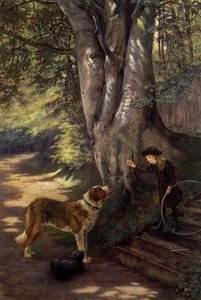
William Biscombe Gardner: A Painter of English Life
William Biscombe Gardner, a name perhaps less familiar than some of his contemporaries, nevertheless holds a significant place in 19th-centuryBritish art. Born in Tunbridge Wells, Kent, in 1847, he was not merely a painter; he was a meticulous observer and recorder of rural England, capturing the rhythms of agricultural life and the dignity of labor with remarkable detail and a subtle social commentary. His career spanned several decades, marked by both artistic refinement and a deep commitment to the craft of wood-engraving, a skill that elevated his work beyond simple illustration and into the realm of fine art.
Gardner’s early influences were rooted in the Pre-Raphaelite movement, evident in his meticulous attention to detail and his interest in depicting scenes from literature and mythology. However, he quickly developed a distinct style, characterized by a precise realism combined with an understated emotional quality. He wasn't interested in grand narratives or dramatic gestures; instead, he focused on the quiet moments of everyday life – farmers tending their fields, shepherds guiding their flocks, women drawing water from wells. These seemingly mundane subjects were imbued with a sense of dignity and beauty, reflecting Gardner’s belief in the inherent worth of rural England and its people. His work frequently featured light and shadow, creating a rich tapestry of textures and tones that brought his scenes to life.
A pivotal moment in Gardner's artistic journey was his embrace of wood-engraving. Initially trained as an artist, he recognized the potential of this technique to achieve a level of detail and tonal subtlety previously unattainable with oil paint. He became a master craftsman, meticulously carving intricate designs onto blocks of wood, ensuring that each line and shade translated faithfully into the printed image. This dedication to his craft earned him considerable respect within the engraving community, and he was widely regarded as one of the foremost practitioners of the art form in Britain. His engravings were published in prestigious magazines such as *The Illustrated London News* and *The Magazine of Art*, reaching a vast audience and contributing significantly to the popularization of rural British life. He wasn’t simply reproducing images; he was imbuing them with his own artistic vision, transforming illustrations into miniature works of art.
Gardner's subject matter often reflected his deep connection to Kent and its surrounding countryside. He produced a series of celebrated watercolors depicting the region’s landscapes and rural communities, capturing the essence of the area’s distinctive character. His work during this period is particularly notable for its meticulous observation of detail – from the texture of weathered stone walls to the patterns in a farmer's clothing. Beyond Kent, he also produced evocative images of Canterbury, The Peak Country, and even scenes from Wales, documenting diverse aspects of British life with equal skill and sensitivity. His series "The Garden of England" is particularly renowned for its celebration of Kent’s agricultural heritage.
Despite his considerable success as a painter and engraver, Gardner remained largely unsung during his lifetime. He was a private man who shunned publicity, preferring to dedicate himself entirely to his art. However, in retrospect, his contribution to British art has been increasingly recognized. His meticulous realism, combined with his subtle social commentary and his mastery of wood-engraving, make him a significant figure in the history of 19th-centuryBritish painting. His work offers a poignant glimpse into a disappearing world – a world of rural traditions, agricultural labor, and close-knit communities – reminding us of the beauty and dignity that can be found in the simplest aspects of everyday life. His legacy endures through his evocative paintings and engravings, continuing to captivate viewers with their quiet power and understated elegance.
Key Works & Notable Achievements
Mending The Nets, Hastings (1887): A quintessential example of Gardner’s meticulous realism, depicting a group of fishermen repairing their nets on the beach. This work exemplifies his ability to capture the details of rural life with remarkable precision and sensitivity.
Apple Blossom (c. 1880): A delicate watercolor capturing the beauty of a blossoming orchard, showcasing Gardner’s mastery of color and light.
Derbyshire Series (1927): A comprehensive collection of watercolors documenting the landscapes and rural communities of Derbyshire, demonstrating his versatility as an artist and his deep appreciation for the natural world.
Kent Water-colours (1906): A series of paintings celebrating Kent’s agricultural heritage, showcasing Gardner's ability to capture the essence of the region’s distinctive character.
Legacy and Historical Significance
Gardner’s influence extends beyond his individual works. His dedication to wood-engraving helped to elevate the medium to a respected art form, influencing generations of artists and illustrators. His meticulous attention to detail and his subtle social commentary paved the way for later Realist painters and Social Realists. He stands as a testament to the power of observation and the importance of documenting the everyday lives of ordinary people. His work serves as a valuable historical record of rural England in the late 19th century, offering insights into the traditions, customs, and values of a bygone era. His legacy continues to inspire artists today who seek to capture the beauty and dignity of the natural world and the human experience.
Explore the captivating world of Benjamin Williams Leader's Victorian genre paintings. Discover his mastery of naturalism, social commentary & lasting influence on British art. Expert insights at ArtsDot.