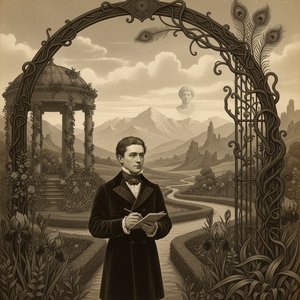
The Mechanical Visionary: The Life and Legacy of William Savage Cooper
In the heart of the Victorian era, a period defined by the rhythmic pulse of steam engines and the rapid expansion of industrial ingenuity, there emerged a figure who bridged the gap between cold iron and ethereal beauty. William Savage Cooper, born circa 1860 in the industrious town of Kings Lynn, Norfolk, was far more than a mere engineer; he was a pioneer of a unique aesthetic movement that transformed the mechanical landscape of amusement parks across Europe and America. Raised in a household shaped by the maritime traditions of his father, a skilled shipwright, Cooper developed an early, profound intimacy with the principles of craftsmanship and structural integrity. This foundation in the physical world provided the essential scaffolding upon which he would later drape his most imaginative artistic visions.
Cooper’s professional journey began within the disciplined realm of locomotive design, where the precision of mathematics and the necessity of functional excellence were paramount. However, his spirit could not be contained by purely utilitarian pursuits. As he transitioned into the burgeoning field of fairground machinery fabrication, he began to infuse the heavy, clanking components of carousels and steam-driven attractions with a sense of profound wonder. He saw in the rotating gears and pistons an opportunity for storytelling, treating every piece of moving machinery as a canvas for decorative splendor. His work became a hallmark of Victorian engineering aesthetics, where the strength of steel met the delicate intricacy of fine art.
A Symphony of Steel and Symbolism
What truly distinguished Cooper from his contemporaries was his ability to weave diverse cultural threads into the very fabric of his mechanical creations. While many engineers focused solely on the efficiency of a steam engine or the stability of a carousel, Cooper looked toward the horizon of human imagination. His designs were often imbued with a rich tapestry of symbolic imagery, drawing deeply from Celtic mythology, the soaring verticality of Gothic architecture, and the exotic allure of Oriental art traditions. This eclectic approach allowed him to create sculptures and embellishments that felt both ancient and cutting-edge.
His artistic output often featured fantastical creatures and stylized landscapes that seemed to dance alongside the machinery they adorned. To witness a Cooper-designed attraction was to experience a sensory overload where the boundaries between reality and fantasy blurred. His ability to manipulate form—creating figures that felt alive even in their stationary, sculpted states—elevated fairground artistry from mere entertainment to a sophisticated form of public sculpture. This mastery of decorative embellishment ensured that his work did not just serve a function but also captivated the collective imagination of the masses, turning every carnival visit into an encounter with the sublime.
The Enduring Impression of a Master Craftsman
The historical significance of William Savage Cooper lies in his role as a bridge between the Industrial Revolution and the birth of modern popular culture. He understood that for technology to truly capture the human heart, it required a soul—a layer of beauty that spoke to the universal desire for magic and escape. His legacy is etched into the very history of amusement design, influencing generations of makers who sought to balance technical prowess with aesthetic grace.
Though the era of steam-driven wonders has passed, the echoes of his creativity remain visible in the enduring charm of classical fairground art. His achievements can be summarized through several key pillars of his career:
- Innovation in Engineering: Pushing the boundaries of locomotive and carousel construction through advanced mechanical design.
- Aesthetic Integration: Successfully blending technical functionality with complex, symbolic ornamentation.
- Cultural Synthesis: Merging diverse artistic influences, from Gothic to Orientalist styles, into a singular, cohesive vision.
- Global Impact: Shaping the visual and experiential landscape of amusement parks across both Europe and the Americas.
Today, as we look back upon the works of Cooper, we see more than just relics of a bygone age; we see the fingerprints of a man who believed that even the most powerful machine deserved to be beautiful. His life remains a testament to the idea that true progress is found when the precision of the mind meets the boundless passion of the artist.