Early Life & Family Legacy
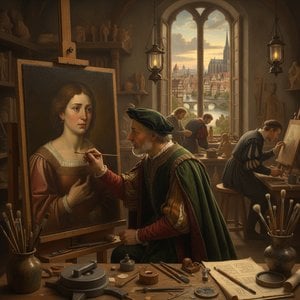
Wenzel Jamnitzer (circa 1507 – December 19, 1585) emerged from a distinguished Moravian German family known for its artistic endeavors under various spellings—Jamnitzer, Jemniczer, Gemniczer, and Jamitzer. This lineage spanned over 160 years, producing remarkable artworks characterized by refined craftsmanship and stylistic innovation. Born in Vienna, Italy, Wenzel was the son of Hans Jamnitzer the Elder, a goldsmith who established a tradition of excellence that would continue through subsequent generations. His brother, Albrecht Jamnitzer, further solidified this family’s artistic reputation, shaping Wenzel's formative years within an environment steeped in artistic heritage.Training & Artistic Foundations
Wenzel’s artistic education commenced under the tutelage of his father and brother. This rigorous training instilled in him a profound understanding of goldsmithing techniques—a craft that demanded precision, artistry, and meticulous attention to detail. Notably, he studied alongside Euclid's Elements and Plato’s Timaeus, texts considered foundational for geometric reasoning and philosophical contemplation – influences that would profoundly shape his later artistic pursuits.Career as Court Goldsmith & Scientific Pursuits
Jamnitzer swiftly ascended to prominence in Nuremberg, securing positions as court goldsmith to several Holy Roman Emperors—Charles V, Ferdinand I, Maximilian II, and Rudolf II. This role afforded him unparalleled access to imperial patronage and enabled him to contribute significantly to the artistic landscape of his time. Beyond royal commissions, Jamnitzer demonstrated a remarkable commitment to advancing the guild’s knowledge base. His publication of “Perspectiva Corporum Regularium” in 1568 stands as a testament to this dedication—a groundbreaking treatise that meticulously documented the construction and properties of polyhedra using geometric principles.Notable Achievements & Artistic Style
Jamnitzer’s artistic style embodied the Northern Mannerist movement, characterized by its elegance, restraint, and intellectual depth. He skillfully blended Renaissance influences with innovative techniques—incorporating hardstones, shells, corals, and small birds' eggs into his sculptures and jewelry boxes. His magnum opus, arguably, was the Nautilus Cup (1550), a breathtaking golden sculpture depicting a rooster in exquisite detail, reflecting the grandeur of the Renaissance aesthetic. Furthermore, he served as coin die-cutter for Nuremberg and later as master of the city mint.Legacy & Recognition
Wenzel Jamnitzer’s influence extended beyond his own lifetime. He collaborated with Johann Gregor van der Schardt on sculptural projects, leaving an indelible mark on Nuremberg's artistic milieu. His tomb in St. John’s Cemetery is adorned with a bronze sculpture by Jost Amman, commemorating his life and achievements—a poignant reminder of a master craftsman whose legacy continues to inspire admiration for centuries.질의응답
Wenzel Jamnitzer의 작품들은 어떤 분위기를 담고 있나요?
Wenzel Jamnitzer의 무드 룸는 작가의 작품들을 분위기별로 모아볼 수 있는 페이지입니다.
Wenzel Jamnitzer의 출생 도시와 국가는 어디인가요?
Wenzel Jamnitzer은(는) Italy의 Vienna에서 태어났습니다.
특정 매체로 분류된 Wenzel Jamnitzer의 모든 작품을 어떻게 찾을 수 있나요?
모든 매체 페이지에서는 Wenzel Jamnitzer의 작품을 기법별로 모아볼 수 있습니다.