A Life Immersed in Abstraction: The Journey of Theodoros Stamos
Theodoros Stamos, a pivotal figure in the evolution of American
Abstract Expressionism, occupies a unique space within the canon of 20th-century art. Born on December 31, 1922, in
New York City to Greek immigrant parents – his mother from Sparta, his father from Lefkada – Stamos’s artistic trajectory was shaped by both his heritage and the vibrant energy of a burgeoning
American art scene. He wasn't merely *present* at the birth of
Abstract Expressionism; he embodied its restless spirit of experimentation and its profound search for new visual languages. From humble beginnings, working various jobs to support his artistic pursuits – printer, florist, hat-blocker, book salesman – Stamos immersed himself in a world where art was not just creation but a vital force of cultural change. His early exposure to European avant-garde artists like
Arshile Gorky and
Fernand Léger through connections made during these formative years proved invaluable, seeding his artistic imagination with possibilities beyond the traditional. A scholarship to the American Artists School in 1936 marked a turning point, where he initially focused on sculpture before gravitating towards painting, a medium that would ultimately become his defining voice. The mentorship of
Joseph Solman, a member of “The Ten,” was crucial, opening doors to the influential An American Place Gallery and the works of
Arthur Dove and
Georgia O’Keeffe – artists who profoundly impacted Stamos's early aesthetic development.
From Biomorphic Beginnings to Fields of Color
Stamos’s artistic journey wasn’t a sudden leap into abstraction but rather a gradual unfolding, marked by distinct phases of exploration. His earliest works, emerging in the 1940s, were characterized by
muted earth tones and biomorphic imagery – forms suggestive of geological shapes or organic life. These paintings reflected an early fascination with
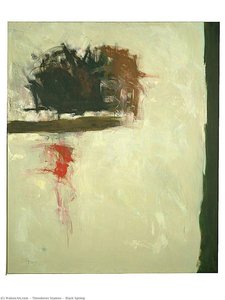
natural history and a desire to tap into primal visual languages. This period laid the groundwork for his later explorations, demonstrating a sensitivity to form and texture that would remain central to his practice. Around 1950, Stamos embarked on the *Tea House Series*, a captivating body of work inspired by East Asian aesthetics. These paintings showcased softly defined
geometric forms overlaid with dark calligraphic brushwork, creating an atmosphere of serene contemplation. This series revealed a willingness to embrace
minimalism and explore the expressive potential of line and space. However, it was in the 1950s onwards that Stamos truly found his signature style:
Color Field painting. Increasingly focused on reductive compositions, he employed layers of thin pigment to create depth within broad expanses of color. These weren’t simply paintings *of* color; they were immersive experiences *in* color, inviting viewers to lose themselves in the subtle nuances and emotional resonance of hue and tone. The culmination of this exploration arrived with the *Infinity Field Series*, beginning in 1971. Characterized by vast areas of color delineated by slim lines or shapes, these paintings evoked a meditative and expansive feeling, suggesting limitless space and boundless possibility. Within this series, the *Lefkada* sub-series held particular significance, drawing direct inspiration from his ancestral homeland and reflecting a deep connection to place and memory.
Influences and Affiliations: A Network of Artistic Exchange
Stamos’s artistic development wasn't solely an individual pursuit; it was deeply intertwined with the intellectual and creative currents of his time, shaped by key relationships and influences. His exposure to
Alfred Stieglitz’s gallery fostered a profound appreciation for
modern art and its radical potential. The works of
Arthur Dove and
Georgia O’Keeffe served as early touchstones, guiding his exploration of abstraction and
organic form. Perhaps most significantly, Stamos forged close friendships with
Barnett Newman and
Mark Rothko, sharing a common interest in primitive imagery and the spiritual dimensions of art. These relationships were characterized by mutual support, critical dialogue, and a shared commitment to pushing the boundaries of artistic expression. The influence of East Asian aesthetics, particularly Zen Buddhism and calligraphy, is evident in his *Tea House Series*, demonstrating an openness to non-Western traditions and their minimalist principles. Furthermore, Stamos’s participation as one of “The Irascibles” – a group of
Abstract Expressionist painters who publicly protested the
Metropolitan Museum of Art's conservative policies towards
American painting in 1950 – solidified his place within the movement and underscored his commitment to artistic independence. This act of defiance was not merely a political statement; it was a declaration of the importance of
abstract art as a vital force in contemporary culture.
Legacy and Historical Significance: A Bridge Between Generations
Theodoros Stamos stands as a crucial link between the early pioneers and later developments within
Abstract Expressionism. He wasn’t simply an imitator of his contemporaries; he forged his own distinct path, bridging the gap between biomorphic forms and expansive
color field explorations. His work contributed significantly to the evolution of
abstract art in America, demonstrating a continuous refinement of form and a deepening exploration of color's expressive power. Despite facing challenges later in life, including involvement in the
Rothko estate controversy, Stamos’s artistic contributions continue to be celebrated for their subtle beauty and meditative qualities. He left an enduring impact on subsequent generations of artists through his dedicated teaching career at institutions like the Art Students League.
His paintings are not merely objects to be viewed; they are invitations to experience a world beyond representation, a realm of pure sensation and emotional resonance. Stamos’s legacy lies in his ability to create works that are both intellectually rigorous and deeply moving – testaments to the power of abstraction to evoke profound human experiences.
He remains a vital voice in the ongoing conversation about the nature of art and its capacity to transform our perception of the world.