The Formative Years in Yerevan
Ruben Adalyan emerged from the academic traditions of Yerevan, refining his craft at the Institute of Fine Arts and Theater before graduating in 1956. His early years were shaped by a rigorous training that provided a foundation for much more radical explorations later in life. While the era demanded adherence to certain ideological frameworks, Adalyan looked toward the trajectories of Pablo Picasso and Yervand Kochar to find a different path. He sought a visual language that moved beyond the surface of reality.
During the 1960s, amidst the cultural shifts of the Khrushchevian Thaw, he began to present works that intentionally diverged from the prevailing socialist-realist expectations. His practice was not limited to a single medium; he moved between painting, drawing, printmaking, and sculpture with a consistent curiosity about form. These early experiments in abstraction were often kept within intimate artistic circles, away from the broader public eye.
A Synthesis of Style and Substance
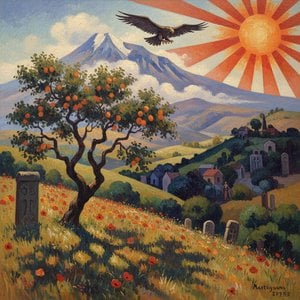
The work of Adalyan is characterized by a complex layering of influences, where classical technique meets the fragmented logic of modernism. He developed a method that fused elements of surrealism, cubism, and expressionism to create works with significant psychological depth. His compositions often utilized symbolism to communicate ideas that were difficult to express through literal representation. This approach allowed him to navigate the tension between personal subjectivity and the external pressures of the Soviet era.
In his later years, particularly between 1985 and 1988, his focus shifted toward the medium of photocollage. Using found photographs and magazine cut-outs, he constructed chaotic, saturated images that reflected a changing world. These pieces dealt with several specific themes:
- The socio-political shifts of the late Soviet era.
- The impact of Mikhail Gorbachev’s Perestroika.
- The visible degradation of historical narratives and ideologies.
- The transition toward a consumer-driven culture.
A Legacy in Collections
Adalyan continued to produce work well into the 21st century, with completed pieces dating as late as 2019. His career spanned the transition from the post-war decades through the collapse of the USSR and into the era of Armenian independence. This long arc allowed him to witness and document the erosion of certain cultural certainties through his art.
His contributions are preserved in several significant institutions, ensuring that his investigations into form and history remain accessible to scholars and the public. Notable repositories for his work include:
- The National Gallery of Armenia, Yerevan.
- The Museum of Modern Art, Yerevan.
- The Zimmerli Art Museum at Rutgers University.