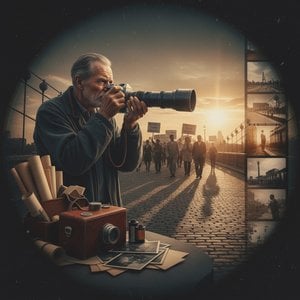
The Lens of Legacy: The Life and Vision of Roland L. Freeman
To look through the lens of Roland L. Freeman was to witness the heartbeat of the American South, captured in a delicate balance of light, shadow, and profound human dignity. Born in Baltimore in 1936, Freeman did not merely observe the world; he documented its soul. His journey as a photographer and documentarian was defined by an unwavering commitment to visual storytelling, acting as a vital bridge between disappearing traditions and the modern consciousness. Through his camera, the ephemeral moments of folk culture—the rhythmic movement of a quilt being stitched or the weary but resilient gaze of a rural elder—were transformed into permanent historical testimonies.
Freeman’s artistic sensibilities were forged in the crucible of mid-century social consciousness. As a young man, he found himself deeply moved by the evocative imagery of Gordon Parks and Roy DeCarava, masters who utilized photography to illuminate the complexities of the Black experience and advocate for social justice. This lineage of purposeful, documentary-style photography became the foundation of his practice. His vision was further enriched by the literary magic of Zora Neale Hurston; meeting her at the age of fourteen left an indelible mark on his psyche, instilling in him a narrative depth that allowed him to approach his subjects not just as figures in a frame, but as characters in a much larger, unfolding epic of American life.
A Journey Through Tradition and Resistance
The trajectory of Freeman’s career is inseparable from the historical movements that shaped the twentieth century. His work often placed him at the epicenter of cultural preservation and civil rights struggle. One of his most significant contributions was his involvement with the Mississippi Folklife Project for the Smithsonian Institution’s Center for National Folklife and Cultural Heritage. In the rural landscapes of Mississippi, Freeman became a meticulous chronicler of heritage, capturing the intricate artistry of African American quilters and the quiet strength of community elders. His photographs from this era serve as more than mere documentation; they are vibrant, breathing archives of a way of life that faced constant pressure from the tides of modernization.
Beyond the preservation of folkways, Freeman’s lens captured the raw energy of political resistance. He was present for the "Mule Train" march, a powerful symbolic journey from Mississippi to Washington D.C., documenting the solidarity and perseverance of those fighting for equality during the Civil Rights Movement. His ability to navigate both the intimate spaces of domestic artistry and the expansive stages of national protest allowed him to create a holistic portrait of Black life in America. Whether working as a stringer for Time or Magnum Photos, or capturing the dignified presence of figures within the White House, Freeman maintained a consistent focus on the humanity that resides within every social stratum.
A Lasting Impression on Visual Anthropology
The significance of Roland L. Freeman lies in his role as a visual anthropologist, an artist who understood that to photograph a culture is to participate in its survival. His work, such as The Arabbers of Baltimore, brought light to the often-overlooked labor of street vendors and their horse-drawn carts, celebrating the grit and character of his hometown. By documenting the intersection of art, struggle, and community, he ensured that the stories of the marginalized were etched into the collective memory of the nation.
As we reflect on his life, which concluded in 2023, his achievements stand as a testament to the power of the empathetic gaze. His legacy is found in:
- The Preservation of Artistry: His profound documentation of African American quilting traditions, ensuring these textile masterpieces are recognized as high art.
- Social Documentation: His vital role in recording the milestones of the Civil Rights Movement and the Poor People's Campaign.
- Cultural Leadership: His tenure as president of The Group for Cultural Documentation, where he championed the importance of community-based visual archives.
Freeman’s life work remains a profound reminder that photography is not merely about capturing what is seen, but about honoring what is felt, remembered, and endured.