Odilon Redon (1840-1916): Between Shadow and Light
Odilon Redon, born Bertrand Jean Redon in Bordeaux, France, on April 20, 1840, was an artist whose profound engagement with the unseen realms of imagination solidified his place as a cornerstone of Symbolism—a movement that anticipated the Surrealist explorations of the subconscious decades later. His artistic journey began not with grand ambition but with quiet observation; at just ten years old he won a drawing prize—a foreshadowing of the visual sensitivity that would permeate his entire life’s work. Though familial expectations initially steered him toward architecture, Redon's true vocation blossomed amidst instruction from Jean-Léon Gérôme and Rodolphe Bresdin, who honed his skills in etching and lithography – techniques he embraced wholeheartedly, allowing him to translate inner anxieties into evocative visual forms. The disruption of the Franco-Prussian War briefly compelled him into military service, yet it was upon his return to Paris that Redon’s artistic vision truly crystallized.Early Life & Artistic Foundations
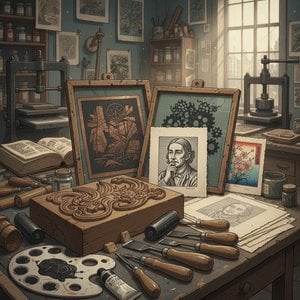
Redon's formative years were marked by a deliberate rejection of academic realism. He wasn’t attempting to faithfully reproduce the observable world; rather, he sought to evoke its hidden currents—the fears, desires, and spiritual yearnings that resided beneath the surface of everyday experience. This conviction fueled his pioneering exploration of “noirs”—monochromatic prints executed in charcoal and lithography – a stylistic choice that distinguished him from his contemporaries and established him as a herald of Symbolism’s distinctive aesthetic. These weren't merely studies in darkness; they were meditations on the subconscious, populated by unsettling creatures—often reminiscent of biblical figures or grotesque hybrids—disembodied eyes gazing out from swirling mists, and haunting forms emerging from desolate landscapes. The influence of writers like Edgar Allan Poe and Charles Baudelaire is palpable here – a shared fascination with the macabre, the mysterious, and the suggestive power of art to unsettle viewers. Redon’s early artistic training included lessons with Stanislas Gorin, who instilled in him an appreciation for the works of Millet, Corot, and Gustave Moreau—artists whose landscapes and depictions of rural life served as inspiration for his own compositions. Crucially, Rodolphe Bresdin imparted invaluable knowledge of etching techniques, equipping Redon with a tool to express his inner vision on stone.The Birth of Symbolism & “Noirs”: Exploring the Unseen
Redon’s artistic breakthrough arrived in 1879 with the publication of *Dans le rêve* (In the Dream)—his debut album of lithographs—a bold declaration of intent to depict not what was visible but what lay beneath. These prints, executed entirely in monochrome, captivated audiences and established Redon as a champion of Symbolism’s core tenets: emotional intensity, psychological depth, and an engagement with mythic and spiritual themes. The series showcased Redon's mastery of tonal gradation—creating dramatic contrasts between light and shadow to heighten the expressive power of his imagery. Recurring motifs—such as the “eye balloon”—became emblems of his artistic vision, embodying a preoccupation with the gaze—both literal and metaphorical—and its role in perceiving reality. Furthermore, Redon’s fascination with Eastern philosophies and religions – particularly Buddhism – profoundly shaped his worldview and informed his artistic explorations. He meticulously studied landscapes and botanical specimens, seeking to capture the essence of nature through precise observation and rendering.Expanding Horizons: Color & Influence
The latter half of Redon's career witnessed a gradual shift toward incorporating color—primarily pastel and oil paints—into his oeuvre. This stylistic evolution reflected not merely an aesthetic preference but also a deepening engagement with contemporary artistic currents, notably Impressionism and Japonism. Artists like Claude Monet and Vincent van Gogh exerted considerable influence on Redon’s palette and compositional techniques – he adopted Impressionistic brushstrokes to convey fleeting moments of beauty and luminosity while simultaneously incorporating decorative patterns inspired by Japanese prints. Notably, Redon's work gained recognition in 1878 with *Guardian Spirit of the Waters*, a monumental lithograph depicting a serene seascape dominated by an enigmatic head—a motif that would recur throughout his artistic life. He exhibited prominently at the Salon des Beaux-Arts in Paris and was awarded the Legion of Honor in 1903, cementing his reputation as one of France’s most distinguished artists. His popularity soared during the Armory Show of 1913 in New York City—where André Mellerio published *Odilon Redon: Peintre Dessinateur et Graveur*, presenting a comprehensive overview of his artistic output and solidifying his legacy as a precursor to Surrealism.Legacy & Enduring Significance
Redon’s profound impact on subsequent generations of artists is undeniable. His unwavering commitment to exploring the subconscious—expressed through unsettling imagery and evocative tonal palettes—inspired Surrealist painters like René Magritte and Salvador Dalí. He championed the notion that art should transcend mere representation, prioritizing emotional resonance and psychological insight above all else. Redon’s artistic vision continues to captivate audiences today—a testament to his enduring ability to communicate universal themes of fear, beauty, and spirituality through a uniquely expressive visual language. His exploration of dreams and mythology remains remarkably relevant in our contemporary culture, reminding us that true art possesses the capacity to illuminate hidden dimensions of human experience.질의응답
오디론 레논 작가의 출신 국가는 어디인가요?
오디론 레논은(는) 프랑스에서 태어났습니다.
특정 주제에 따른 오디론 레논의 작품을 어떻게 찾을 수 있나요?
오디론 레논의 작품은 아티스트의 키워드별로 페이지에서 키워드별로 찾아보실 수 있습니다. 각 키워드는 관련 작품들을 그룹화하여 보여줍니다.
오디론 레논의 출생지와 출생 연도는 언제인가요?
오디론 레논은(는) 1840년 보르도에서 태어났습니다.
미술 사조별로 분류된 오디론 레논의 작품은 어디에서 볼 수 있나요?
오디론 레논 작가가 활동했던 예술 사조는 작품을 사조별로 분류하여 보여주는 작가의 모든 사조 페이지에서 확인하실 수 있습니다.
오디론 레논 작가의 작품을 감상할 수 있는 3D 가상 투어가 있나요?
가상 방문이 가능합니다: 오디론 레논의 3D 뮤지엄 페이지에서 작가의 작품들을 3D 갤러리를 통해 만나보실 수 있습니다.
오디론 레논 작가의 작품을 연도별로 어떻게 확인할 수 있나요?
오디론 레논의 작품 연표를 확인해 보세요: 작품 연대기 페이지에서 작품들을 제작 날짜순으로 보실 수 있습니다.
오디론 레논의 출생 도시와 국가는 어디인가요?
오디론 레논은(는) 프랑스의 보르도에서 태어났습니다.