Ni Yuanlu: A Master of Ming Dynasty Calligraphy and the Echoes of a Turbulent Era
Ni Yuanlu (c. 1593 – 1644), a name often whispered in the halls of Chinese art history, was more than simply a calligrapher and painter; he was a man inextricably linked to the tumultuous final years of the Ming Dynasty. Born Ni Wenzhong in Shangyu, Zhejiang province, his life unfolded against a backdrop of political upheaval, rebellion, and ultimately, tragic suicide – an event that imbued his work with a profound sense of melancholy and quiet dignity. His art, particularly his semicursive script style, offers a poignant window into the era’s anxieties and the artist's own complex character.
Ni’s early life was marked by rigorous study and imperial examinations. He quickly established himself as a skilled scholar and calligrapher, earning the courtesy name Yuru (玉汝) and the art name Hongbao (鴻寶). His training emphasized traditional techniques, but it was his willingness to experiment with form and expression that distinguished him. Unlike many of his contemporaries who adhered rigidly to established conventions, Ni developed a distinctive style characterized by its fluidity, dynamism, and subtle emotional depth. This wasn’t merely aesthetic; it reflected a growing dissatisfaction with the corruption and inefficiency within the Ming court – a sentiment he would later embody in his final act.
The Semicurative Script: A Reflection of Character
Ni Yuanlu's most celebrated achievement lies in his mastery of the semicursive script, or kaishu (楷書). This style, a hybrid between the rigid formality of traditional calligraphy and the looseness of cursive writing, allowed for both precision and expressive freedom. He employed a unique technique – holding the brush at an oblique angle – to create strokes that were simultaneously sharp and graceful, conveying a sense of controlled energy. His work is often described as “angular,” reflecting his personality and the turbulent times he inhabited. Unlike the smoother, more rounded styles favored by some other masters, Ni’s script possessed a certain tension, a feeling of contained force.
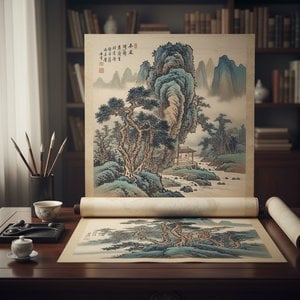
His paintings, frequently executed in monochrome ink wash (guohua), complemented this calligraphic style perfectly. He often depicted landscapes, birds, and flowers – subjects common to Chinese painting – but imbued them with a sense of quiet contemplation and subtle symbolism. A particularly striking example is “Cloud Rock,” where the dynamic brushstrokes capture the essence of a rocky outcrop against a vast expanse of sky, evoking both strength and vulnerability. Similarly, his inscription on a hanging scroll, "Poems in Cursive Script," demonstrates his ability to seamlessly blend calligraphy and painting, creating a unified artistic statement.
A Life Defined by Service and Disillusionment
Ni Yuanlu’s career was marked by a rise through the imperial bureaucracy. He served as a minister of revenue and lecturer to the emperor, gaining recognition for his intelligence and administrative skills. However, he became increasingly disillusioned with the corruption and decadence within the Ming court, particularly under the influence of the powerful eunuch Wei Zhongxian. He was a vocal critic of these abuses, advocating for reform and challenging the established order.
This opposition ultimately led to his tragic demise. As the rebel Li Zicheng seized Beijing in 1644, Ni Yuanlu, along with the emperor, chose to commit suicide rather than surrender to the enemy. This act of defiance – a refusal to compromise one’s principles – cemented his legacy as a symbol of integrity and resistance against tyranny. It's believed that this decision was driven by a deep sense of moral obligation and a profound disappointment in the state of affairs.
Legacy and Historical Significance
Despite his untimely death, Ni Yuanlu’s artistic legacy endures. His work is prized for its technical mastery, emotional depth, and unique stylistic innovations. He stands as a significant figure in Ming Dynasty art, representing a bridge between traditional techniques and a more expressive approach to calligraphy and painting. His life story – one of service, disillusionment, and ultimately, sacrifice – provides a powerful commentary on the political and social turmoil of his era.
Today, Ni Yuanlu’s works are housed in prestigious collections around the world, including the Metropolitan Museum of Art in New York and the Palace Museum in Beijing. His art continues to inspire artists and scholars alike, offering a glimpse into the soul of a man who sought to uphold his principles amidst a period of profound crisis.