A Life Etched in Maritime Detail: The World of Liverpool Gothic Scroll Artist
The name Liverpool Gothic Scroll Artist belies a fascinating and complex artistic journey, one rooted in the Victorian era’s fascination with history, naval power, and dramatic storytelling. While often referred to by this evocative title, the artist was born Henry John Charlton in 1849, in Bamburgh, Northumberland, into a family facing financial hardship. This early struggle shaped his path, initially diverting him from formal artistic training towards practical employment. However, even amidst these challenges, a passion for drawing, nurtured by his father from a tender age, refused to be extinguished. His formative years were marked by a blend of necessity and nascent talent – lessons at Dr. Sharp’s charity school followed by work as a bookstore clerk where he honed his skills copying the works of masters like Thomas Bewick. It was a period of quiet observation and self-directed learning, laying the groundwork for a distinctive style that would later captivate audiences.
From Newcastle Beginnings to London Recognition
Charlton’s artistic development truly began to accelerate in Newcastle upon Tyne. A pivotal moment arrived with encouragement from Joseph Crawhill, a respected illustrator who urged him to attend evening classes at the Newcastle School of Arts under William Bell Scott. This mentorship proved invaluable, fostering his reputation as a skilled painter of horses and dogs – subjects that garnered local commissions and provided crucial early support. Recognizing the limitations of regional opportunities, Charlton ventured south to London in 1874, seeking further education at the South Kensington Museum (now the Victoria and Albert Museum). He supplemented his studies by working as an illustrator for *The Graphic*, a prominent illustrated newspaper of the time. This experience exposed him to a wider audience and broadened his understanding of visual storytelling, particularly within the realm of military illustration. His debut at the Royal Academy in 1870 marked the beginning of a consistent presence, with contributions spanning over three decades until 1904 – a testament to his growing recognition and demand.
The Rise of a Military Chronicler
Charlton’s artistic focus gravitated towards historical and battle scenes, specifically those contemporary to his era. He possessed an exceptional ability to capture the grandeur and intensity of conflict with remarkable accuracy and dramatic flair. Paintings depicting events from the Peninsular War and the English Civil War became hallmarks of his oeuvre, showcasing meticulously researched details and a keen eye for composition. However, it was his ambitious undertaking to portray the Suakim Campaign of 1885 that truly cemented his reputation as a leading military artist. These works weren’t merely depictions of battles; they were immersive narratives, conveying the palpable atmosphere of conflict and the human cost of war. He didn't serve as an official war artist but captured the spirit of these events through extensive research and skillful execution.
A Legacy Forged in Gothic Detail
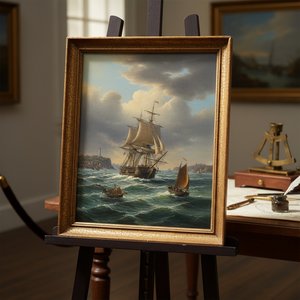
While celebrated for his military paintings, Charlton’s enduring legacy lies in a more nuanced aspect of his work: his pioneering role in what is now recognized as Maritime Gothic Art. This style, characterized by dramatic lighting, intricate scroll designs, and a romanticized depiction of naval life, emerged during the Victorian period's fascination with seafaring adventure and imperial power. His paintings often feature majestic sailing ships battling turbulent seas, evoking both awe and a sense of melancholy. The “Magellan” and “Gaboon” are prime examples – oil canvases rich in blues and details that transport viewers to another time, stirring feelings of nostalgia and adventure. This unique blend of realism and romanticism distinguishes his work, appealing to collectors seeking timeless elegance and evocative storytelling. He wasn’t simply painting ships; he was crafting visual poems about the sea, exploration, and the human spirit's resilience in the face of adversity.
Historical Significance and Enduring Appeal
John Charlton’s impact extends beyond the aesthetic qualities of his paintings. His work provides a valuable glimpse into Victorian society’s perception of war, naval power, and historical events. He captured not only the spectacle of battle but also the underlying anxieties and romantic ideals that shaped the era. The tragic loss of both his sons during World War One profoundly affected him, leading to poignant works reflecting personal grief and the devastating consequences of conflict. Though he lived a life marked by both artistic triumph and personal sorrow, Charlton left behind a body of work that continues to resonate with audiences today. His paintings are not merely historical documents; they are powerful expressions of human emotion, skillfully rendered in a style that embodies the drama and detail of the Victorian Gothic tradition – a legacy etched forever in maritime history.