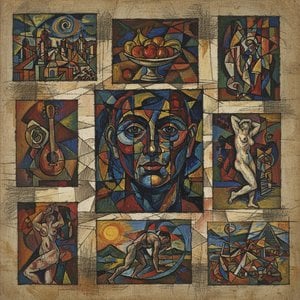
Lee Ki-young (born August 26, 1963) stands as a prominent figure in contemporary Korean art, recognized primarily for his innovative glass sculptures that explore themes of minimalism and the relationship between form and space. His artistic journey began with formal training at Hongik University’s College of Fine Arts, where he honed his skills in painting before transitioning to sculpture—a pivotal shift that profoundly shaped his distinctive style.
Early Influences: Lee Ki-young's formative years were marked by exposure to international art movements and avant-garde ideas, fostering a desire for experimentation beyond conventional artistic boundaries.
The Breakthrough Experience: A transformative encounter with Jean-Jacques Lévêque’s performance art—specifically the use of a live foal as a medium—awakened Lee Ki-young's awareness of corporeality within artistic expression. This experience spurred him to reconsider his approach and embrace new possibilities.
Signature Style: His signature style is characterized by meticulous craftsmanship, geometric precision, and an unwavering commitment to simplicity. He favors translucent materials like borosilicate glass, skillfully manipulating heat and pressure to achieve breathtaking visual effects.
Major Works & Artistic Philosophy
Lee Ki-young’s artistic philosophy centers on challenging perceptions of art and exploring its capacity to transcend traditional conventions. Inspired by minimalist aesthetics—particularly the works of artists like Donald Judd and Agnes Martin—he seeks to distill form into its purest essence, prioritizing spatial relationships over decorative embellishments. His sculptures often resemble crystalline structures or frozen landscapes, conveying a sense of stillness and contemplation.
"Ice" & "Vase": These iconic pieces exemplify Lee Ki-young’s mastery of glassblowing technique, resulting in ethereal forms that capture the beauty of natural elements.
Exploring Spatial Dynamics: He meticulously considers how his sculptures interact with their surroundings, creating immersive experiences for viewers and inviting reflection on concepts of space and time.
Recognition & Exhibitions
Lee Ki-young’s artistic achievements have garnered considerable acclaim within Korea and internationally. His work has been showcased in numerous exhibitions across Asia and Europe, establishing him as a respected voice in the global art community. Notably, he participated in the 8th Paris Biennale in 1973, marking an early milestone in his career and demonstrating his commitment to pushing artistic boundaries.
Hongik University Collection: His sculptures are housed in Hongik University’s collection, reflecting the institution's dedication to supporting emerging talent and fostering innovation.
Continuing Legacy & Artistic Evolution
Despite his relatively young age, Lee Ki-young has consistently pursued artistic exploration and refinement. He continues to experiment with new techniques and materials, adapting his style to reflect evolving aesthetic sensibilities while maintaining a steadfast connection to his core principles—simplicity, precision, and contemplation. His enduring influence on Korean glass sculpture ensures that his vision will continue to inspire future generations of artists.
Further Exploration
For more information about Lee Ki-young’s artistic journey and accomplishments, consult the following resources:
Explore the captivating world of Yi Eungro (Lee Ungno), a pivotal figure in Korean modernism. Discover his unique fusion of Eastern and Western artistic traditions, abstract masterpieces, and lasting legacy. A must-read for discerning art collectors.
Explore 10 defining Cubist Expressionism masterpieces by Picasso, Braque & more. Discover the stories behind these bold, geometric paintings and bring museum-quality art to your home with ArtsDot.com. Explore the full collection online.
Lee Ki-young: A Pioneer of Korean Glass Sculpture
Lee Ki-young (born August 26, 1963) stands as a prominent figure in contemporary Korean art, recognized primarily for his innovative glass sculptures that explore themes of minimalism and the relationship between form and space. His artistic journey began with formal training at Hongik University’s College of Fine Arts, where he honed his skills in painting before transitioning to sculpture—a pivotal shift that profoundly shaped his distinctive
What artistic movement influenced Lee Kiyong's early work?
Informel
ArtsDot.com에서 Lee Kiyong 작가의 작품 중 가장 높은 순위를 기록한 회화는 무엇인가요?
Glass Plates, Glass Incense Burner Materials
Lee Kiyong gained renewed attention for his paintings in which year?
2005
Lee Kiyong 작가는 어떤 미술 사조에 속하나요?
Contemporary
What is Lee Kiyong's signature style characterized by?
Minimalist simplicity
Lee Kiyong 작가는 언제, 어디에서 태어났나요?
1963, South Korea
In which film did Lee Kiyong play a prominent role?