Justus van Gent (Joos van Wassenhove): A Master of Early Netherlandish Devotion
Justus van Gent, more accurately known as Joos van Wassenhove (c. 1410 – c. 1480), stands as a pivotal figure in the transition between the late Gothic and early Renaissance art of the Netherlands. His career, spanning roughly seven decades, witnessed a fascinating evolution—from his formative years in Ghent to his influential period working for the powerful Duke Federico da Montefeltro in Urbino. While often overshadowed by contemporaries like Jan van Eyck and Rogier van der Weyden, Justus’s contributions to religious painting, particularly his masterful depictions of the Eucharist and portraits, reveal a uniquely sophisticated artistic sensibility deeply rooted in both Northern European tradition and burgeoning Italian influence.
Born around 1410 in Ghent, Joos van Wassenhove’s early life remains shrouded in relative obscurity. Records suggest he was apprenticed to Jan van Eyck, a connection that undoubtedly shaped his initial artistic training. However, unlike many of his contemporaries who remained firmly within the Flemish guild system, Justus embarked on a more itinerant path, traveling extensively throughout Europe. He spent time in Bruges, Antwerp, and eventually Rome, absorbing diverse artistic styles and techniques along the way. This period of exploration proved crucial to his development, laying the groundwork for his later innovations.
The Early Works: Gothic Roots and Boutsian Echoes
Justus’s early works, such as the *Crucifixion* triptych (circa 1465) housed in the Saint Bavo Cathedral in Ghent, provide a compelling glimpse into his artistic origins. These paintings are characterized by a distinctly Gothic aesthetic—a flattened perspective, attenuated figures, and a somber color palette reminiscent of the work of Dieric Bouts. The *Adoration of the Magi* (circa 1466), now residing in the Metropolitan Museum of Art in New York, further demonstrates this early influence, retaining many of Bouts’s stylistic hallmarks—a dramatic use of light and shadow, a focus on emotional intensity, and a somewhat stylized representation of human forms. These paintings are not merely imitations; they represent a deliberate engagement with a powerful artistic lineage.
The *Crucifixion* triptych is particularly significant as it showcases Justus’s early experimentation with spatial depth and narrative complexity. The panel depicts the events leading up to Christ's crucifixion, employing a stage-like arrangement of figures that draws inspiration from theatrical conventions. This innovative approach—a departure from the more conventional altar panels of the time—demonstrates Justus’s willingness to push artistic boundaries.
The Italian Period: Federico da Montefeltro and the Rise of Giusto
Around 1470, Justus van Wassenhove journeyed south to Italy, where he entered the service of Duke Federico da Montefeltro in Urbino. Here, he adopted the name “Giusto di Gand” (Justus of Ghent), a moniker that reflected his origins and gained considerable prestige within the Italian art world. Federico’s court became a vibrant hub for artistic exchange, attracting artists from across Europe—including Leonardo da Vinci—and fostering a dynamic environment of innovation.
During this period, Justus produced some of his most celebrated works, including the monumental *Communion of the Apostles* (1472–1474), now in the Galleria nazionale delle Marche in Urbino. This altarpiece is a testament to Justus’s evolving style—a masterful synthesis of Northern European realism and Italian Renaissance ideals. The composition is strikingly dynamic, with figures arranged in two parallel diagonal lines that create a sense of movement and drama. The use of light and color is particularly noteworthy, contributing to the painting's overall luminosity and emotional impact. Notably, the *Communion* incorporates elements borrowed from Paolo Uccello’s earlier *Miracle of the Desecrated Host*, demonstrating Justus’s willingness to engage with contemporary artistic trends.
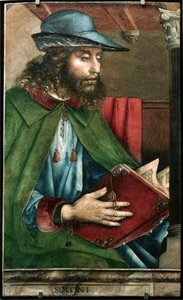
Furthermore, Justus created a series of portraits of prominent men for Federico da Montefeltro's *studiolo* (a private study filled with curiosities and works of art). These portraits—including depictions of Cardinal Bessarione and Virgil—are considered among the finest examples of early Renaissance portraiture. They showcase Justus’s ability to capture not only physical likeness but also psychological depth, imbuing his subjects with a sense of dignity and character.
Legacy and Influence
Justus van Gent's career spanned nearly seven decades, during which he established himself as one of the leading painters of his time. His work bridged the gap between the late Gothic and early Renaissance styles, reflecting both Northern European traditions and Italian artistic innovations. While his individual style is difficult to define precisely—a characteristic of many artists working during this transitional period—his influence can be seen in the works of subsequent generations of Netherlandish painters.
His legacy extends beyond his own paintings. The portraits he created for Federico da Montefeltro, in particular, served as a model for later portraitists, influencing the development of Renaissance portraiture throughout Europe. Justus van Gent’s artistic journey—from his humble beginnings in Ghent to his influential period in Urbino—stands as a testament to the dynamism and creativity of the early Netherlandish art world.