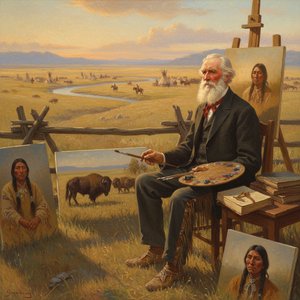
A Life of Devotion and Detail: The Multifaceted Legacy of Joseph Steward
In the tapestry of early American history, few figures embody the era's unique blend of spiritual fervor and burgeoning intellectual curiosity as gracefully as Joseph Steward. Born in Upton, Massachusetts, on July 6, 1753, Steward’s life was a profound journey through the realms of faith, music, and visual art. A graduate of Dartmouth College in 1780, his initial path was paved with theological rigor; he was a man destined for the pulpit, trained under the guidance of Reverend Doctor Levi Hart. Yet, as is often the case with the most vibrant souls, the boundaries of his vocation were never strictly confined to the sermon. While his life was marked by the heavy toll of chronic health challenges—including bouts of illness that forced him to seek refuge in Newport, Rhode and later shaped his professional transitions—these very hardships seemed to deepen his observational eye, turning a minister's gaze toward the intricate details of the human countenance and the natural world.
The artistry of Steward was not merely a hobby but a secondary calling that emerged from a life of meticulous observation. Though largely self-taught, he possessed an innate ability to capture the essence of his subjects with a precision that bordered on the scientific. It is whispered in art historical circles that he may have received informal guidance from the renowned Jonathan Trumbull during the latter's residency in Hartford in 1792. This influence, whether direct or atmospheric, contributed to a style that blended the delicate sensibilities of the Rococo with the emerging structural clarity of Neoclassicism. His work often functioned as a bridge between eras, capturing the dignity of the American character through portraits that were both intimate and formal. Whether he was rendering the subtle features of a prominent figure like Jonathan Dwight or documenting the members of the esteemed Denison family, Steward’s brushwork sought a truth that went beyond mere likeness, finding beauty in the authentic, even in the smallest imperfections.
The Curator of Curiosities and the Harmony of Hymns
Beyond the canvas, Steward was a pioneer of public engagement and cultural preservation. In 1797, demonstrating an entrepreneurial spirit and a passion for the wonders of the natural world, he established a museum within the attic of the Connecticut State House in Hartford. This was no mere collection of trinkets; it was a curated exhibition of paintings, waxworks, and "natural and artificial curiosities" that offered the public a window into the marvelous. This venture as a museum curator highlights his role as an educator and a bridge-builder between the known and the unknown, much like his musical contributions. Alongside Nathan Strong and Abel Flint, Steward helped compile “The Hartford Selection of Hymns,” a monumental achievement in American musical culture. The collection’s immense popularity, reaching eight editions by 1821, speaks to his ability to harmonize the spiritual needs of his congregation with the aesthetic joys of melody.
As we reflect on the historical significance of Joseph Steward, we see an artist whose impact was felt through multiple sensory experiences—the sight of a perfectly rendered portrait, the sound of a well-composed hymn, and the wonder of a museum exhibit. His life serves as a testament to the following achievements:
- Artistic Precision: The ability to masterfully blend portraiture with landscape, creating works that captured both individual identity and environmental context.
- Cultural Stewardship: The establishment of one of the region's earliest public exhibition spaces, fostering curiosity and education in the heart of Hartford.
- Musical Legacy: The creation of a lasting hymnal that shaped the liturgical and musical landscape of early New England for decades.
- Resilience of Spirit: A career defined by the ability to pivot and find new modes of expression and service despite significant physical adversity.
Ultimately, Joseph Steward remains a vital figure in the study of American folk and fine art. He was a man who saw no distinction between the beauty of a divine truth and the beauty of a painted line. Through his portraits, his hymns, and his museum, he left behind a sensory record of an era transitioning from colonial tradition to a distinct American identity, ensuring that the faces and voices of his time would never be forgotten.