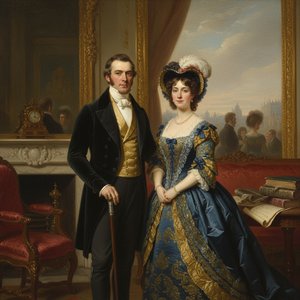
The Maritime Visionary of Cumbria
Born amidst the rugged, salt-sprayed landscapes of Whitehaven and Egremont in 1799, Joseph Heard was an artist whose very soul seemed tethered to the rhythmic pulse of the tides. While his early years were rooted in the Cumbrian terrain, his intellectual journey led him to the prestigious halls of Edinburgh University. There, he immersed himself in the rigorous study of anatomy and physiology—a scientific pursuit that would later manifest in his art as an uncanny, almost surgical precision when rendering the complex rigging and structural anatomy of seafaring vessels. This unique intersection of scientific observation and artistic passion allowed Heard to approach the maritime world not merely as a romantic subject, but as a living, breathing entity composed of intricate wood, tensioned sail, and shifting water.Heard’s life unfolded during the transition from the Georgian era to the Victorian age, a period characterized by an unwavering fascination with the sea and the burgeoning industrial power of the British Empire. His background in science provided him with a lens through which to view the mechanical evolution of maritime technology, making him a vital chronicler of an era defined by both elegance and engineering prowess.
A Symphony of Salt and Light
Heard’s true canvas was the ocean itself, a medium he explored through extensive travels aboard the paddle steamers that were then transforming coastal travel. These voyages were far more than mere transit; they were essential expeditions that provided him with an intimate, firsthand perspective on the drama of naval life. His brushwork often employed a masterful use of impasto, adding a tactile dimension to his canvases that mirrored the churning, turbulent energy of the sea. In celebrated works such as the ‘Wooden Paddle Steamer ‘Falcon’’, one can sense the physical weight of the water and the visceral spray of the salt air.His artistic style masterfully balanced the restrained precision of the Georgian aesthetic with the burgeoning emotional intensity of the Romantic movement. He possessed a rare ability to capture atmospheric conditions that ranged from the serene, crystalline clarity of a summer morning to the terrifying majesty of a gathering storm. Through his meticulous attention to detail, he could render the delicate play of light on a wave or the heavy, brooding shadows of a ship caught in a tempest, ensuring that each piece conveyed both the beauty and the inherent danger of the maritime existence.
The Enduring Legacy of a Marine Master
As the nineteenth century progressed, Heard’s work became an essential record of a transformative epoch in maritime history. His paintings, including notable pieces such as ‘The Ship Abbotsford’, ‘The Barque Mary’, and ‘The Three-masted Merchantman Eleanor Dixon’, serve as windows into a world of merchantmen and naval encounters that were rapidly changing under the influence of industrial progress. His oeuvre captures the transition from traditional sailing vessels to the more modern, steam-driven era, documenting the evolution of seafaring life with unparalleled accuracy.Today, the legacy of Joseph Heard continues to resonate through prestigious collections in institutions such as Pickford's House and Derby Museums. His ability to bridge the gap between scientific realism and romanticized maritime splendor remains an inspiration. He stands not just as a painter of ships, but as a chronicler of the sea’s enduring power, leaving behind a body of work that continues to evoke the sublime mystery of the ocean for all who behold it.
질의응답
Joseph Heard 작가는 어떤 색상을 가장 자주 사용했나요?
Joseph Heard 작가 작품의 컬러 프로필은 작가의 팔레트 지놈 페이지에서 확인하실 수 있습니다.
Joseph Heard의 작품을 매체별로 찾아볼 수 있나요?
모든 매체 페이지에서는 Joseph Heard의 작품을 기법별로 모아볼 수 있습니다.
Joseph Heard 작가의 작품을 3D 갤러리에서 어디서 볼 수 있나요?
가상 방문이 가능합니다: Joseph Heard의 3D 뮤지엄 페이지에서 작가의 작품들을 3D 갤러리를 통해 만나보실 수 있습니다.