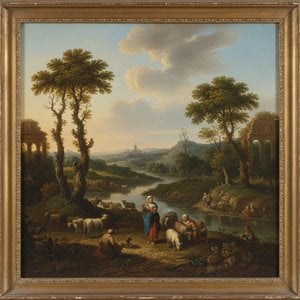
Jan de Momper: Master of Atmospheric Landscapes
Jan de Momper, a name often intertwined with that of his father, Bartholomeus de Momper the Elder, stands as a pivotal figure in 17th-century Flemish landscape painting. Born in Antwerp around 1564 – though some sources suggest 1614 or 1617 – he inherited not just an artistic lineage but also a profound understanding of the craft, shaping his own distinctive style that bridged the Mannerist and Baroque periods. His life was one of both privilege and persistent obscurity, a testament to the challenges faced by artists navigating the complex patronage systems of the era. De Momper’s legacy rests primarily on his ability to capture the sublime beauty of nature – particularly the dramatic vistas of the Alps – with an unparalleled sense of atmosphere and depth.Early Life and Artistic Training
De Momper's artistic journey began within a family deeply rooted in the visual arts. His grandfather, also a landscape painter, provided an initial foundation, while his father, Bartholomeus de Momper the Elder, was a renowned painter, print publisher, and art dealer. This familial connection afforded him invaluable early training, immersing him in the techniques of oil painting and printmaking. Crucially, he became a master of the Antwerp Guild of St. Luke at the remarkably young age of seventeen in 1581 – a remarkable achievement that underscored his prodigious talent. Accounts suggest a formative period spent in Italy during the 1580s, where he likely studied the works of masters like Paul Bril and absorbed the burgeoning interest in landscape painting prevalent within Roman circles. This exposure undoubtedly influenced his later style, particularly his penchant for dramatic mountainscapes and expansive vistas.Style and Technique: A Synthesis of Influences
De Momper’s artistic voice is a fascinating synthesis of influences. He was profoundly shaped by the work of Pieter Brueghel the Elder, evident in his depictions of rural life and seasonal changes, but he also possessed a distinct sensitivity to atmospheric perspective and color transitions that set him apart. His landscapes are characterized by a masterful use of light and shadow, creating an illusion of depth and distance rarely seen in contemporary works. He frequently employed a “brown foreground to green background” technique – a hallmark of Mannerism – gradually transitioning from earthy tones to vibrant blues as the eye moved into the distance. This approach wasn’t merely stylistic; it reflected a deep understanding of how light interacts with natural elements, imbuing his paintings with an almost palpable sense of realism. Furthermore, De Momper collaborated extensively with other leading artists, notably Frans Francken II and Jan Brueghel the Younger, often contributing the atmospheric landscape element to larger compositions featuring figures and narrative scenes. This collaborative approach allowed him to showcase his skills while benefiting from the expertise of others in depicting human activity within the broader scene.Patronage and Recognition
Despite his considerable talent, De Momper’s career was punctuated by periods of relative obscurity. However, he enjoyed significant patronage throughout his life, a testament to the quality of his work and his connections within Antwerp's artistic circles. Archduchess Isabella Clara Eugenia, the influential governor of Flanders, famously requested that he be excused from paying taxes and fees in 1616 – a remarkable gesture indicative of her appreciation for his artistry. His paintings frequently adorned the galleries of wealthy collectors and noble families, both real and imagined, solidifying his reputation as one of the most sought-after landscape painters of his time. His likeness was even engraved by Anthony van Dyck, further elevating his status within the artistic community.Legacy and Historical Significance
Jan de Momper’s output is surprisingly modest – only a handful of his estimated 500 paintings are signed, and just one is dated. This scarcity underscores the significant role of workshop participation in his career. Nevertheless, his influence on subsequent generations of landscape painters is undeniable. His work served as an inspiration for artists like Frans de Momper and Hercules Segers, who built upon his techniques and expanded his vision. De Momper’s landscapes, with their dramatic mountainscapes and atmospheric depth, represent a crucial bridge between the late Mannerist style and the rise of Baroque landscape painting in the Netherlands. He is remembered not just as a skilled painter but as a master of atmosphere, capable of capturing the sublime beauty of nature with an unparalleled sense of realism and emotional resonance. His paintings continue to captivate viewers today, offering a glimpse into the artistic world of 17th-century Flanders and the enduring power of landscape art.질의응답
특정 매체로 분류된 Jan de Momper의 모든 작품을 어떻게 찾을 수 있나요?
모든 매체 페이지에서는 Jan de Momper의 작품을 기법별로 모아볼 수 있습니다.
Jan de Momper 작가의 작품을 3D 갤러리에서 어디서 볼 수 있나요?
가상 방문이 가능합니다: Jan de Momper의 3D 뮤지엄 페이지에서 작가의 작품들을 3D 갤러리를 통해 만나보실 수 있습니다.
Jan de Momper의 작품 중 조회수가 가장 높은 것은 무엇인가요?
Jan de Momper의 작품에 관한 통계를 보여주는 통계 페이지가 본 웹사이트에 마련되어 있습니다.