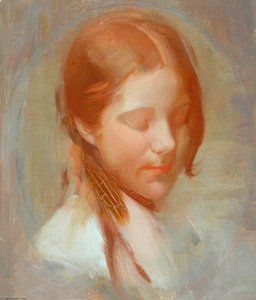
A Life Immersed in Light and Shadow: The World of James Torrance
James Torrance, a Slovakian painter born in 1859 and passing in 1916, remains a figure shrouded in intriguing mystery despite possessing a body of work that speaks volumes. While biographical details are scarce—a testament to the often-overlooked artists of his era—his paintings offer a compelling glimpse into a life deeply attuned to portraiture, the quiet beauty of nature, and the spiritual atmosphere of his surroundings. Torrance’s artistic journey unfolded primarily in Scotland, where he became part of the vibrant Glasgow art scene, exhibiting at the prestigious Glasgow Institute of the Fine Arts. His marriage to fellow artist Louisa Perman suggests a shared creative life, though much about their collaborative endeavors remains undocumented. The lack of extensive documentation only adds to the allure surrounding Torrance’s oeuvre, inviting viewers to connect directly with the emotional resonance of his canvases rather than relying on established narratives.
Portraits and Pigeons: Recurring Themes in a Delicate Style
Torrance is perhaps best known for his evocative portraits, which capture not merely likenesses but also the inner lives of his sitters. He possessed a remarkable ability to convey personality through subtle nuances of expression and gesture. His brushwork, often described as delicate and refined, lends a romantic realism to his depictions, hinting at both strength and vulnerability in equal measure. Beyond portraiture, pigeons emerge as a recurring motif in Torrance’s work—a curious fascination that sets him apart. These birds, symbols of peace, communication, and domesticity, appear frequently in his compositions, often rendered with meticulous detail against atmospheric backgrounds. The choice of subject matter suggests an appreciation for the everyday beauty found within the natural world, elevating seemingly ordinary creatures to a level of artistic significance. His painting “The Blue Pigeon” exemplifies this sensitivity, showcasing the bird as a focal point imbued with quiet dignity.
Influences and Artistic Development
Pinpointing Torrance’s precise influences proves challenging given the limited historical record. However, his work reveals an affinity for 19th-centuryrealism, particularly in its emphasis on accurate representation and emotional depth. The Dutch Masters, renowned for their mastery of light and shadow, likely played a role in shaping his technique. His portraits bear traces of this influence, with a similar attention to detail and atmospheric perspective. Furthermore, the Pre-Raphaelite movement’s focus on narrative storytelling and symbolic imagery may have resonated with Torrance, informing his approach to composition and subject matter. His illustrations for Sir George Douglas' “Scottish Fairy and Folk Tales” demonstrate an ability to translate literary themes into compelling visual form, showcasing a versatility that extended beyond the realm of portraiture.
Levoča’s St. James Church: A Spiritual Center in Torrance’s Art
A significant aspect of Torrance’s artistic output centers on scenes depicting Levoča's St. James Church—a UNESCO World Heritage site renowned for its stunning Gothic architecture and intricate wooden altar carved by Master Paul of Levoča. These paintings are not merely topographical representations but rather evocative interpretations that capture the church’s spiritual atmosphere and historical significance. Torrance imbues these scenes with a sense of reverence, highlighting the interplay of light and shadow within the sacred space. The inclusion of figures within these compositions suggests an interest in exploring the human connection to faith and tradition. These works stand as testaments to his ability to capture both the physical grandeur and emotional resonance of this iconic landmark.
A Lasting Legacy: Rediscovering a Slovakian Master
Despite the relative obscurity surrounding his life, James Torrance’s work continues to captivate art enthusiasts with its delicate beauty and emotional depth. His paintings offer a window into a bygone era—a time when portraiture served as a powerful means of preserving memory and capturing personality. His evocative depictions of pigeons and scenes of Levoča's St. James Church demonstrate a unique artistic vision that deserves greater recognition. As more of his work comes to light, Torrance’s place within the broader context of 19th-century Slovakian and Scottish art is sure to be solidified—a testament to the enduring power of artistic talent and the importance of rediscovering forgotten masters.
Portraits revealing inner lives.
Recurring pigeon motifs symbolizing peace and communication.
Explore 10 defining masterpieces of Romantic Realism! Discover Courbet, Millet & Daumier's powerful paintings—capturing emotion and social realities. Find museum-quality reproductions for your home at ArtsDot.com.
19th-century Slovakian painters like László Mednyánszky, Pál Szinyei Merse, and Viktor Madarász defined an era. View their masterpieces on ArtsDot.com.
낭만주의 예술의 정수를 담은 10대 걸작을 만나보세요! 들라크루아, 프리드리히 등 거장의 작품 비하인드 스토리와 감동적인 표현 기법을 탐구하고, 와후아트에서 고품질 아트 프린트로 당신의 공간에 예술적 영감을 더하세요. 지금 바로 온라인 갤러리에서 모든 걸작을 발견해보세요!
ArtsDot.com에서 James Torrance 작가의 작품 중 가장 높은 순위를 기록한 회화는 무엇인가요?
Head of a Lady
In which year did James Torrance exhibit with the International Society of Sculptors, Painters, and Gravers?
1898
James Torrance 작가는 생애가 얼마나 되었나요?
57 years (1859–1916)
James Torrance was also known as an accomplished artist in what medium?
Black and white illustration
James Torrance 작가는 언제, 어디에서 태어났나요?
1859, United Kingdom of Great Britain and Ireland
James Torrance 작가는 누구인가요?
A Life Immersed in Light and Shadow: The World of James Torrance
James Torrance, a Slovakian painter born in 1859 and passing in 1916, remains a figure shrouded in intriguing mystery despite possessing a body of work that speaks volumes. While biographical details are scarce—a testament to the often-overlooked artists of his era—his paintings offer a compelling glimpse into a life deeply attuned to portraiture, the quiet beauty of nature, and the spiritual atmosphere of his surroundings. Torran