The Formative Journey from Japan to England
In the late nineteenth century, as the borders of the world began to blur through unprecedented cultural exchange, a young Kinichiro Ishikawa was preparing to bridge the gap between Eastern sensibility and Western technique. Born in 1871, his early years were shaped by the tension between tradition and modernity. Though he was the son of a former official from the Tokugawa era, his heart was captured not by the rigid structures of the past, but by the fluid, translucent beauty of watercolor. His initial training was unexpectedly technical, rooted in the Tokyo Telecommunications School, yet this foundation in precision would later serve him well in mastering the delicate gradations of light and moisture that define his greatest works.
Seeking to expand his artistic vocabulary, Ishikawa traveled to England, a journey that would prove transformative. In the heart of the West, he immersed himself in the study of watercolor, absorbing the principles of plein air painting and the subtle art of capturing atmosphere. This period of intense study allowed him to integrate Western realism with a uniquely Japanese aesthetic, creating a style that was both grounded in observation and elevated by poetic emotion. He learned to treat the paper not merely as a surface,
but as a space where light could breathe through layers of pigment, a skill that would become his hallmark.
Cultivating a New Artistic Landscape in Taiwan
Ishikawa’s most profound historical significance lies in his role as a pioneer of Western art education in Taiwan. Arriving during a period of significant transition, he did not merely paint landscapes; he planted the seeds for an entire movement. Through his tireless work as a professor at the Taipei Teacher's College and his involvement with various educational institutes, he championed the idea that art was a vital component of modern culture. He was a master organizer, establishing platforms where local artists could gather, share ideas, and find their voices under the guidance of his Western-influenced principles.
His leadership was instrumental in the creation of several foundational artistic institutions, including:
- The Seven Star Painting Society, which provided a space for emerging talent.
- The Taiwan Watercolor Painting Society, dedicated to the medium he loved most.
- The Keelung Asian Painting Association, further expanding the reach of modern art.
Beyond his organizational feats, Ishikawa acted as a mentor to a generation of legendary Taiwanese painters, such as Lee Shih-chiao and Huang Yibin. By advocating for sponsored exhibitions and the establishment of the Taiwan Fine Arts Exhibition, he ensured that the artistic progress he initiated would endure long after his passing.
Capturing the Ethereal Essence of Nature
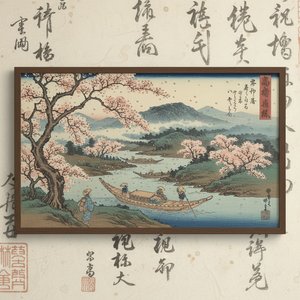
To look upon a painting by Ishikawa Kinichiro is to experience the fleeting moments of the natural world. His work is characterized by an extraordinary ability to render the ephemeral—the way mist clings to a mountain peak, the shimmer of sunlight on a tranquil pond, or the heavy, damp atmosphere of a rainy afternoon in Japan. He possessed a singular talent for tonal gradation, using subtle shifts in color to convey depth and humidity. His landscapes are never static; they pulse with the life of the elements.
In notable works such as “The Old Path at Toyohara,” one can see his meticulous attention to detail, where lush greenery and traditional architecture are harmonized through a soft, atmospheric haze. He utilized the transparency of watercolor to mimic the very nature he depicted, allowing the white of the paper to act as the brightest light of a sun-drenched clearing or the pale glow of a foggy morning. Through his dedication to painting directly from nature, Ishikawa Kinichiro left behind a legacy that remains a testament to the beauty of the transient and the enduring power of a well-placed brushstroke.