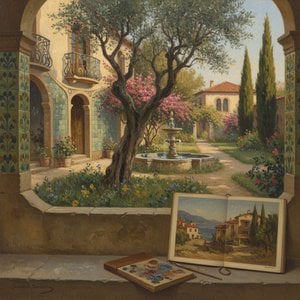
Joaquín Sorolla y Bastida - A Life Bathed in Light
Joaquín Sorolla y Bastida, a name synonymous with the radiant light and vibrant energy of Spain, was more than just a painter; he was a chronicler of his nation’s soul. Born in Valencia in 1863, Sorolla's early life was marked by tragedy. Orphaned at the tender age of two following a cholera epidemic that claimed both parents, young Joaquín and his sister were raised by their maternal aunt and uncle. This early experience with loss perhaps instilled within him a profound appreciation for the fleeting beauty of life – a sentiment that would permeate his art. Though hardship shadowed his beginnings, it did not dim the spark of artistic talent that quickly became apparent. He received initial instruction in Valencia, demonstrating an aptitude that led to studies under established artists like Cayetano Capuz and José Benlliure, eventually culminating in a four-year grant to study in Rome. It was there, amidst the classical grandeur of Italy, that Sorolla began to forge his unique artistic path, absorbing influences while simultaneously developing a style distinctly his own.Early Life and Influences
Joaquín Sorolla’s formative years instilled within him a deep understanding of vulnerability and resilience. Born into a modest family in Valencia—a city steeped in maritime tradition—his parents succumbed to cholera when he was just two, leaving him and his sister under the care of their maternal aunt and uncle. This poignant experience profoundly shaped his artistic sensibility, fostering an unwavering fascination with capturing ephemeral moments and conveying emotion through color and light. Recognizing Sorolla’s exceptional talent early on, his teachers recognized his innate aptitude for art and encouraged his pursuit of knowledge. He began his formal training at Valencia's School of Artisans, where he honed his skills under the guidance of Salustiano Asenjo, absorbing stylistic cues from the academic tradition prevalent at the time. However, Sorolla’s artistic vision extended beyond mere imitation; he actively sought inspiration from masters like Francisco Pradilla and Jules Bastien-Lepage, whose works championed dramatic narratives and expressive brushwork—influences that would become integral to his distinctive style.Rome and Impressionistic Exploration
A pivotal moment in Sorolla's artistic development arrived when he secured a prestigious scholarship to study in Rome in 1884. Amidst the monumental sculptures and architectural splendor of the Italian capital, he encountered the burgeoning movement of Impressionism—a revolutionary approach to painting that prioritized capturing fleeting impressions of light and color over meticulous detail. Artists like Bastien-Lepage and Edvard Munch captivated Sorolla’s imagination with their bold experimentation and emotional intensity. He embraced these influences wholeheartedly, immersing himself in Parisian artistic circles and absorbing the techniques pioneered by Monet and Renoir—artists who championed *plein air* painting and employed loose, vibrant brushstrokes to convey atmosphere and emotion. This transformative period solidified Sorolla's commitment to Luminism—a style characterized by its luminous quality and masterful depiction of sunlight—marking a decisive break from academic conventions.The Valencian Coast: A Painter’s Obsession
Sorolla’s artistic focus soon centered on the Valencian coast—a landscape he regarded as both aesthetically sublime and emotionally resonant. Drawn to the intense Mediterranean sunlight, the shimmering sea, and the vibrant energy of the local population, he embarked on a lifelong endeavor to capture these elements with unparalleled precision and beauty. He became renowned for his beach scenes—images brimming with life and movement—where figures bathed in golden light danced across canvases rendered with breathtaking spontaneity and vitality. Unlike many artists of his era who sought to portray idealized landscapes or historical grandeur, Sorolla prioritized conveying the immediacy of experience—the sensation of warmth, airiness, and joyful interaction between people and their surroundings. His technique—characterized by rapid brushstrokes and a masterful manipulation of color—became instantly recognizable—a testament to his unwavering dedication to capturing the essence of Luminism.Major Achievements and Legacy
Sorolla’s artistic career spanned decades, punctuated by numerous exhibitions throughout Europe and America, securing international acclaim and establishing him as one of Spain's most celebrated painters. He achieved considerable success early on, winning the gold medal at the National Exhibition in Madrid for *Another Marguerite* (1892) and garnering first prize at the Chicago International Exposition (1893). His monumental mural cycle, Vision of Spain—commissioned by Archer Milton Huntington—became a crowning achievement, showcasing his artistic prowess and cementing his place as a visionary artist. Completed posthumously in 1928, this ambitious project—featuring fourteen canvases depicting the regional costumes and customs of Spain—continues to inspire admiration for Sorolla’s technical skill and expressive vision. Today, Sorolla's paintings reside in prominent museums worldwide—including the Museo Sorolla in Madrid—where they stand as enduring symbols of Luminism and Spanish artistic heritage. His legacy extends beyond his masterful technique; he captured a specific moment in Spanish history and culture—a celebration of light, color, and human emotion—reminding us that art possesses the power to illuminate our world.질의응답
호아킨 소로라 이 바스티다의 출생지와 출생 연도는 언제인가요?
호아킨 소로라 이 바스티다은(는) 1863년 발렌시아에서 태어났습니다.
호아킨 소로라 이 바스티다의 작품을 색상별로 모아둔 곳은 어디인가요?
색상별 인덱스 페이지에서는 호아킨 소로라 이 바스티다의 작품들을 색상별로 모아 보실 수 있습니다.
호아킨 소로라 이 바스티다의 출생 도시와 국가는 어디인가요?
호아킨 소로라 이 바스티다은(는) 스페인의 발렌시아에서 태어났습니다.
호아킨 소로라 이 바스티다의 연도별 활동 기록이 있나요?
호아킨 소로라 이 바스티다의 작품 세계를 시간순으로 정리한 기록은 아티스트 연대기 페이지에서 확인하실 수 있으며, 이곳에서는 각 시기별로 분류된 챕터를 따라 작품들을 제작 순서대로 만나보실 수 있습니다.
호아킨 소로라 이 바스티다 작가의 출신 국가는 어디인가요?
호아킨 소로라 이 바스티다은(는) 스페인에서 태어났습니다.
호아킨 소로라 이 바스티다의 작품을 컬러 팔레트별로 둘러볼 수 있나요?
호아킨 소로라 이 바스티다의 작품은 작가의 컬러 팔레트별 페이지에서 컬러 팔레트별로 둘러보실 수 있습니다.
호아킨 소로라 이 바스티다가 그린 모든 주제를 한눈에 볼 수 있는 개요가 있나요?
호아킨 소로라 이 바스티다의 주제별 아틀라스는 작가의 작품들을 주제별로 분류하여 보여주는 페이지입니다.