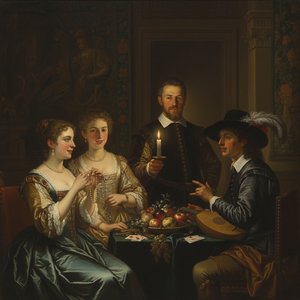
The Artisan of the Golden Age
While history often reserves its most luminous spotlights for the painters who captured the light of the Dutch Golden Age, the story of Herman Doomer offers a profound glimpse into the skilled hands that framed and built that very era. Born in Anrath, near Venlo, Doomer was not a visual artist in the traditional sense, but rather a master craftsman whose life was defined by the tactile beauty of ebony and wood. As a successful furniture maker and framemaker, his work provided the physical structure for the burgeoning culture of 17th-century Amsterdam. He operated a prosperous business specializing in ebony-veneer furniture and intricate frames, navigating the bustling streets of the Kalverstraat, Gasthuismolensteeg, and Hartenstraat with the confidence of a man at the heart of a global trading hub.Craftsmanship and Connection
The legacy of Herman Doomer is inextricably linked to the artistic giants of his time. His mastery of materials like ebony and colored baleen allowed him to contribute to the aesthetic opulence of the Dutch Republic, creating pieces that reflected the wealth and taste of a new middle class. His professional network was deeply embedded in the highest circles of Amsterdam's creative community; he was known to collaborate with figures such as Pieter Quast and Johannes Lutma. Perhaps most significantly, his role as a supplier of frames placed him in direct contact with Rembrandt van Rijn. This connection resulted in one of the most enduring portraits of the era, where Rembrandt captured Doomer not merely as a subject, but as a dignified professional, immortalizing the quiet strength of the craftsman behind the canvas.A Lasting Material Legacy
Though his name may not be found on the signatures of canvases, Doomer’s influence persists through the enduring physical objects he created. His work, such as the remarkable Cupboard (Interior) housed in the Rijksmuseum, serves as a window into the lavish tastes and meticulous artistry of the period. These pieces were more than mere utility; they were embodiments of Dutch innovation and skill. Through his specialized trade, Doomer helped shape the visual environment of the 17th century, leaving behind a material history that continues to speak of an age defined by prosperity, intricate detail, and an unparalleled devotion to the beauty of fine craftsmanship.Q&A
Herman Doomer은(는) 어느 시대의 작품을 남겼나요?
Herman Doomer은(는) 근세 초기 시대에 활동했습니다. 이 시기는 역사적 맥락 속에서 작가의 예술적 위치를 보여줍니다.
특정 주제별로 Herman Doomer의 작품을 어떻게 찾아볼 수 있나요?
Herman Doomer의 키워드별 탐색 페이지에서는 작가의 작품들을 키워드별로 모아볼 수 있습니다.
Herman Doomer의 작품을 기법별로 모아볼 수 있는 곳은 어디인가요?
특정 매체로 제작된 Herman Doomer의 모든 작품을 확인하시려면, 작가의 모든 매체별 페이지를 이용해 주세요.
Herman Doomer 작가의 작품을 감상할 수 있는 3D 갤러리는 어디인가요?
Herman Doomer의 3D 갤러리는 작가의 작품들을 가상 3D 갤러리로 감상할 수 있는 페이지입니다.