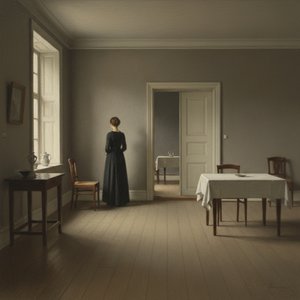
The Quiet Observer of Estonian Life
Hans Kuusik lived a life defined by the steady, disciplined pursuit of visual truth. Born in 1872, he emerged from a period of profound transition, eventually establishing himself as both a practitioner and a teacher of art. His training took him to the Saint Petersburg Stieglitz State Academy of Art and Design, an experience that provided the technical foundation for a career spanning several decades. He did not merely observe the world; he sought to record its nuances through a variety of media, from formal paintings to the intimate, fleeting marks of a sketchbook.
His presence in the Estonian art scene was marked by a prolific output that spanned from 1905 to 1938. Rather than seeking the spotlight of grand movements, Kuusik focused on the essential elements of his surroundings. His work often turned toward the human form and the quietude of daily existence, capturing moments of reflection and the subtle geometry of the street.
Technical Versatility and Subject Matter
The breadth of Kuusik's practice is evident in the diverse range of materials he employed to translate his observations. His hand was as comfortable with the heavy application of paint as it was with the delicate precision of a pencil. This versatility allowed him to move between large-scale compositions and small, private studies.
- Portraiture: Works such as Naise portree demonstrate his interest in the character and presence of the individual.
- Sketchbook Studies: His drawings, including Page from a Sketchbook and Street Motif, reveal a preoccupation with light and urban movement.
- Spiritual and Symbolic Themes: Pieces like Palvetav nooruk and his stained glass work Kristuse pea suggest a preoccupation with the internal life and religious iconography.
His sketches, often rendered in colored pencil or watercolor, provide a glimpse into his thought process. These works are not mere rehearsals for larger canvases but are complete expressions of a specific moment. They capture the texture of paper and the immediacy of a thought caught in transit.
A Legacy in Public Collections
By the time of his death in 1953, Kuusik had left behind a substantial body of work that remains integrated into the cultural fabric of Estonia. His contributions are not held in isolation but are distributed across various public institutions, ensuring his perspective remains part of the national record. His influence extended beyond the canvas through his role as an art teacher, passing his technical knowledge to the next generation of creators.
The sheer volume of his output—with over two hundred works held in Estonian public collections—speaks to a life of consistent, dedicated labor. He remains a significant figure for those studying the development of Estonian visual culture during the first half of the twentieth century.