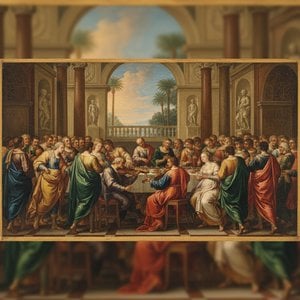
Giuseppe Nuvolone: A Milanese Baroque Visionary
Giuseppe Nuvolone (1619 – 1703) emerged from the artistic crucible of San Gimignano, Italy, inheriting a legacy of painting prowess from his father and brother, Carlo Francesco Nuvolone. This familial tradition firmly rooted him in the vibrant artistic landscape of Milanese
Baroque, where he honed his craft alongside prominent contemporaries and established himself as a respected figure within the burgeoning art scene. His life’s journey was marked by dedication to his profession and an unwavering pursuit of excellence, resulting in a body of work that continues to captivate scholars and admirers alike.
- Early Life & Family Influence: Born into a family deeply invested in artistic pursuits, Giuseppe benefited from the mentorship of Carlo Francesco Nuvolone, whose stylistic sensibilities undoubtedly shaped his formative years. This familial connection fostered an environment conducive to artistic development and instilled within him a profound appreciation for classical ideals.
- Milanese Artistic Circle: Nuvolone’s career flourished in Milan during the reign of Vincenzo I Gonzaga, a period characterized by considerable patronage and intellectual ferment. He actively participated in the vibrant artistic circle that gathered around Gonzaga’s court, collaborating with fellow artists and absorbing influences from established masters like Bartholomäus Bettera and Felice Boselli.
- Notable Commissions & Patronage: Giuseppe Nuvolone secured prestigious commissions—most notably the monumental altarpiece depicting ‘Christ and the Woman Taken in Adultery’ for the church of San Domenico in Cremona—demonstrating his artistic reputation and securing financial stability. These commissions allowed him to explore ambitious compositional concepts and refine his technical skills.
Style & Technique: Baroque Sensibility Embodied
Nuvolone’s artistic style aligns seamlessly with the tenets of
Baroque painting, characterized by
dramatic lighting,
dynamic movement, and an expressive portrayal of emotion. He skillfully employed chiaroscuro—the interplay between
light and shadow—to heighten visual impact and imbue his canvases with palpable energy. His meticulous attention to detail—evident in portraits like ‘
Portrait of Luigi Cusani’—revealed a mastery of anatomical accuracy and textural nuance. Influenced by Cremonese and Bergamasca styles, Nuvolone's works are distinguished by their
vibrant colors and masterful rendering of surfaces.
- Compositional Innovation: Nuvolone demonstrated an inventive approach to composition, favoring dynamic arrangements that captured the grandeur and theatricality emblematic of the Baroque era. He skillfully utilized perspective and spatial illusion to create immersive environments that transported viewers into the depicted scenes.
- Color Palette & Texture: His palette embraced rich hues—deep reds, blues, and golds—harmoniously blended to convey mood and atmosphere. Nuvolone’s meticulous brushwork achieved remarkable textural effects, capturing the subtleties of fabric, skin, and stone with exceptional realism.
Major Achievements & Legacy
Giuseppe Nuvolone's enduring legacy rests primarily on his monumental altarpiece for San Domenico in Cremona—a testament to his artistic ambition and technical prowess. This masterpiece exemplifies the
Baroque ideal of conveying religious fervor through visual splendor, securing Nuvolone’s place among Milanese
Baroque artists. Furthermore, his portraits—particularly ‘
Portrait of Luigi Cusani’—offer invaluable insights into the social customs and aesthetic sensibilities of 17th-century Italy. His influence extended beyond Cremona, shaping the artistic landscape of Lombardy and contributing to the broader dissemination of
Baroque ideals.
Further Exploration
To delve deeper into Giuseppe Nuvolone’s oeuvre, consider visiting
San Giuseppe di Castello, where you can explore his artistic vision alongside other prominent Venetian artists and admire breathtaking watercolors by
John Singer Sargent. Also, examine the frescoes adorning San Sigismondo in Cremona—a masterpiece of
Renaissance art—to appreciate Nuvolone’s stylistic connections to earlier artistic traditions.