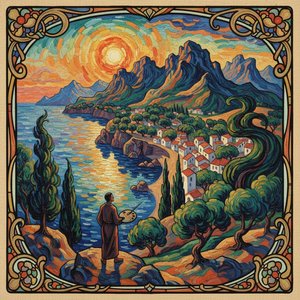
The Soul of the Catalan Landscape: The Life and Vision of Galos Victor
In the heart of the 19th century, a period defined by the sweeping emotional tides of Romanticism, there emerged a painter capable of finding the profound within the humble. Victor Balaguer, known to many as Galos Victor, was not merely an observer of the natural world but a poet of its most quiet moments. Born in Barcelona in 1828, his artistic journey was deeply rooted in the textures of his homeland. The son of the sculptor José María Balaguer y Serra, Victor grew up surrounded by the tactile language of form and craftsmanship. This early exposure to the sculptural arts instilled in him a rigorous discipline regarding light and shadow, a foundation that would later allow him to breathe life into the rolling hills and sun-drenched plains of Catalonia.
His formal education at the Escuela Superior de Bellas Artes de Barcelona provided him with the classical tools of his trade. Under the guidance of masters like Ignacio Quintanilla y Aranda, he mastered the complexities of perspective and the precision of academic realism. Yet, where others sought to replicate the world through rigid formalism, Balaguer felt a pull toward something more ephemeral. He began to move away from the sterile perfection of the academy, gravitating instead toward the atmospheric nuances that define the landscape. His true passion lay in the way light dances across a wheat field or how a storm gathers over a distant mountain range—elements that required not just technical skill, but an emotional resonance with the subject matter.
A Mastery of Light and Rural Realism
The essence of Balaguer’s oeuvre lies in his ability to elevate the mundane to the monumental. While many of his contemporaries chased grand, idealized vistas or historical epics, Victor found his muse in the rhythmic simplicity of rural life. His canvases serve as windows into a vanishing world of shepherds, quiet villages, and the enduring toil of the peasantry. Through his brush, a simple scene of Chaumine béarnaise or a view of a mountain landscape becomes an exploration of the human condition and our connection to the earth.
Technically, his work is characterized by a sophisticated use of tonal gradation and atmospheric effects. He possessed a scientific curiosity regarding geological formations and meteorological shifts, yet he never allowed this study to become cold or clinical. Instead, he used these observations to enhance the Romantic emotion of his pieces. His brushstrokes, while grounded in realism, possess an expressive quality that captures the movement of wind through grass or the heavy, humid air before a rainfall. This delicate balance between the precise and the evocative is what distinguishes his legacy.
Key elements of his artistic development include:
- The Influence of Sculpture: A lifelong appreciation for volume, texture, and the interplay of light and shadow inherited from his father.
- Rejection of Formalism: The transition from strict academic precision to a more fluid, atmospheric approach to landscape painting.
- Commitment to Realism: An unwavering dedication to portraying the authentic beauty and hardships of the Catalan countryside.
- Atmospheric Focus: A specialized ability to capture fleeting moments of light, such as the golden hour in a wheat field or the dramatic chiaroscuro of a stormy sky.
Legacy and Historical Significance
Though his life was relatively short, ending in 1879, the impact of Galos Victor remains etched in the history of Spanish landscape painting. He stands as a vital bridge between the structured traditions of the early 19th century and the more emotive, sensory-driven movements that would follow. His work does not merely document the landscapes of Catalonia; it preserves the spirit of an era, capturing the dignity of rural existence with a tenderness that transcends time.
Today, his paintings are cherished not only for their aesthetic beauty but as historical documents of a landscape and way of life that have since been transformed by modernity. To look upon a work by Victor Balaguer is to experience a sense of nostalgia—a longing for the quiet, unhurried rhythms of the natural world. His ability to find the infinite within the intimate ensures that his vision continues to resonate with collectors and art lovers, offering a sanctuary of peace and profound beauty in an ever-changing world.