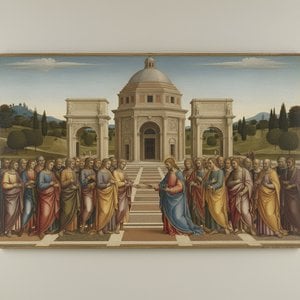
The Master of Swabian Devotion
In the twilight of the Middle Ages, amidst the bustling trade routes of Southern Germany, the name Friedrich Herlin emerged as a beacon of spiritual and artistic refinement. A painter whose life was deeply intertwined with the religious fabric of his era, Herlin navigated the transition from late Gothic traditions to the burgeoning influences of the Northern Renaissance. Though historical records offer only fragments of his personal journey, we know him as a man of significant standing—a citizen of Nördlingen who enjoyed rare tax exemptions, a testament to the value his craft brought to his community. His origins, likely rooted in Rothenburg ob der Tauber or perhaps the artistic hub of Ulm, placed him at the heart of a vibrant cultural exchange where German piety met the sophisticated aesthetics of the Low Countries.
Herlin was far more than a mere craftsman; he was a painter-entrepreneur, a visionary who understood the intersection of sacred art and large-scale production. Working in close collaboration with skilled joiners like Hans Waidenlich, he orchestrated the creation of monumental altarpieances that served as both liturgical focal points and breathtaking displays of wealth and devotion. His ability to manage complex commissions allowed his influence to ripple across regional borders, making him a principal figure in bringing Netherlandish sensibilities to the Swabian landscape.
A Synthesis of Northern Light and German Piety
To gaze upon a work by Herlin is to witness a profound dialogue between different artistic worlds. He was a master of synthesis, skillfully borrowing from the emotive power and meticulous detail of Rogier van der Weyden. This influence is evident in his handling of drapery, the tender expressions of his holy figures, and the way light seems to cling to the surfaces of his subjects, creating a sense of tangible presence. His earliest known works, such as the scenes from the Life of the Virgin dating back to 1459, reveal an artist already deeply engaged with the delicate nuances of sacred narrative.
His technical prowess was matched by a deep understanding of symbolic language. In his altarpieces, every fold of a cloak and every botanical detail in a landscape served to deepen the viewer's meditative experience. Whether depicting the Adoration of the Kings or the quiet intimacy of the Birth of Christ, Herlin utilized a palette and composition that guided the eye toward moments of divine revelation. His work often bridged the gap between the sculptural and the painterly; some of his altarpieces were even integrated with sophisticated carvings, suggesting he moved within the highest artistic circles of his time, potentially interacting with masters like Nicolaus Gerhaert.
Legacy of the Altarpiece Architect
The historical significance of Friedrich Herlin lies in his role as a cultural conduit. He did not merely replicate existing styles but helped forge a unique regional identity that blended local German traditions with the prestigious innovations flowing from the Netherlands and Cologne. His legacy is preserved not only in the surviving panels housed in museums like the Bayerisches Nationalmuseum but also in the very structure of religious art in Southern Germany during the late 15th century.
Through his industrious spirit, Herlin left behind a blueprint for the successful artist of the Renaissance—one who was as much a businessman and collaborator as he was a creator. His life, though ending in Nördlingen around 1500, remains etched in the gilded frames and sacred imagery of the era, reminding us of a time when art was the primary vessel for the human soul's encounter with the divine.