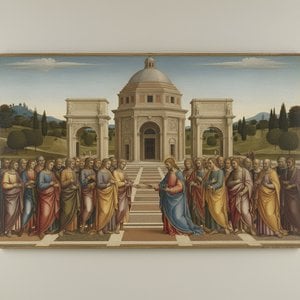
The Silent Shadow of the Venetian Master
In the luminous history of the Venetian Renaissance, certain names shine with an almost blinding intensity, much like the sun-drenched canvases of Tiziano Vecellio, known to the world as Titian. Yet, standing in the periphery of this monumental legacy was his elder brother, Francesco Vecellio. Born around 1475 in the rugged, picturesque landscape of Pieve di Cadore, Francesco’s life was a complex tapestry woven from threads of martial valor and artistic devotion. While history often relegates him to the role of a supporting figure, a closer examination reveals a man whose identity was forged in the crucible of both the battlefield and the studio, contributing a unique, subtle strength to the Venetian school.
Francesco’s early years were far from the quiet life of a cloistered scholar. Before he ever took up the brush to capture the divine, he took up the sword. His service in the Venetian army during the pivotal conflicts at Vienna in 1529 and Verona in 1530 provided him with a perspective rarely found in the studios of Venice. These military campaigns were not merely interruptions to his artistic development; they were essential to it. The grit, the anatomical precision required to understand the human form under duress, and the vast, sweeping landscapes encountered during his travels all seeped into his visual vocabulary. This lived experience lent a certain groundedness and observational rigor to his later works, allowing him to approach sacred subjects with a profound understanding of earthly reality.
A Legacy of Craft and Collaboration
The artistic evolution of Francesco Vecellio was deeply intertwined with the workshop traditions of the Veneto. His formative years were shaped by an apprenticeship that blended technical mastery with a peculiar sense of intrigue. Under the guidance of figures like Perotto Calderon, Francesco learned the meticulous discipline required for high-level Renaissance production. This period of his life was characterized by a deep respect for the secrets of the craft—a trait that mirrored the clandestine nature of some of his mentors. As he matured, his work began to reflect the grander stylistic movements of Venice, yet it maintained a distinct, quieter voice that complemented rather than merely imitated the bravado of his brother.
His creative output was remarkably diverse, showcasing a versatility that extended beyond the traditional medium of oil on canvas. Francesco’s hand can be seen in various forms of visual storytelling:
- Sacred Painting: His religious compositions, such as the Annunciation for San Nicola di Bari, demonstrate a mastery of light and devotion, now preserved in the prestigious Gallerie dell'Accademia.
- Decorative Art: In 1530, he displayed his ability to integrate art with architecture by painting the magnificent organ shutters of the church of San Salvador in Venice.
- Printmaking: From approximately 1534, Francesco ventured into the intricate world of wood-engraving, a medium that required immense precision and allowed his artistic vision to reach a broader, more reproducible audience.
The Enduring Resonance of the Vecellio Name
As the decades progressed, Francesco’s role transitioned from a collaborator in the shadow of Titian to an established artist in his own right. His ability to navigate the worlds of military service, engraving, and painting allowed him to leave a multifaceted imprint on the 16th-century art scene. Even as he worked alongside his brother, his contributions helped sustain the prolific output of the Vecellio workshop, ensuring that the aesthetic standards of Pieve di Cadore and Venice were upheld through various media.
Ultimately, the significance of Francesco Vecellio lies in his ability to bridge the gap between the visceral reality of a soldier and the spiritual aspirations of a Renaissance painter. He was not merely a "silent brother," but a vital component of a larger artistic movement. His life reminds us that the greatness of the Renaissance was not solely built upon singular geniuses, but also upon the dedicated hands of artists who brought depth, texture, and a worldly wisdom to the sacred traditions of their time. When we look upon his surviving works, we see more than just religious iconography; we see the echoes of a life lived with courage and a soul dedicated to the enduring beauty of the Venetian spirit.