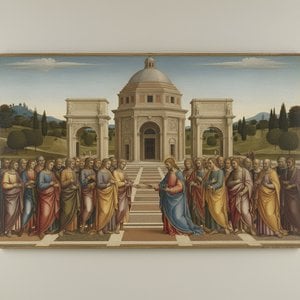
The Life and Legacy of Francesco Bergamini
In the vibrant tapestry of late nineteenth-century Italian art, few figures capture the quiet transition from classical tradition to a more nuanced observational style as gracefully as Francesco Bergamini. Born around 1851 in the historic and spiritual enclave of Assisi, Bergamini emerged from an era where the echoes of the Renaissance still resonated deeply within the Italian soul. His early years were shaped by the profound landscapes and religious heritage of Umbria, a setting that undoubtedly instilled in him a reverence for light, form, and the subtle drama found within everyday existence. As his talent blossomed, he moved toward the intellectual and artistic epicenter of Rome, eventually establishing himself as a figure of significant academic importance.
Bergamini’s career was marked by a profound dedication to the mastery of the craft, a pursuit that led him to the prestigious Academy of Fine Arts of Rome. His tenure there, particularly between 1894 and 1898, saw him transition from a student of the masters to a respected university teacher. This period of his life was crucial, as it allowed him to influence a new generation of painters, passing on the rigorous technical standards of the Roman school while encouraging a more personal, emotive approach to subject matter. His role as an educator underscores his deep understanding of the foundational elements of painting—composition, anatomy, and the delicate interplay of shadow and light.
Artistic Vision and Thematic Depth
The works of Francesco Bergamini are characterized by a remarkable ability to breathe life into both the mundane and the monumental. His repertoire suggests a painter deeply enamored with the human condition and the narrative potential of a single moment. Whether capturing the rhythmic movement of a religious procession or the intimate, psychological tension found in a portrait of a fortune teller, Bergamini possessed a unique gift for storytelling through brushwork. His technique often balanced a disciplined academic precision with a burgeoning interest in the atmospheric qualities that would define much of the era's evolving aesthetic.
In his compositions, one can observe a masterful use of light to direct the viewer's eye and evoke specific emotional responses:
- Narrative Realism: His ability to depict scenes such as The Procession demonstrates a keen eye for capturing communal energy and the solemnity of tradition.
- Character Study: Through works like Die Wahrsagerin (The Fortune Teller), he explored the mystery and intrigue of individual personalities, using light to shroud or reveal character traits.
- Genre Painting: His depictions of everyday life, including more whimsical or rustic subjects, showcase a versatility that allowed him to move between high academic themes and charming, relatable vignettes.
Historical Significance and Final Years
As the nineteenth century drew to a close, Bergamini’s work stood as a testament to the enduring strength of Italian figurative painting. While the art world began to shift toward more radical modernism, Bergamini remained anchored in a tradition that valued the integrity of the subject and the technical excellence of the execution. His life, which came to an end around 1910 in Rome, spanned a period of immense political and social transformation within the Kingdom of Italy, yet his art remained focused on the timeless elements of human experience.
Today, the legacy of Francesco Bergamini resides in the quiet power of his canvases. He remains a significant figure for those studying the evolution of Italian academic art, representing a bridge between the rigid structures of the past and the more expressive, observational freedoms of the coming century. His contributions to the Academy and his enduring imagery continue to offer a window into the heart of late 19th-century Roman artistic life, reminding us of a time when every brushstroke was an act of profound devotion to beauty and truth.