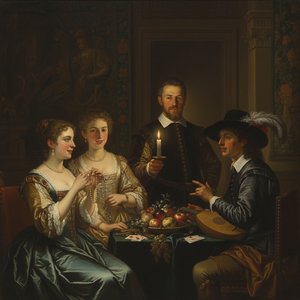
A Master of the Northern Light
The story of Abraham Wuchters is one of movement, prestige, and the seamless blending of artistic traditions across borders. Born in the vibrant artistic hub of Antwerp around 1608, Wuchters carried with him the sophisticated essence of the Low Countries to the royal courts of Scandinavia. While his early years remain somewhat shrouded in the mists of history, it is widely believed that he may have been shaped by the atmosphere of Amsterdam, perhaps even absorbing the dramatic chiaroscuro techniques associated with the legendary Rembrandt. This infusion of Dutch Golden Age mastery provided him with a technical foundation that would later define the visual language of the Danish Baroque.
His journey took a definitive turn in 1638 when he arrived in Copenhagen, an arrival that would forever alter the trajectory of Danish art. Almost immediately, Wuchters established himself as a painter of profound capability, securing the patronage of King Christian IV. His ability to capture not just the likeness, but the very soul and status of his subjects, made him an indispensable figure in the royal circle. By 1639, his reputation was so firmly established that he was appointed as the director of the drawing academy at Sorø, a position that allowed him to influence a new generation of artists and solidify his role as a cornerstone of Northern European painting.
The Synthesis of Elegance and Realism
As Wuchters’ career matured, his style evolved into a breathtaking synthesis of diverse European influences. He possessed a unique ability to marry the fluid, aristocratic elegance of Anthony van Dyck with a more grounded, unadorned precision. This duality allowed him to navigate the demands of high-society portraiture while maintaining a sense of tactile reality. In his hands, the heavy textures of velvet robes and the delicate shimmer of lace were rendered with such fidelity that they seemed almost tangible to the viewer.
His technical prowess is perhaps most evident in his mastery of light. Rather than relying solely on harsh contrasts, Wuchters often employed a warm, luminous glow that lent his portraits a dreamy, ethereal quality. This is particularly striking in his depictions of the Danish nobility and royalty, where the incidence of light serves to highlight the dignity of the sitter. His work often features:
- Luminous Skin Tones: A soft, radiant treatment of flesh that suggests vitality and grace.
- Textural Depth: An extraordinary command over the depiction of varied materials, from heavy brocades to fine linens.
- Psychological Depth: The use of a "dreamy glance" or subtle facial expressions to convey the inner character of his subjects.
A Lasting Legacy in the Danish Golden Age
The historical significance of Abraham Wuchters cannot be overstated. Alongside contemporaries like Karel van Mander III, he acted as a primary conduit through which the innovations of the Dutch Golden Age flowed into Denmark. He did not merely transplant foreign styles; he cultivated a local aesthetic that was both cosmopolitan and distinctly Danish. His portraits of figures such as Frederick III and the statesman Peter Griffenfeld remain enduring monuments to an era of political and cultural transition.
Through his work, the court of Copenhagen found a visual voice that reflected its growing power and sophistication. Wuchters’ ability to blend the grandiosity of the Baroque with a personal, fresh approach to light ensured that his influence would linger long after his death in 1682. Today, his paintings stand as vital windows into the seventeenth century, capturing the splendor, the weight of authority, and the quiet, human moments of a bygone age.