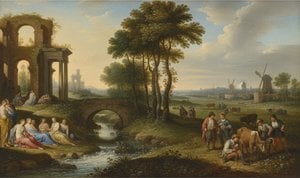
The Shadow of a Master: The Life and Legacy of Cornelis Kruys
In the grand tapestry of the seventeenth century, where the golden light of the Dutch Golden Age illuminated the canvases of masters, certain names linger in the periphery like soft echoes of a fading melody. Cornelis Kruys remains one such figure, an artist whose presence is felt through the historical currents of his era, yet whose personal narrative remains shrouded in the delicate mists of time. Born in 1619, Kruys emerged during a period of unparalleled artistic flourishing in the Netherlands, a time when the very air seemed thick with the scent of oil paint and the ambition of a rising merchant class.
While much of the biographical detail surrounding his early years has been lost to the centuries, we know that he lived through an epoch defined by profound transformation. The world into which Kruys was born was one of burgeoning maritime power and intellectual awakening. As a contemporary to the giants of the Baroque movement, his existence was intertwined with the same cultural shifts that allowed for the rise of intricate landscapes, dramatic portraiture, and the meticulous observation of everyday life that would come to define Northern European art.
Artistic Context and the Spirit of the Age
To understand the essence of Cornelis Kruys, one must look beyond the scarcity of written records and instead observe the artistic landscape that surrounded him. The mid-seventeenth century was a period where technique and symbolism danced in a delicate balance. Artists were no longer merely recording reality; they were interpreting the divine through the lens of the mundane. Whether it was the allegorical depth found in the works of his contemporaries or the quiet, atmospheric stillness of a Dutch interior, the era demanded a mastery of light and shadow—a chiaroscuro that could breathe life into a flat surface.
Though specific records of Kruys's individual stylistic evolution are rare, he operated within a tradition that valued precision, texture, and the evocative power of the natural world. The influence of the Dutch masters—those who could capture the glint of light on a silver goblet or the heavy dampness of a low-hanging cloud—would have been the very foundation of his training. His era was one where every brushstroke carried the weight of meaning, and every composition was a carefully constructed window into a world of both physical beauty and moral reflection.
A Historical Resonance
The significance of an artist like Cornelis Kruys lies not only in the surviving fragments of his oeuvre but in his role as a participant in a monumental movement. He belonged to a generation that helped solidify the identity of Dutch art, moving it away from the religious iconographies of the South toward a more secular, observational, and humanistic approach. His life, spanning the mid-1600s until his passing in 1654, coincided with the peak of this artistic revolution.
In reflecting upon his legacy, we find a poignant reminder of the ephemeral nature of fame. While names like Rembrandt or Vermeer have become synonymous with the heights of human achievement, artists like Kruys represent the essential fabric of the era—the skilled hands and observant eyes that contributed to the collective brilliance of the Dutch Golden Age. His life serves as a testament to the enduring spirit of an age that sought to capture the infinite within the finite, leaving behind a legacy that continues to haunt the halls of art history with its quiet, dignified presence.