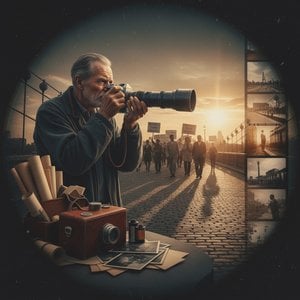
The Convergence of Spirit and Lens: The Art of Cang Xin
In the vibrant, ever-shifting landscape of contemporary Chinese art, few figures command as much contemplative presence as Cang Xin. Born in Beijing in 1967, his journey is not one of traditional academic painting, but rather a profound odyssey through movement, ritual, and the silver halide of photography. Growing up within a family of artists, Cang Xin was immersed from birth in an environment where visual expression was a primary language. Yet, his path took an unexpected detour through music school, a period that instilled in him a rhythmic sensibility and a deep understanding of sensory storytelling. This musical foundation would later inform the cadence of his performances, allowing him to treat the human body and the photographic frame as instruments capable of composing complex emotional symphonies.
As he transitioned from the auditory to the visual, Cang Xin bypassed the conventional mastery of the brush to embrace the raw, immediate power of performance art. His work emerged during a pivotal era in Chinese contemporary art, characterized by a search for new identities amidst rapid social transformation. Rather than seeking to represent reality through static imagery, he sought to inhabit it. By utilizing his own body as a canvas and a site of experimentation, he began to explore the delicate boundaries between the self and the external world, often drawing upon the ancient, shamanic traditions of China. These ritualistic elements—rooted in the belief that spirits reside within the natural environment—imbue his work with a spiritual gravity that transcends mere spectacle.
The Alchemy of Photography and Ritual
The true brilliance of Cang Xin’s practice lies in the seamless marriage of performance and photography. For him, the camera is far more than a tool for documentation; it is an alchemical device used to distill the ephemeral essence of a performance into a permanent, haunting image. His photographic style is frequently defined by a stark, evocative use of black and white, which strips away the distractions of color to focus on texture, light, and symbolic weight. In this monochromatic realm, the boundaries between the physical body and the natural landscape begin to blur.
A central pillar of his oeuvre is the celebrated 'Exchange Series', a body of work that exemplifies his fascination with human connection and biological continuity. Through these works, he explores themes of:
- The profound interconnectedness between individual identity and the collective human experience.
- The use of symbolic imagery, such as acupuncture, to bridge the gap between ancient medicinal traditions and modern conceptual thought.
- The exploration of the body as a vessel for both cultural memory and spiritual transcendence.
Legacy and Historical Significance
Cang Xin’s contribution to the global art dialogue is marked by his ability to navigate the tension between East and West. While his techniques—performance and conceptual photography—align with international contemporary movements, his soul remains deeply anchored in the philosophical traditions of China. He does not merely observe history; he performs it, reinterpreting the spiritual heritage of his ancestors through a lens that is critically aware of the modern condition. His work serves as a vital bridge, connecting the ritualistic past to an uncertain, technological future.
In the broader context of the East Village artists and the evolution of Chinese contemporary art, Cang Xin stands as a pioneer who redefined what it means to "make" art. He proved that the artist's presence, their breath, and their very skin could be just as potent a medium as oil or clay. Through his enduring commitment to exploring identity, spirituality, and our relationship with the earth, Cang Xin has secured a legacy that continues to challenge viewers to look beyond the surface and seek the profound, unseen connections that bind all living things.
질의응답
Cang Xin 작가의 작품을 감상할 수 있는 3D 가상 투어가 있나요?
Cang Xin의 3D 뮤지엄는 작가의 작품들을 가상 3D 갤러리로 선보이는 페이지입니다.
키워드별로 분류된 Cang Xin의 작품은 어디에서 볼 수 있나요?
Cang Xin의 작품은 아티스트의 키워드별로 페이지에서 키워드별로 찾아보실 수 있습니다. 각 키워드는 관련 작품들을 그룹화하여 보여줍니다.
Cang Xin의 작품을 분위기별로 모아둔 곳은 어디인가요?
Cang Xin의 작품은 각 작품에 담긴 분위기에 따라 분류된 아티스트의 무드 룸 페이지에서 무드별로 감상하실 수 있습니다.
특정 팔레트의 Cang Xin 작품은 어떻게 찾을 수 있나요?
컬러 팔레트별 페이지에서는 Cang Xin의 작품들을 색상 팔레트별로 모아볼 수 있습니다.
Cang Xin은(는) 어느 시대에 활동했나요?
Cang Xin은(는) Contemporary 시대에 활동했습니다. 이 시기는 역사적 맥락에서 작가의 활동 위치를 보여줍니다.
Cang Xin의 출생 도시와 국가는 어디인가요?
Cang Xin은(는) China의 Beijing에서 태어났습니다.
Cang Xin의 작품을 연도순으로 어디에서 볼 수 있나요?
Cang Xin의 작품 연표를 확인해 보세요: 작품 연대기 페이지에서 작품들을 제작 날짜순으로 보실 수 있습니다.
Cang Xin의 모든 작품을 어디에서 볼 수 있나요?
본 웹사이트에 등록된 Cang Xin의 모든 작품은 작가의 모든 작품 보기 페이지에서 확인하실 수 있습니다.