The Sonic and Visual Tapestry of Brian V. Jones
To contemplate the legacy of Brian V. Jones is to wander through a labyrinth where the boundaries between sound and sight dissolve into a singular, psychedelic experience. A figure often shrouded in the mythic aura of the late 1960s, Jones was far more than a mere participant in the cultural revolution; he was a primary architect of its atmosphere. Born in Bristol, England, on August 9, 1942, his early life was a fertile ground for both musical virtuosity and an burgeoning aesthetic curiosity. His journey began with the raw, emotive power of the blues, drawing inspiration from legends like Muddy Waters, yet he possessed a restless intellect that sought to marry these traditional roots with the avant-garde textures of experimental composers such as Karlheinz Stockhausen. This unique duality—the ability to ground himself in tradition while reaching for the unknown—would become the hallmark of his entire creative existence.
The trajectory of his life changed irrevocably in 1963 when he joined The Rolling Stones, a move that would catapult him into the global epicenter of rock and roll. Within the band, Jones acted as a sonic chameleon, utilizing an array of instruments—from the slide guitar to the sitar and marimba—to expand the group's musical vocabulary. His contributions to seminal albums such as Sticky Fingers, Let It Bleed, and Beggar's Banquet provided the essential psychedelic textures that defined an era. Through his mastery of the slide guitar, he injected a sense of swirling, hypnotic movement into the band’s repertoire, creating a soundscape that was as much about atmosphere and color as it was about rhythm and melody.
A Vision in Color and Urban Realism
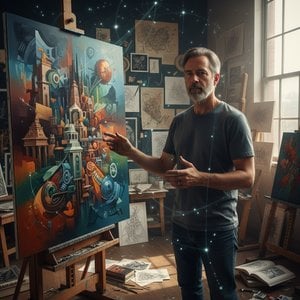
While history often remembers him through the lens of musical innovation, Jones’s visual explorations offered a parallel dimension to his sonic experiments. His artistic practice was deeply intertwined with the zeitgeist of the psychedelic era, characterized by a fascination with vibrant colors and fluid forms that mirrored the kaleidoscopic shifts in consciousness prevalent during the late 1960s. However, as his career progressed, his gaze shifted toward a different kind of intensity: the gritty, textured reality of the urban landscape. This evolution saw him moving from the ethereal realms of psychedelic imagery into the profound, documentary-style observations found in his later works.
In series such as Connecticut Avenue, Jones demonstrated a remarkable ability to capture the soul of the city through both photography and painting. His work from this period, including pieces like "Dancing" and "Shoe Store," reveals an artist obsessed with the interplay of light, shadow, and materiality. He possessed a singular talent for finding beauty in urban decay, using layered textures and striking contrasts to evoke memory and the fleeting nature of time. Whether through the stark, black-and-white realism of his photography or the evocative, textured layers of his canvases, Jones sought to tell stories of the human experience embedded within the architecture of the streets.
Legacy of a Multifaceted Visionary
The historical significance of Brian V. Jones lies in his refusal to be confined by a single medium. He existed at the intersection of multiple disciplines, proving that the impulse to create is a unified force, whether expressed through a guitar string or a paintbrush. His ability to translate the turbulent spirit of his era into both auditory and visual forms has left an indelible mark on the landscape of contemporary art and music.
Reflecting on his enduring impact, several key elements of his contribution stand out:
- Musical Innovation: The introduction of diverse instrumentation and psychedelic textures to the blues-rock foundation of The Rolling Stones.
- Visual Storytelling: A transition from psychedelic abstraction to a profound, documentary-style exploration of urban life and architecture.
- Aesthetic Synthesis: The seamless blending of experimental influences with traditional forms, creating a cohesive sensory experience.
- Cultural Resonance: Capturing the essence of the late 20th-century zeitgeist through both his sonic textures and his focus on the grit and beauty of the modern cityscape.