Lee Salvador: A Voice of Urban Resilience Through Vibrant Textile Art
Born in Manila, Philippines, in 1983, blic – more formally known as Lee Salvador – is a name increasingly recognized within the global street art community. His work transcends mere graffiti; it’s a potent blend of urban observation, personal reflection, and a distinctly Filipino sensibility. From his early beginnings sketching on discarded paper to his current explorations of textile art and large-scale murals, Salvador's journey reflects a deep engagement with both the raw energy of the streets and the rich cultural heritage of his homeland.
Salvador’s artistic trajectory began organically, fueled by childhood memories and a desire to express himself beyond the confines of formal education. Growing up amidst the vibrant chaos of Manila, he was profoundly influenced by the iconic cartoons and television shows of his youth – a potent mix of Western animation and Filipino storytelling. This early exposure instilled in him a love for bold colors, playful characters, and a willingness to embrace the unconventional. He initially honed his skills through street art, experimenting with stickers and smaller-scale interventions before gravitating towards the more permanent medium of murals. A pivotal moment came through his connection with Cavity Collective, a group of artists dedicated to amplifying marginalized voices within Filipino society.
The Language of Character and Textile
Salvador’s distinctive style is immediately recognizable: a captivating cast of characters that often inhabit surreal landscapes. These figures – frequently described as “monsters” or “creatures” – are imbued with a surprising vulnerability, reflecting the complexities of human experience. He masterfully employs a ‘lowbrow’ aesthetic, drawing inspiration from pop art and comic books, but infusing it with a distinctly Filipino perspective. His characters aren't simply decorative; they carry symbolic weight, often grappling with themes of identity, social commentary, and personal struggle.
A significant shift in Salvador’s practice occurred as he began to explore textile art. Moving beyond the traditional boundaries of street art, he embraced fabrics – silks, velvets, and other textured materials – creating layered compositions that add a tactile dimension to his work. This transition reflects a deeper engagement with storytelling; textiles offer a rich visual vocabulary for conveying narratives and emotions. The use of fabric also allows him to incorporate elements of traditional Filipino weaving techniques, subtly blending contemporary street art with ancestral artistry.
Cavity Collective: A Hub of Collaborative Creativity
Salvador’s involvement with Cavity Collective is central to understanding his artistic development. This collective serves as a vital incubator for emerging Filipino artists, fostering collaboration and providing a platform for diverse voices. The group's ethos aligns closely with Salvador’s own commitment to social engagement – using art as a tool for dialogue and challenging conventional narratives. Through Cavity Collective, he has had the opportunity to exhibit his work in galleries across Manila and beyond, expanding his reach and solidifying his position within the contemporary Filipino art scene.
Notable Works and Recognition
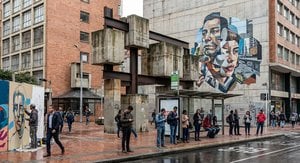
Several of Salvador’s works have garnered significant attention, including “untitled” (D9BU9Q), a vibrant graffiti mural featuring an alien figure amidst geometric patterns that evokes both dystopian futurism and a sense of childlike wonder. His work has been featured in exhibitions at Galerie Roberto, Village Art Gallery, and Ysobel Gallery, demonstrating his growing recognition within the broader art community. Furthermore, his contributions to the Filipino Street Art Project have ensured his visibility as a key figure in documenting and celebrating this dynamic movement.
Beyond his individual achievements, Salvador’s work speaks to a larger cultural conversation – one that explores themes of identity, resilience, and the power of art to transform urban spaces. His distinctive style, combined with his commitment to social engagement, positions him as a compelling voice within contemporary Filipino art.
질의응답
Blic, Lee Salvador의 출생지와 출생 연도는 언제인가요?
Blic, Lee Salvador은(는) 1983년 Manila에서 태어났습니다.
Blic, Lee Salvador 작가는 어떤 사조에 참여했나요?
Blic, Lee Salvador 작가가 활동했던 예술 사조는 작품을 사조별로 분류하여 보여주는 작가의 모든 사조 페이지에서 확인하실 수 있습니다.
Blic, Lee Salvador 작가 작품에 대한 통계 정보는 어디에서 확인할 수 있나요?
Blic, Lee Salvador 작가 작품에 관한 통계 정보는 작가의 통계 페이지에서 확인하실 수 있습니다.
Blic, Lee Salvador의 출생 도시와 국가는 어디인가요?
Blic, Lee Salvador은(는) Philippines의 Manila에서 태어났습니다.
Blic, Lee Salvador 작가의 출신 국가는 어디인가요?
Blic, Lee Salvador은(는) Philippines에서 태어났습니다.
Blic, Lee Salvador의 연도별 활동 기록이 있나요?
Blic, Lee Salvador의 연대기는 작가의 활동 시기별로 분류된 작품들을 연대순으로 보여주는 스크롤 방식의 타임라인입니다.
주제별로 Blic, Lee Salvador의 작품을 탐색할 수 있나요?
Blic, Lee Salvador의 작품은 작가의 주제별 아틀라스 페이지에서 주제별로 찾아보실 수 있습니다.