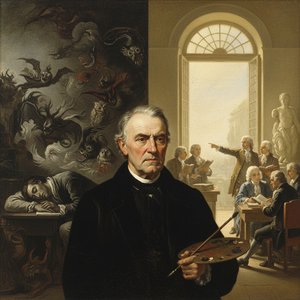
The Florentine Influence in the Spanish Court
To understand Bartolomeo Carducci, one must look past the Spanish corruption of his name, Carducho, and see the technical rigor of a Florentine upbringing. He did not arrive in Madrid as a finished product but as a student of structural discipline. His training was multidisciplinary, spanning architecture and sculpture under Bartolomeo Ammannati and painting under Federico Zuccari. This foundation gave his later canvases a specific weight. He understood how to build a figure in space before he ever applied color to a surface.
His career was defined by a significant relocation. Following Zuccari to Madrid, Carducci moved from the intellectual atmosphere of Florence into the service of the Spanish court. This was not a mere change of scenery; it was a shift in purpose. He contributed to the monumental decoration of the Escorial, working on the library ceiling and the frescos within the palace cloisters. His ability to handle large-scale architectural spaces made him an essential asset in the production of these grand religious environments.
Technical Precision and Religious Narrative
Carducci’s work is characterized by a commitment to disegno—the Florentine emphasis on precise drawing and structural integrity. This was not a decorative impulse but a method of creating presence. His figures possess a sculptural quality that stems directly from his early studies in sculpture. This technical grounding allowed him to navigate the demands of the Counter-Reformation, where art was required to communicate intense religious fervor through clear, human emotion.
His output during the early seventeenth century shows a mastery of light and shadow used to define form. His notable works include:
- The Last Supper (1605), currently held in the Museo del Prado.
- Descent from the Cross, also located in the Museo del Prado.
- Penitent St. Jerome, held by the Real Academia de Bellas Artes de San Fernando.
- Reliquary altarpieces for San Diego de Valladolid, completed between 1604 and 1606 with his brother Vincenzo.
The presence of his work in the Museo del Prado confirms his standing within the Spanish Golden Age. He did not merely paint scenes; he constructed them with a sense of volume that resisted the flatness of lesser contemporaries. His brother, Vincenzo, eventually succeeded him as the chief painter to King Philip III, marking a period of significant familial influence in the Spanish court.