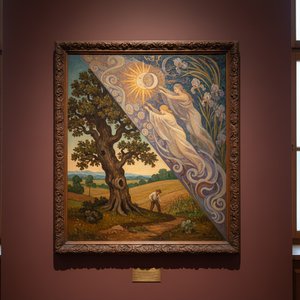
The Visionary of Czech History: The Life of Adolf Liebscher
Born amidst the vibrant cultural landscape of Prague in 1857, Adolf Liebscher emerged as a profound voice in the realm of Czech history painting. His journey into the heart of classical artistry began with a rigorous education in his native city, but it was his move to Vienna that truly ignited his creative spirit. Under the tutelage of Ferdinand Laufberger, Liebscher mastered the delicate nuances of drawing and composition, preparing himself for the grand stages of European art. A pivotal moment in his early career arrived when he secured second prize in a prestigious competition for the decorations of the National Theater's foyer, a feat that saw his meticulous drawings integrated into the very fabric of one of Prague's most iconic cultural landmarks.
Liebscher’s artistic soul was further enriched by the sun-drenched landscapes and classical grandeur of Italy. This period of travel provided him with a fresh perspective on light and form, which he would later weave into his monumental historical narratives. Upon returning to Bohemia, he became a sought-after figure for public commissions, decorating significant structures such as the Rudolfinum and various government buildings in Vinohrady and Vyškov. His ability to blend academic precision with deep emotional resonance allowed him to capture not just scenes of the past, but the very essence of national identity.
Symbolism and the Spirit of a Nation
Beyond his technical mastery, Liebscher was an artist deeply attuned to the political and social currents of his time. His work often served as a silent yet powerful commentary on the struggles of the Czech people under the Austro-Hungarian monarchy. This is perhaps most poignantly realized in his 1903 cycle of tempera paintings titled "Czech Elegy." Within this series, he utilized religious and historical iconography—most notably an iconic portrait crowned with thorns—to symbolize the collective suffering and resilience of the Czech nation. Through such evocative imagery, Liebscher transformed the canvas into a space for national reflection and quiet defiance.
His versatility extended far beyond the heavy themes of history painting. He possessed a remarkable ability to pivot between the monumental and the intimate, producing:
- Folk-costume studies that celebrated the rich, tactile traditions of Bohemian culture.
- Altarpieces that brought a sense of sacred grandeur to religious spaces.
- Illustrations for renowned magazines such as Zlatá Praha and Světozor, which brought his artistic vision into the homes of the general public.
A Legacy of Collaboration and Instruction
The creative life of Adolf Liebscher was also marked by a profound familial connection to the arts. Alongside his brother, the landscape painter Karel Liebscher, he contributed to the visual splendor of Prague through collaborative works, such as the panoramic mural "The Swedes on the Charles Bridge"* located in the Mirror Maze at Petřín. This synergy between the two brothers allowed for a unique blending of historical narrative and atmospheric landscape, creating immersive environments that captured the imagination of contemporary viewers.
As his career matured, Liebscher transitioned from a rising star to a pillar of the academic community. His dedication to the craft led him to the Technical University, where he rose through the ranks from teacher to Associate Professor, and eventually to the esteemed position of Professor in 1911. Through his teaching, he ensured that the traditions of historical painting and meticulous draftsmanship would be passed down to future generations. When he passed away in 1919, he left behind a legacy defined by a profound respect for history, a deep love for his homeland, and an unwavering commitment to the transformative power of art.