

Willem de Kooning: Abstraction, Gesture & the Evolution of Post-War American Painting
목차
The Genesis of a New Vanguard: De Kooning & the Shift from Social Realism
The early 1940s witnessed a seismic shift in the American art landscape, a departure from the Regionalism and Social Realism that had defined much of the preceding decade. While artists like Grant Wood and Thomas Hart Benton sought to depict distinctly American scenes with narrative clarity, a new generation, largely centered in New York City, began to explore the depths of subjective experience. This wasn’t merely a stylistic change; it was a fundamental re-evaluation of art's purpose, fueled by the anxieties of a world grappling with the aftermath of the Great Depression and the looming shadow of World War II. Willem de Kooning stood at the forefront of this movement, though defining him as simply an “Abstract Expressionist” feels inadequate given the breadth and complexity of his artistic journey. He, along with contemporaries like Jackson Pollock and Mark Rothko, inherited a legacy of European modernism – Cubism, Surrealism, and Fauvism – but sought to forge something distinctly American, rooted in their own psychological and emotional terrain.
The influence of the German expatriate Hans Hofmann cannot be overstated. As a teacher, Hofmann instilled in his students a rigorous understanding of form and color, emphasizing the importance of pushing boundaries and embracing abstraction as a means of conveying deeper meaning. He encouraged artists to move beyond representation, urging them to explore the inherent qualities of paint itself – its texture, weight, and capacity for emotional expression. This emphasis on process, on the act of painting as a performative gesture, became central to the Abstract Expressionist ethos. The Works Progress Administration (WPA) also played a crucial role, providing artists with employment during the Depression and fostering a sense of community and experimentation.
Abstract Expressionism Defined: Core Tenets, Influences & Key Characteristics
To categorize Abstract Expressionism is to inherently limit its scope. It was less a unified style than a shared set of sensibilities – an emphasis on large-scale canvases, spontaneous gesture, and the exploration of the subconscious mind. The movement’s roots lie in Surrealism's automatic techniques, but where Surrealists sought to unlock hidden imagery through dreamlike landscapes, Abstract Expressionists focused on the raw energy of the painting process itself. The term “action painting,” coined by Harold Rosenberg, aptly captures this emphasis; the canvas became an arena for direct physical engagement, a record of the artist’s emotional state and psychological struggles. However, to focus solely on action painting overlooks another crucial strand within Abstract Expressionism: Color Field painting, exemplified by Mark Rothko's luminous blocks of color.
The diverse group of artists associated with the New York School – Arshile Gorky, Franz Kline, Lee Krasner, Barnett Newman, Adolph Gottlieb, Clyfford Still, Robert Motherwell – shared a common desire to create art that was monumental in scale and deeply resonant in emotional impact. They rejected traditional notions of beauty and representation, instead prioritizing authenticity and individual expression. The influence of European modernism remained potent, but it was filtered through the lens of American experience, resulting in a uniquely powerful and visceral aesthetic.
De Kooning’s Signature Style: Gesture, Brushwork and the Figure-Ground Relationship
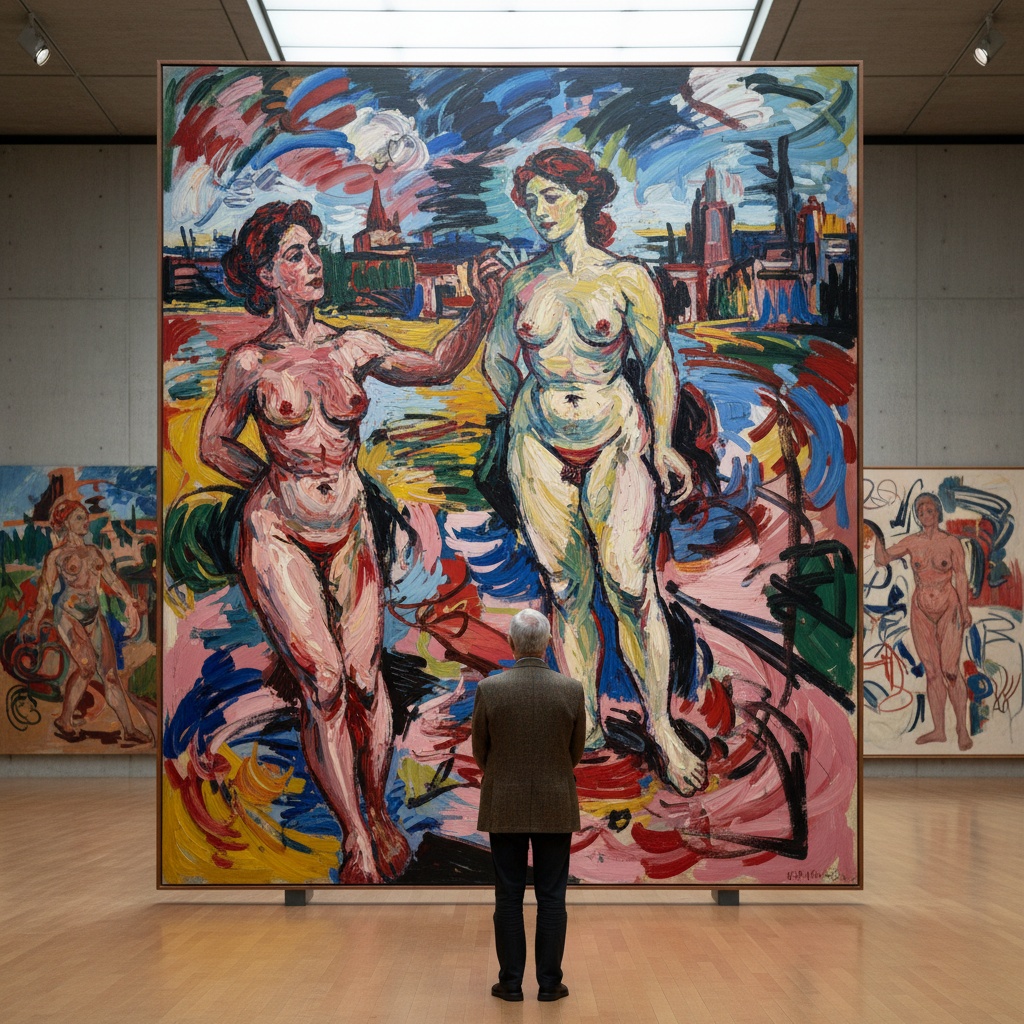
Willem de Kooning's style is immediately recognizable for its dynamic energy, aggressive brushwork, and ambiguous forms. Unlike Pollock’s all-over compositions or Rothko’s serene color fields, De Kooning often grappled with figuration, albeit a highly distorted and fragmented one. His early works demonstrate a clear understanding of traditional painting techniques, but he quickly abandoned conventional representation in favor of a more intuitive approach. He layered paint thickly, scraping, slashing, and reworking the surface to create a sense of depth and movement. This process wasn’t about achieving a polished finish; it was about revealing the underlying struggle, the constant negotiation between intention and accident.
The figure-ground relationship in De Kooning's paintings is often deliberately ambiguous, creating a tension that draws the viewer into the work. Forms emerge from and dissolve back into the surrounding space, challenging traditional notions of perspective and composition. His brushstrokes are not merely descriptive; they are expressive gestures that convey emotion, energy, and psychological intensity.
Woman I & Beyond: Exploring Themes of Identity, Abstraction & Controversy
Perhaps De Kooning’s most famous – and controversial – series is the *Woman* paintings (1950-1953). These monumental canvases depict distorted female figures with aggressive brushwork and unsettling gazes. The series sparked considerable debate, with some critics accusing De Kooning of misogyny. However, a closer examination reveals a more complex narrative. The women are not simply representations of the feminine; they are embodiments of primal energy, anxiety, and the complexities of human relationships.
Woman I, in particular, is a powerful example of De Kooning’s ability to blend abstraction with figuration. The figure is fragmented and distorted, yet undeniably present. The clashing colors and aggressive brushwork convey a sense of turmoil and psychological tension. De Kooning himself described the series as an attempt to grapple with his own anxieties about representation and the challenges of depicting the human form. He wasn’t interested in creating idealized images; he wanted to capture the raw, visceral reality of human experience.
The Later Years: Landscapes, Color Fields & De Kooning's Continued Evolution
In the late 1950s and early 1960s, De Kooning’s work underwent another significant transformation. Motivated by a move to Springs, Long Island, he began to paint landscapes inspired by water, light, and motion. These “Parkway Landscapes,” as they are often called, feature more open compositions and a looser brushstroke than his earlier works. He experimented with new techniques, mixing his paint with greater liquidity and applying it with a speed and force that is especially apparent in paintings like Door to the River.
These later landscapes demonstrate De Kooning’s continued willingness to push boundaries and explore new artistic possibilities. While they may appear less overtly aggressive than his earlier works, they are no less emotionally resonant. He described the content of these paintings as “emotions…landscapes and highways and sensations…outside the city—with the feeling of going to the city or coming from it.” Even in his later years, De Kooning remained committed to exploring the relationship between painting, emotion, and experience.
Collecting De Kooning: Investment Value, Provenance & Considerations for Connoisseurs
Willem de Kooning’s works are highly sought after by collectors worldwide. His paintings consistently command high prices at auction, reflecting their historical significance and enduring aesthetic appeal. Investing in a De Kooning is not merely acquiring an artwork; it's owning a piece of art history.
When considering a purchase, provenance – the documented history of ownership – is paramount. A clear provenance establishes authenticity and adds to the value of the work. It’s also crucial to consider the condition of the painting, as well as its exhibition history and scholarly publications. De Kooning's works are often complex and nuanced, so it’s essential to consult with an experienced art advisor or appraiser before making a purchase. At ArtsDot.com, we offer expert guidance on collecting Abstract Expressionist paintings, providing detailed information about artists, movements, and investment potential. We also specialize in creating high-quality reproductions of De Kooning’s masterpieces, allowing collectors to experience the power and beauty of his work firsthand.
관련 기사 더 보기

Beyond Representation: Exploring Gesturality, Emotion, and Philosophical Underpinnings of Contemporary Abstract Painting
Explore the evolution of abstract painting with ArtsDot. Discover key artists, historical context & investment insights. Find museum-quality reproductions and expert appraisal services.

Beatrice Parsons: A Study in Abstract Expressionism & the Poetics of Color Field Painting
Explore the captivating world of Beatrice Parsons, a pioneering British abstract expressionist. Discover her journey from garden watercolors to evocative color field paintings and learn about her place within art history.

Yvonne Jean Haffen: A Breton Vision of Post-War Abstraction
Discover the captivating world of Yvonne Jean Haffen, a leading figure in post-war French abstraction. Explore her unique style, vibrant color palettes, and investment potential with ArtsDot.

Paul Jenkins: Abstraction, Color Field Painting & the Pursuit of Lyrical Expression
Explore the captivating world of Paul Jenkins, a pioneer of abstract expressionism & color field painting. Discover his unique ‘Phenomena’ series and investment potential for art collectors. Expert insights at ArtsDot.

추상표현주의를 정의한 10대 걸작: 예술과 인테리어의 새로운 영감
추상표현주의의 심장을 뛰게 한 10대 걸작을 만나보세요. 폴록, 로스코 등 거장의 작품 비하인드 스토리와 예술적 영감을 ArtsDot에서! 지금 바로 미술품 컬렉션을 탐험하고, 당신의 공간에 특별한 예술적 감성을 더하세요. ArtsDot.com

