


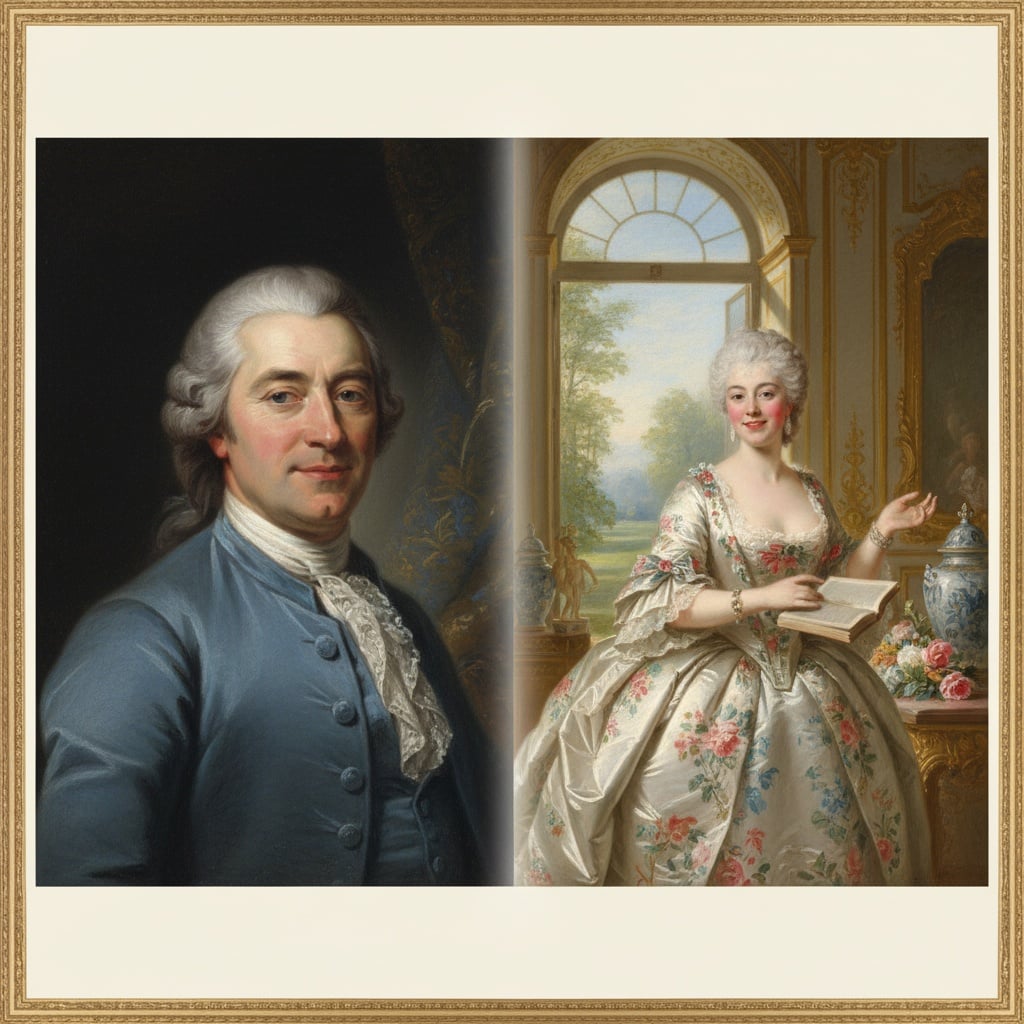
The Enigmatic Life of Maurice Quentin de La Tour
 Wikipedia: Maurice Quentin de La Tour
Maurice Quentin de La Tour (French pronunciation: [mɔʁis kɑ̃tɛ̃ də la tuʁ]; 5 September 1704 – 17 February 1788) was a French painter who specialised in portrait painting using pastels in the Rococo style. Among his most famous subjects were Voltaire...
Maurice Quentin de La Tour remains a somewhat elusive figure within the pantheon of 18th-century French artists, yet his contribution to portraiture – specifically through the delicate medium of pastel – is undeniable. Born in Saint-Quentin in 1704, his early life offers few documented details beyond familial connections to music and craftsmanship. This relative obscurity only adds to the mystique surrounding his work, fostering a sense that each portrait reveals not just the sitter’s likeness but also a carefully guarded aspect of the artist himself. Unlike many contemporaries who benefited from extensive academic training, de La Tour's path was more self-directed, initially apprenticing with Claude Dupouch before venturing to Paris in his late teens – a move reportedly prompted by a discreet romantic entanglement. This early independence perhaps instilled within him a unique artistic sensibility, one that prioritized psychological insight over rigid adherence to convention.
De La Tour’s arrival in Paris coincided with the burgeoning Rococo movement, a style characterized by its lightness, elegance, and focus on aristocratic leisure. However, his work distinguishes itself from the more overtly frivolous aspects of Rococo, possessing instead a remarkable degree of realism and emotional depth. He quickly established himself as a sought-after portraitist, attracting commissions from prominent figures including Voltaire, Jean-Jacques Rousseau, and even Louis XV and Madame de Pompadour – testaments to his growing reputation for capturing not merely appearance but the very essence of his subjects.
A Master of Pastel: Technique & Innovation
 Wikipedia: Pastel
A pastel (US: ) is an art medium that consists of powdered pigment and a binder. It can exist in a variety of forms, including a stick, a square, a pebble, and a pan of color, among other forms. The pigments used in pastels are similar to those used ...
The defining characteristic of Maurice Quentin de La Tour’s artistry lies in his exclusive dedication to pastel. While the medium had been utilized previously, he elevated it to an unprecedented level of sophistication and expressive potential. He wasn't simply applying color; he was building form through layers of meticulously blended pigment, achieving a luminosity and softness that oil paint often struggled to replicate. His technique involved a complex process of layering chalks – sometimes hundreds of layers – on blue paper, carefully modulating tone and texture to create an astonishingly lifelike effect. This painstaking approach demanded exceptional skill and patience.
De La Tour’s mastery extended beyond mere technical proficiency. He understood the inherent qualities of pastel—its ability to capture fleeting expressions, its delicate surface, and its capacity for subtle gradations of color—and exploited them to create portraits that were remarkably intimate and psychologically revealing. He often employed a technique of *fixing* his pastels with multiple layers of gum arabic, a process which, while preserving the work, also contributed to the unique texture and depth found in his paintings. This dedication to experimentation and refinement set him apart from his contemporaries and cemented his position as a leading figure in pastel portraiture.
Intimacy and Status: Portraits of the French Elite
 Mademoiselle Salle
Admire 'Mademoiselle Salle,' a stunning Rococo portrait by Maurice Quentin de La Tour. Delicate pastel technique captures elegance & status of 18th-century French nobility.
The portraits of Maurice Quentin de La Tour offer a fascinating glimpse into the world of 18th-century French aristocracy. His sitters weren’t merely presented as symbols of wealth and power; they were depicted as individuals, each possessing a unique personality and inner life. Consider his portrait of Claude Dupouch, his early mentor – a work that showcases not just the sitter's social standing but also a palpable sense of intellectual curiosity and quiet dignity. Similarly, “Mademoiselle Salle,” reveals a young woman radiating both elegance and self-assurance.
These portraits weren’t simply exercises in flattery; they were carefully constructed representations designed to convey status, taste, and refinement. The elaborate costumes, the subtle gestures, and the meticulously rendered details all served to underscore the sitter's position within society. However, de La Tour also imbued his subjects with a remarkable degree of humanity, capturing fleeting moments of vulnerability or introspection that transcend mere social representation. His ability to balance these seemingly contradictory elements – status and intimacy – is what makes his portraits so compelling.
La Tour’s Artistic Circle: Influences & Contemporaries
 Joseph Ducreux
Joseph Ducreux (1735-1802): French portrait painter to Marie Antoinette & Louis XVI, famed for expressive self-portraits—including the iconic 'Yawning Man' meme! Explore his mastery of pastel & innovative style.
While de La Tour carved out a distinctive niche for himself, he was not working in isolation. He existed within a vibrant artistic milieu populated by talented painters who shared similar aesthetic sensibilities and technical concerns. Jean-Baptiste Perronneau, another master of pastel portraiture, stands as a key contemporary, known for his delicate renderings of both noblemen and commoners. Both artists embraced the Rococo emphasis on grace and elegance but approached it with their own unique styles.
Joseph Ducreux, famed for his expressive self-portraits (including the now iconic “Yawning Man”), also represents a significant figure in this artistic landscape. While Ducreux experimented with more dramatic compositions, he shared de La Tour’s mastery of pastel and his commitment to capturing psychological depth. De La Tour's relationship with these artists was complex – sometimes competitive, often collaborative – contributing to the overall flourishing of portraiture during this period. He also benefited from the patronage of influential figures who championed his work and helped establish his reputation.
Rediscovering a Rococo Genius: Legacy & Modern Appreciation
Despite his success during his lifetime, Maurice Quentin de La Tour’s work experienced periods of relative obscurity in the centuries following his death. His later years were marked by increasing mental instability, leading to a withdrawal from public life and a decline in artistic output. However, in recent decades, there has been a renewed appreciation for his unique contribution to art history.
Today, de La Tour is recognized as a master of Rococo portraiture, celebrated for his innovative technique, psychological insight, and delicate rendering of light and shadow. His portraits offer a captivating glimpse into the world of 18th-century French aristocracy, revealing not just their outward appearance but also their inner lives. His legacy continues to inspire artists and art lovers alike, reminding us of the power of pastel to capture both beauty and truth. Explore the exquisite collection of Maurice Quentin de La Tour reproductions available at ArtsDot.com, bringing the elegance and intimacy of Rococo portraiture into your own home.



