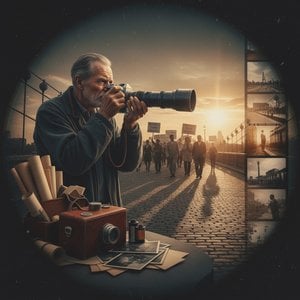
The Shadows of History and the Making of a Visionary
To understand the profound impact of Ly Daravult, one must first navigate the turbulent landscape of late 20th-century Cambodia. Born in Phnom Penh in 1968, his early years were defined by the harrowing instability of the Khmer Rouge regime, a period that left indelible scars on the nation's collective psyche and shaped his lifelong preoccupation with memory and trauma. His journey was one of profound displacement, moving from the chaos of his homeland to the refugee camps of Thailand, and eventually finding a different kind of sanctuary in France. It was at La Sorbonne University in Paris that Daravuth began to bridge the gap between his traumatic heritage and the formal rigors of Western art history. This duality—the lived experience of a survivor and the disciplined eye of an academic—became the cornerstone of his artistic identity, allowing him to approach Cambodian history not merely as a witness, but as a meticulous chronicler of the human condition.
A Sanctuary for Culture: The Reyum Legacy
Upon returning to Cambodia, Daravuth sought to transform his personal and academic insights into a communal lifeline for a nation attempting to rebuild itself. In 1998, alongside Ingrid Muan, he co-founded the Reyum Institute of Arts and Culture, an endeavor that would become much more than a simple gallery space. For Daravuth, Reyum was a vital instrument for cultural reclamation, a platform designed to educate a new generation about the richness of Khmer art that had been nearly extinguished by war. Through his work as a publicist, historian, and lecturer, he has dedicated himself to the preservation of Cambodian identity, ensuring that the voices of the past are not silenced by the passage of time. His efforts have fostered a crucial dialogue between the trauma of the recent past and the creative potential of the future, making him a central figure in the reconstruction of Cambodia's artistic landscape.
The Messenger: Confronting the Fragility of Truth
Nowhere is Daravuth’s profound inquiry into the nature of reality more evident than in his haunting photographic series, The Messenger. In this work, he delves into the lives of the young Cambodians who served as messengers during the Khmer Rouge era, utilizing a deliberately muted palette and a precise numbering system to challenge the viewer's perceptions. The images are often presented in a blurred black-and-white format, creating an atmosphere of ambiguity that mirrors the difficulty of accessing historical truth. By presenting these children not merely as passive victims but as active participants in a complex political machinery, Daravuth forces a confrontation with the uncomfortable complexities of documentation. His work invites us to contemplate several haunting questions:
- What constitutes a true document in the wake of catastrophe?
- How does the visual format of an image shape our capacity for empathy?
- Where does the line blur between historical fact and the fragility of personal memory?
Q&A
キーワードごとに分類されたLy Daravuthの作品はどこでご覧いただけますか?
特定のテーマに沿ったLy Daravuthの作品を探すには、キーワードごとに作品が分類されているアーティストのキーワード別ページをご活用ください。
Ly Daravuthは、どの芸術運動に属していましたか?
Ly Daravuthの作品は、アーティストのすべてのムーブメントページから、各ムーブメント(芸術運動)別に閲覧いただけます。
Ly Daravuthによるすべての作品を見るには、どうすればよいですか?
当サイトにおけるLy Daravuthのすべての作品は、アーティストのすべての作品一覧ページからご覧いただけます。