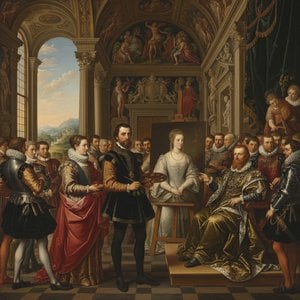
The Master of Wrought Iron: The Life and Legacy of Hans Jacob Fincke
In the grand tapestry of the Danish Renaissance, where architectural splendor met the intricate precision of craftsmanship, few names resonate with as much structural elegance as Hans Jacob Fincke. Born in 1584 in Flensburg, Germany, Fincke was far more than a mere blacksmith; he was an architect of iron, a man capable of transforming cold, unyielding metal into poetic expressions of royal power and religious devotion. His life, spanning the transformative reigns of Christian IV and Frederick III, coincided with a period of profound artistic fervor in Denmark, a time when the strength of a kingdom was often reflected in the permanence and beauty of its monuments.
Fincke’s journey began amidst the intellectual currents of Bohemia, yet his destiny was inextricably linked to the Danish court. His early training as a smith provided him with a rigorous technical foundation, a mastery over fire and hammer that would later allow him to push the boundaries of what metalwork could achieve. This period of intense apprenticeship instilled in him a meticulous attention to detail and an understanding of the structural integrity required for large-scale architectural commissions. As he moved toward the heart of Danish power, his reputation preceded him, leading to his pivotal appointment at the Kronborg Rifle Factory in 1610 and his formal admission into the prestigious Helsingør Smith's Guild in 1612.
A Symphony of Metal and Architecture
The true genius of Fincke lay in his ability to blend functionality with an almost ethereal artistic vision. His workshop, located at the intersection of Sankt Annagade and Kongensgade—a street later immortalized as Caspar Finckes Stræde—became a crucible of innovation. Here, he labored on projects that would define the skyline and the interior grandeur of Denmark's most iconic landmarks. To walk through the halls of Frederiksborg Castle or Kronborg Castle is to encounter the enduring spirit of his artistry, where wrought iron railings and decorative elements serve as both structural necessities and breathtaking ornaments.
One of his most profound achievements can be found within the hallowed walls of Roskilde Cathedral. For Christian IV's Chapel, Fincke crafted an elaborate wrought iron gate that remains a masterpiece of the era. The gate is famously marked with his personal signature in German: ‘cf. bin ich genant, diser arbeit bin ich bekant’ (“Here I am named, this work is known to me”). This inscription serves as a bold testament to the pride of a craftsman who viewed his labor not merely as a job, but as an indelible mark upon history. Similarly, his contribution to the Copenhagen Castle’s Round Tower—specifically the intricate railing on the observation platform—demonstrates his skill in creating metalwork that invites the eye upward, mirroring the celestial aspirations of the Renaissance age.
The Enduring Flame of a Craftsman's Legacy
Fincke’s influence extended far beyond the physical objects he forged. He represented a bridge between the medieval tradition of the guildsman and the burgeoning Renaissance ideal of the artist-engineer. His work helped establish a visual language for the Danish monarchy, one characterized by strength, complexity, and an unapologetic display of wealth and sophistication. Through his hands, iron ceased to be a utilitarian material and became a medium for storytelling, capable of conveying the stability of the state and the piety of the church.
As we look back upon the life of Hans Jacob Fincke, we see a legacy forged in the heat of the forge and tempered by time. His ability to navigate the demands of royal patronage while maintaining an uncompromising standard of excellence ensured that his name would be etched into the very fabric of Danish heritage. He remains a pivotal figure whose work continues to command respect, reminding us that true art is often found in the most resilient of materials, shaped by a hand that understands both the weight of the hammer and the lightness of a beautiful design.